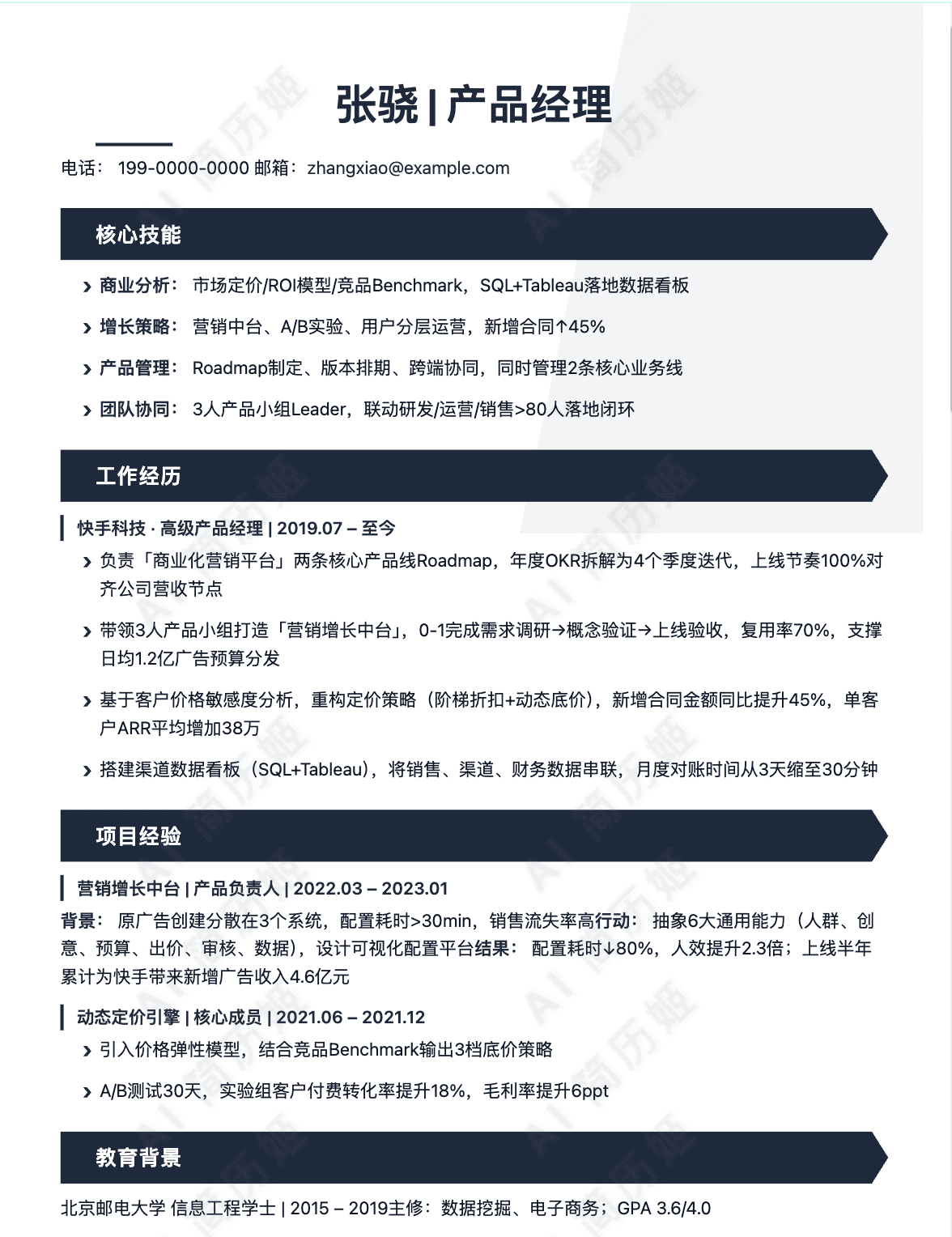
Properly Format Your Account Manager Resume
A polished, professional format is non-negotiable for an Account Manager resume. It's your first demonstration of attention to detail and client-facing professionalism. A well-structured document ensures your key achievements in revenue growth and client retention are easily found by both human recruiters and automated systems.
Resume Length: The One-Page Standard
For most Account Managers, a one-page resume is ideal and expected. It forces conciseness and highlights your most impactful achievements. A two-page resume is acceptable if you have over 10-15 years of highly relevant experience with numerous major accounts and quantifiable results. Never stretch content to fill two pages; if you have less than 10 years of experience, rigorously edit to fit one.
Choosing the Right Resume Format
The reverse-chronological format is the gold standard for Account Managers. It presents your work history in reverse order, emphasizing career progression and stable employment—key factors for trust-based roles. A combination format (which leads with a skills summary before the chronological experience) can be effective for those transitioning industries or with a diverse skill set, but the chronological flow remains paramount.
Font, Margins, and Spacing for Readability
Use clean, professional fonts like Calibri, Arial, Georgia, or Garamond in a size between 10.5 and 12 points. Your name can be slightly larger. Maintain margins of at least 0.5 inches on all sides. Use consistent spacing between sections and employ bullet points to break up text. White space is your ally—it makes the document easy to scan quickly.
File Format: Always Submit a PDF
Unless the job posting specifically requests a .docx file, always submit your resume as a PDF. This preserves your careful formatting across all devices and operating systems. Name your file professionally: FirstName_LastName_AccountManager.pdf.
Optimizing for Applicant Tracking Systems (ATS)
Most large companies use ATS software to screen resumes. To pass through: Use standard section headings (e.g., "Work Experience," "Skills," "Education"). Avoid headers, footers, text boxes, columns, or graphics that can scramble the parsed text. Incorporate keywords from the job description naturally (e.g., "Key Account Management," "Quarterly Business Reviews," "Revenue Growth," "Client Retention"). Save the PDF as text-based, not an image scan.
Good Formatting Example: Resume Header
Senior Account Manager | Strategic Partnerships & Revenue Growth
(555) 123-4567 | alex.chen@email.com | linkedin.com/in/alexchen-am | Chicago, IL
Bad Formatting Mistakes to Avoid
One‑click format & basics check
Auto‑check contacts, links and layout; generate an ATS‑friendly header.
Write a Strong Account Manager Resume Summary or Objective
The opening statement of your resume is prime real estate. A compelling summary or objective immediately tells a hiring manager who you are and the value you bring, setting the tone for the rest of your application.
Summary vs. Objective: Knowing the Difference
A resume summary is a brief, impactful overview of your career achievements, skills, and the value you offer. It is best for professionals with relevant experience. An resume objective states your career goals and what you aim to achieve in the role. It is more suitable for entry-level candidates, career changers, or those with limited direct account management experience.
When to Use a Summary or an Objective
Use a Summary if: You have 2+ years of experience in account management, sales, or a closely related field. Your goal is to showcase a proven track record.
Use an Objective if: You are a recent graduate, transitioning from a different career, or have limited direct account management experience. Your goal is to highlight transferable skills and express your career target.
Key Elements to Include
Whether summary or objective, your statement should be a powerful blend of the following: Years of experience (for summaries), Core competencies (e.g., key account strategy, CRM software, client retention), Quantifiable achievements (e.g., "grew revenue by 30%"), and a clear Value proposition that states how you intend to benefit the prospective employer.
Optimal Length and Conciseness
This section should be a quick, scannable read. Aim for 2 to 4 concise sentences or 3-5 bullet points. Avoid lengthy paragraphs. Every word should serve a purpose and push your candidacy forward.
How to Tailor It to the Job Posting
Carefully review the job description. Identify keywords (e.g., "client lifecycle management," "cross-selling," "quarterly business reviews") and mirror the language used. If the role emphasizes "enterprise client retention," ensure your statement speaks directly to that skill with a relevant achievement.
Good Examples to Follow
For Experienced Professionals (Resume Summary):
For Entry-Level or Career Transition (Resume Objective):
Bad Examples to Avoid
Generate skills list / summary
Extract hard/soft skills from the JD and create 3 summary variants.
Include Your Best Hard and Soft Skills as an Account Manager
For an Account Manager, your skills section is a strategic pitch. It must demonstrate a powerful blend of technical proficiency (hard skills) and interpersonal excellence (soft skills). Recruiters scan this section quickly to assess if you have the right tools and temperament to grow revenue, retain clients, and serve as their primary liaison. A well-crafted skills presentation can significantly boost your resume's impact.
Hard Skills vs. Soft Skills: The Strategic Balance
Hard skills are the teachable, measurable technical abilities and knowledge required for the job. They are often software-specific or process-driven. Soft skills are the interpersonal attributes and behaviors that determine how you work, communicate, and solve problems. For an Account Manager, success is impossible without both. Hard skills get you in the door to manage the account; soft skills enable you to deepen the relationship and identify growth opportunities.
Essential Hard Skills for an Account Manager
Your hard skills should reflect competency in customer management, data analysis, and sales operations. Be specific with tools and methodologies to pass through Applicant Tracking Systems (ATS) and impress hiring managers.
Critical Soft Skills for an Account Manager
These skills illustrate your ability to build trust, navigate challenges, and drive value. They are best proven through achievements in your work experience section.
How to Organize Your Skills Section
A categorized format is vastly superior to a simple list. It improves readability and shows you understand how skills function together. Use clear subheadings to group related skills.
Good Example: A Properly Categorized Skills Section
Account Management & CRM: Salesforce, HubSpot, Account Planning, QBR Facilitation, Contract Renewals Client Relations: Strategic Relationship Building, Consultative Selling, Expectation ManagementCore Competencies
Data Analysis & Reporting: Salesforce Dashboards, Excel (Advanced Formulas, PivotTables), KPI Tracking, ROI Analysis
Communication & Presentation: Client Presentations, Stakeholder Reporting, Microsoft PowerPoint, Zoom, SlackProfessional Skills
Problem-Solving: Conflict Resolution, Upsell/Cross-Sell Strategy, Churn Risk Mitigation
Business Operations: Forecasting, Budget Management, Project Management (Asana)
Bad Examples: Common Mistakes in Skills Sections
Matching Skills with Job Description Keywords
Carefully review the job description and mirror its language. If it asks for "Gainsight" and "quarterly business reviews," use those exact terms. This ATS optimization is crucial. Identify 5-8 key hard and soft skills from the posting and ensure they are prominently featured in your skills section and woven into your bullet points.
AI‑assisted bullet quantification
Rewrite bullets using STAR/metrics and auto‑fill numbers and verbs to highlight impact.
Describe Your Work Experience and Key Projects as an Account Manager
Senior Account Manager | TechSolutions Inc. | San Francisco, CA | Jan 2021 – Present
Manage a portfolio of 12 key enterprise accounts in the SaaS sector with a combined annual recurring revenue (ARR) of $4.5M.
Account Manager | BrandVision Marketing | Chicago, IL | Mar 2018 – Dec 2020
Cultivated relationships with 18 mid-market B2B clients across the manufacturing and professional services industries.
Account Coordinator -> Junior Account Manager | SwiftScale Logistics | Boston, MA | Jun 2016 – Feb 2018
Supported a team of senior AMs before managing a book of 8 small business clients.
Examples of Poor Work Experience Descriptions
Project experience quantifier
Split goals, actions and results; auto‑suggest metrics and format project cards.
Include Action Words to Make Your Account Manager Resume Pop
Strategic action verbs are the engine of a powerful resume. They transform passive lists of duties into dynamic narratives of achievement. For Account Managers, this is critical for two reasons: first, Applicant Tracking Systems (ATS) scan for these potent keywords to rank your resume, and second, recruiters and hiring managers are drawn to resumes that clearly demonstrate proactivity, impact, and skill. Strong action words create a vivid picture of your capabilities and immediately set you apart from candidates who use generic, weak language.
Categories of Action Verbs for Account Managers
Organizing your accomplishments with targeted verbs showcases the full spectrum of your role. Here are key categories to draw from:
Leadership & Management: Directed, Spearheaded, Championed, Orchestrated, Mentored, Governed, Steered
Technical Implementation: Integrated, Automated, Configured, Launched, Deployed, Optimized, Streamlined
Problem-Solving: Resolved, Remediated, Troubleshot, Rectified, Mitigated, Diagnosed, Overcame
Collaboration: Liaised, Aligned, Partnered, Facilitated, Coordinated, Unified, Bridged
Achievement & Impact: Accelerated, Expanded, Maximized, Boosted, Secured, Retained, Grew
Analysis & Research: Analyzed, Evaluated, Assessed, Audited, Forecasted, Identified, Validated
Innovation: Pioneered, Engineered, Revamped, Redesigned, Transformed, Introduced, Modernized
Avoiding Repetition and Weak Language
Using the same verb like "managed" or "responsible for" repeatedly dilutes your impact. Scrutinize your resume for overused terms and replace them with more precise, powerful alternatives from the categories above. The goal is to convey not just what you did, but how you did it and the result it produced.
Before and After: Weak vs. Strong Verb Examples
Weak: Was responsible for client relationships.
Strong: Cultivated and nurtured key client relationships, achieving a 95% satisfaction score.
Weak: Did sales forecasting for my accounts.
Strong: Analyzed account data to forecast sales pipelines with 98% accuracy.
Weak: Had to deal with client complaints.
Strong: Resolved escalated client complaints, mitigating churn risk and strengthening trust.
Weak: Made a new onboarding process.
Strong: Designed and implemented a streamlined client onboarding process, reducing time-to-value by 30%.
Weak: Worked with the product team on client requests.
Strong: Partnered with product development to advocate for client-driven features, influencing the quarterly roadmap.
Examples of Strong Action Verb Usage in Context
1. Orchestrated the successful renewal of 15 enterprise accounts, securing $2.5M in annual recurring revenue.
2. Diagnosed a critical service gap and engineered a custom reporting solution, which boosted client engagement by 40%.
3. Championed a customer feedback initiative that informed product development, leading to the launch of two high-demand features.
4. Expanded account footprint within a key vertical by identifying cross-sell opportunities, resulting in a 25% increase in average contract value.
3 summary versions in seconds
Combine role highlights and strengths to generate concise, confident and specific summaries.
Make Your Education Section Count
Your education section is more than a formality; it's a chance to showcase foundational knowledge and intellectual rigor. For an Account Manager role, it demonstrates your ability to learn complex subjects and communicate effectively. Tailoring this section to your career stage is crucial for making the right impact.
Essential Information to Include
At a minimum, your education entry should clearly state your degree, your major or field of study, the university name, and your graduation date. Use a consistent, easy-to-scan format.
Master of Business Administration (MBA)
University of Chicago Booth School of Business – Chicago, IL
Graduated: May 2018
Strategic Placement on Your Resume
Where you place the Education section depends on your experience level. Recent graduates (less than 3-5 years in the workforce) should place it near the top, just after the summary. Experienced professionals with a solid career history should place it at the bottom, as their work achievements now carry more weight.
Enhancing Your Entry for Entry-Level Roles
If you're new to the field, bolster your education section with relevant details that hint at your potential. Include a short list of pertinent coursework, a notable academic project, or your thesis topic. This helps compensate for a lack of direct job experience.
Bachelor of Science in Marketing, Minor in Psychology
University of Texas at Austin – Austin, TX
Graduated: Magna Cum Laude, May 2023 | GPA: 3.7/4.0
Relevant Coursework: Strategic Marketing, Consumer Behavior, Business Negotiations, Sales Management
Senior Thesis: "The Impact of Customer Success Metrics on SaaS Renewal Rates"
GPA, Honors, and Awards
Include your GPA only if it is strong—generally a 3.5 or higher on a 4.0 scale. Otherwise, omit it. Always include academic honors (e.g., Cum Laude), scholarships (e.g., Dean's List, named scholarships), and awards. These provide third-party validation of your performance and work ethic.
Concise Format for Experienced Professionals
With a decade or more of experience, your education should be succinct. Focus on the degrees and any recent, high-level certifications that are directly relevant to account management or your industry (e.g., CSPO, PMP, industry-specific certifications).
Bachelor of Arts in Communications
Boston University – Boston, MA
Graduated: 2008
Certifications: Certified Strategic Account Manager (CSAM), 2021 | Google Analytics Individual Qualification, 2023
Examples of What to Avoid
Steer clear of these common mistakes that weaken your resume's professionalism and clarity.
Education: Went to State U from 2019 to 2023. Got a degree in business stuff. Did pretty good in my classes.
UNIVERSITY OF CALIFORNIA, LOS ANGELES
Graduated 2015
Major: Economics
(No degree type listed, inconsistent formatting)
Associate of Arts
Community College (City, State)
Graduated: 2005
Bachelor of Science in Business Administration
University of Phoenix (Online)
Graduated: 2020
(GPA: 2.8/4.0)
(Including a low GPA and placing more recent but less respected degree above a core degree)
High School Diploma
Lincoln High School – Anytown, USA
Graduated: 1999
(Only include high school if you have no college degree. For experienced professionals, this is unnecessary filler.)
Auto‑format education & certifications
Normalize titles, dates and bullets — ATS‑safe by default.
Select the Perfect Extra Sections for Your Account Manager Resume
While your core resume sections—experience, skills, and education—tell the primary story, strategically chosen extra sections can provide the compelling details that differentiate you from other candidates. These optional areas showcase specialized knowledge, professional engagement, and personal drive that are highly relevant to account management.
1. Technical Projects
Include this section if you are an entry-level candidate, career changer, or have directly managed a key technical implementation for a client. Detail a project where you led the integration of a CRM (like Salesforce or HubSpot), analyzed customer data to drive retention strategy, or migrated a client to a new platform. Format it with a clear project name, your role, the tools used, and a bullet point on the quantifiable outcome for the client or your team.
2. Publications & Speaking Engagements
This section is powerful for senior account managers, strategic advisors, or those in thought leadership roles. Listing a published article in a trade journal, a guest blog post on customer success, or a presentation at an industry conference (e.g., "Presented on 'Upsell Strategies in SaaS' at TechGrowth 2023") establishes immediate credibility and positions you as an expert. Include the title, publication/event name, and date.
3. Languages
Always include this if you are proficient in more than one language, especially if the role involves multinational accounts or a diverse client base. Clearly state your proficiency level (e.g., Native, Fluent, Professional Working Proficiency, Conversational). This is a concise but highly valuable section that addresses specific business needs.
4. Professional Affiliations
Listing memberships in organizations like the American Marketing Association (AMA), Strategic Account Management Association (SAMA), or a local business network shows proactive career investment and provides networking context. Simply list the organization name and, if applicable, your membership duration or any leadership role (e.g., "Member, 2020-Present" or "Chapter Secretary, 2022-2023").
5. Volunteer Experience
Include volunteer work only if it demonstrates relevant skills like leadership, fundraising, board management, or community relations. For example, organizing a charity event showcases project management and stakeholder coordination. Format it like a professional role, focusing on responsibilities and achievements that mirror account management competencies. If it's not relevant, omit it.
Sections to Avoid on Your Account Manager Resume
Avoid cluttering your resume with irrelevant personal information. Do not include: "Hobbies and Interests" (unless they are extraordinary and directly relevant, like competitive public speaking), "References Available Upon Request" (this is assumed), an "Objective" statement (use a professional summary instead), or a full street address (city and state are sufficient). Also, avoid a generic "Skills" section that just lists soft skills; always integrate and demonstrate skills within your experience bullets. These elements waste valuable space and can appear unprofessional.
Pitfalls check
Detect formatting/wording pitfalls and suggest instant rewrites and formatting.
How to Tailor Your Account Manager Resume for a Specific Job Description
In today's competitive job market, a generic resume is a fast track to the rejection pile. For an Account Manager role, where relationship-building and strategic alignment are paramount, tailoring your resume to the specific job description is not just a recommendation—it's a necessity. It demonstrates that you've done your homework, you understand the company's needs, and you're the precise solution they're looking for.
Step-by-Step Process for Effective Tailoring
1. Analyze the Job Description
Begin by dissecting the job posting. Look beyond the job title and highlight every requirement, skill, and qualification mentioned. Use two highlighters or create a simple list: one for hard skills (e.g., CRM software like Salesforce, contract negotiation, QBR presentations) and one for soft skills & attributes (e.g., client advocacy, strategic thinking, collaborative). Pay special attention to words that are repeated, as these are core keywords that Applicant Tracking Systems (ATS) and hiring managers will be scanning for.
2. Map Your Experience
With your list of key requirements in hand, audit your own career history. For each requirement from the job description, identify a specific accomplishment, project, or responsibility from your past roles that provides concrete evidence. Don't just match keywords; match context. If the job emphasizes "expanding footprint in enterprise healthcare," find an example where you grew accounts in a complex, regulated industry. This mapping exercise becomes the blueprint for your tailored resume.
3. Customize Key Sections
This is where you apply your mapping. Start with your Professional Summary. Instead of a generic objective, craft a 2-3 line pitch that incorporates the company's name, the role's core challenge (e.g., "driving retention in the SaaS sector"), and 2-3 of your most relevant high-level achievements. Next, weave the keywords and mapped experiences into your Work Experience bullet points. Use the same language from the job ad. Finally, ensure your Skills Section is a concise list of the hard and soft skills explicitly requested.
Good Practice: Before and After Example
Generic Bullet Point (Before):
• Managed a portfolio of key client accounts.
Tailored Bullet Point (After - for a job stressing "renewal rate" and "cross-selling"):
• Owned a $4M portfolio of 15 enterprise accounts, achieving a 98% renewal rate and driving a 22% increase in revenue through strategic cross-selling of data analytics modules.
Bad Practice: Common Mistakes to Avoid
While tailoring is critical, there are pitfalls to avoid. First, never misrepresent your skills or experience. Tailoring is about framing, not fabricating. Second, avoid over-tailoring to the point of losing your authentic professional narrative; your resume should still be a coherent story of your career. Third, do not simply copy-paste phrases from the job description verbatim without context; this is obvious to recruiters and can be flagged by ATS. Finally, never send a tailored resume without also tailoring your cover letter to create a consistent and compelling application.
Striking the Right Balance
The ultimate goal of tailoring is to create a resume that feels like a direct response to the company's stated problems. It should bridge the gap between their needs and your proven capabilities. By meticulously analyzing the job description, strategically mapping your relevant experience, and customizing your content with concrete examples, you transform your application from a general introduction into a targeted business case for your candidacy. Keep a master resume with all your accomplishments, and use it as the source material to craft a powerfully tailored version for every important application.
Pick the right template and apply
Recommend templates by industry and seniority; auto‑map existing content.
Account Manager Resume Examples (Complete Samples)
Apply example in one click
Pick an example and auto‑adapt to your experience and skills.
Frequently Asked Questions (FAQ)
How long should an Account Manager resume be?
For most Account Managers, a one-page resume is ideal and expected by recruiters. If you have over 10-15 years of highly relevant experience, a second page may be justified, but prioritize conciseness. Focus on recent, impactful roles and achievements rather than listing every job you've ever held.
What's the best format for an Account Manager resume?
The reverse-chronological format is the standard and most effective choice. It lists your work experience starting with your most recent job, which immediately highlights your career progression and current level of expertise. This format is ATS-friendly and preferred by hiring managers as it's easy to scan.
What are the most important skills to include on an Account Manager resume?
You must include a balance of hard and soft skills. Key hard skills include CRM software (e.g., Salesforce), contract negotiation, and data analysis. Essential soft skills are relationship management, communication, and strategic planning. Always tailor these to the specific job description to pass Applicant Tracking Systems (ATS).
Should I include a summary or an objective on my resume?
Yes, a professional summary is highly recommended. In 2-3 lines, state your title, years of experience, key achievements (e.g., "Retained 95% of key accounts"), and core skills. Avoid generic objectives; a summary immediately communicates your value proposition to a hiring manager.
How should I describe my work experience to stand out?
Use bullet points that start with strong action verbs and quantify your achievements. Instead of "Responsible for client accounts," write "Grew key account revenue by 25% ($500K) in 2023 through strategic upselling and quarterly business reviews." Numbers for growth, retention, and satisfaction rates are crucial.
Should I include projects or only full-time jobs?
Definitely include relevant projects, especially if they demonstrate key skills missing from your primary roles. For example, leading a cross-functional team to launch a new client onboarding process is a valuable addition. This is particularly useful for entry-level candidates or those highlighting specific competencies.
How do I write an Account Manager resume with no direct experience?
Focus on transferable skills from other roles like customer service, sales, or project management. Create a strong summary that frames your goal, and use a "Relevant Experience" or "Projects" section to highlight related achievements. Emphasize skills like client communication, problem-solving, and any revenue or satisfaction metrics you influenced.
Should I include my GPA or university honors?
Only include your GPA (e.g., 3.5/4.0 or higher) or honors like *magna cum laude* if you are a recent graduate (within 1-3 years). For experienced Account Managers, this space is better used for professional certifications, awards, or recent achievements. Remove it once you have substantial work history.
How many years of work history should I include?
Generally, include the last 10-15 years of relevant work history. This provides ample evidence of your expertise without dating your early career. If you have older experience that is critically relevant, you can mention it briefly in a "Earlier Career" or "Additional Experience" section without detailed bullet points.
What if I'm changing careers to become an Account Manager?
Use a hybrid or combination resume format that leads with a strong summary and a "Relevant Skills" section. Frame your past roles to highlight client-facing, revenue-generating, and relationship-building responsibilities. Consider adding a "Career Transition" statement in your summary to proactively address the change in a positive light.
How should I handle employment gaps on my resume?
Be transparent but strategic. You can use years only (2020-2023) instead of months to de-emphasize short gaps. For longer gaps, consider using a "Career Note" or mentioning relevant activities during that time (e.g., freelance consulting, professional development courses) in your summary or experience section.
Are certifications important to include?
Yes, relevant certifications can significantly strengthen your resume. Include industry-recognized ones like Certified Strategic Account Manager (CSAM) or platform-specific certifications (e.g., Salesforce Certified Administrator). Place them in a dedicated "Certifications" section or within your education/professional development area.