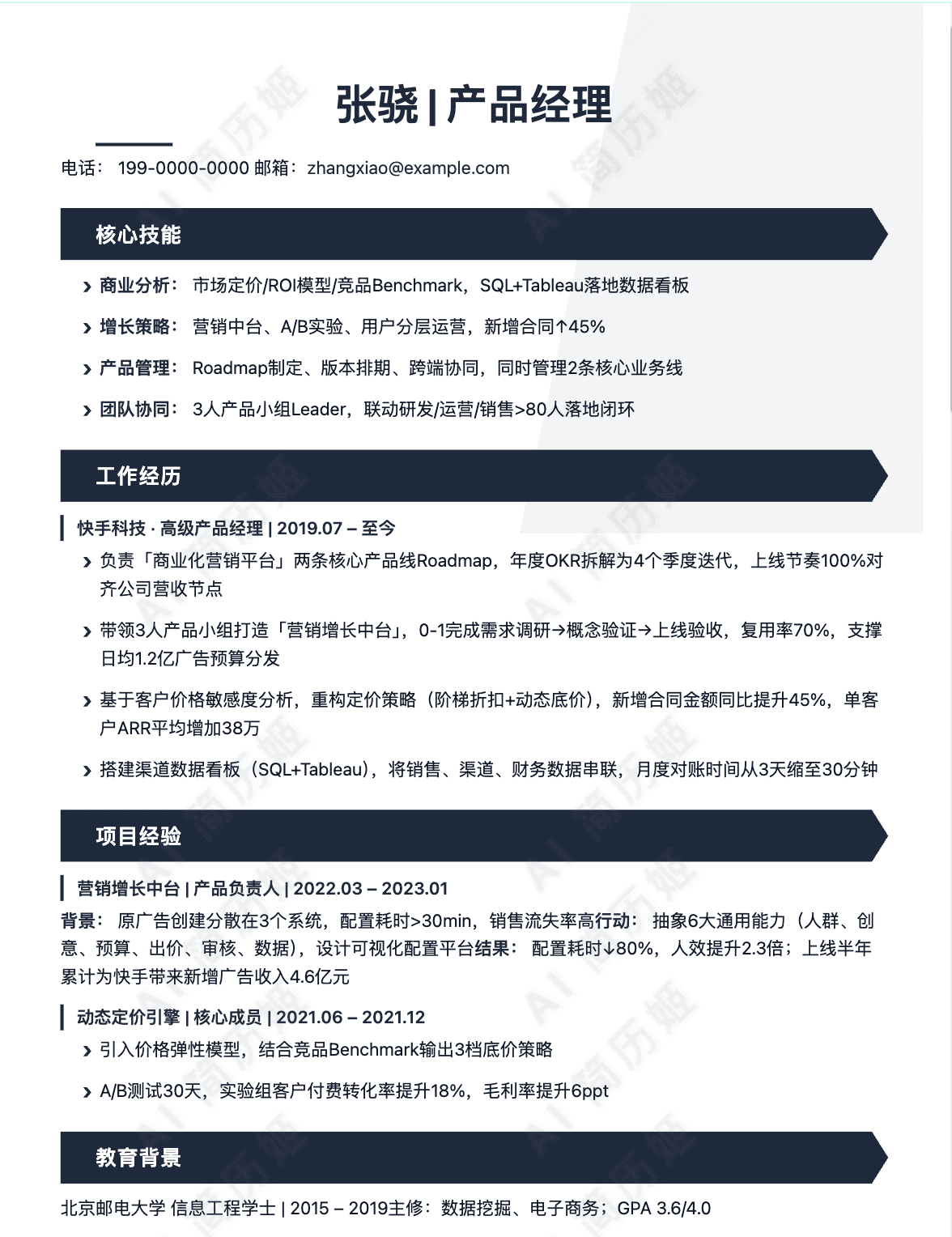
Properly Format Your Software Engineer Resume
A well-formatted resume is your first deployment to production. It must be clean, functional, and pass all automated tests before it ever gets seen by a human reviewer. Proper formatting not only makes your resume visually appealing but also ensures it can be parsed correctly by Applicant Tracking Systems (ATS) and easily scanned by busy hiring managers.
Resume Length: The One-Page Rule vs. Reality
For most software engineers, especially those with less than 10 years of experience, a one-page resume is the standard and expected format. It forces you to be concise and highlight only your most relevant and impressive achievements. However, if you are a senior, staff, or principal-level engineer with a long history of significant contributions, patents, publications, or a wide array of specialized skills, a two-page resume is acceptable. The key rule is that every line on the second page must be as compelling as those on the first.
Choosing the Right Resume Format
The three main resume formats are chronological, functional, and combination. For software engineers, the reverse-chronological format is overwhelmingly the preferred choice. It lists your work experience in reverse chronological order (most recent job first), which is what recruiters and hiring managers expect. This format clearly showcases your career progression and the impact you've made at each role.
Font, Margins, and Spacing Standards
Your resume's typography and layout are critical for readability. Use a professional, clean, and widely available font. Sans-serif fonts like Calibri, Arial, or Helvetica are excellent for on-screen reading. Serif fonts like Garamond or Georgia are also acceptable. Your font size should be between 10 and 12 points for body text, with your name and section headers slightly larger. Margins should be no less than 0.5 inches on all sides, with 0.75 to 1 inch being ideal. Use consistent spacing between sections and adequate line spacing (1.0 or 1.15) to prevent the document from looking cluttered.
File Format: Always PDF
Always save and send your resume as a PDF file (.pdf). A PDF preserves your formatting across different devices and operating systems, ensuring that every recruiter sees the resume exactly as you designed it. A Microsoft Word document (.docx) can have its formatting altered depending on the viewer's software version and settings, which can ruin your carefully crafted layout.
ATS Optimization Basics
Most companies use Applicant Tracking Systems (ATS) to screen resumes before they reach a human. To get past this digital gatekeeper, your resume must be ATS-friendly. This means using standard section headings (like "Work Experience," "Skills," "Education"), incorporating relevant keywords from the job description (e.g., "Python," "React," "AWS," "microservices"), and avoiding complex layouts with tables, columns, images, or graphics that the ATS cannot parse correctly.
Good and Bad Formatting Examples
Here is an example of a properly formatted resume header and contact section, followed by common mistakes to avoid.
Software Engineer | Backend Specialist
(123) 456-7890 | jane.doe@email.com | linkedin.com/in/janedoe | github.com/janedoe
Seattle, WA
Software Guru & Code Ninja | I ♥ Python | 123-456-7890 | jane.doe.cool@gmail.com
(Uses an unprofessional font, informal titles, and symbols that an ATS might misinterpret.)
One‑click format & basics check
Auto‑check contacts, links and layout; generate an ATS‑friendly header.
Write a Strong Software Engineer Resume Summary or Objective
The resume summary or objective is the first substantive section a recruiter reads. It's your 15-second pitch to convince them you're the right candidate for the job. A well-crafted opening can set the tone for a successful review, while a weak one can lead to your application being quickly passed over.
Summary vs. Objective: Which One Is For You?
While often used interchangeably, summaries and objectives serve different purposes and are suited for different candidate profiles.
Resume Summary: A brief, powerful statement that highlights your professional experience, key skills, and major accomplishments. It's best for candidates with relevant work experience in the field.
Resume Objective: A statement that focuses on your career goals, enthusiasm, and transferable skills (like those from academia or personal projects). It's ideal for entry-level candidates, career changers, or recent graduates.
When to Use a Summary vs. an Objective
Your career level should dictate your choice. Use a summary if you have more than 2-3 years of professional software engineering experience. Use an objective if you are a recent graduate, a career changer, or have less than 2 years of direct experience. The objective should clearly state what you are seeking and what you can offer, even without extensive professional history.
Key Elements to Include
Regardless of whether you choose a summary or an objective, it must be packed with relevant information. Include your years of experience (if applicable), your core technical and soft competencies, and a strong value proposition—what you have achieved or what you aim to achieve for the employer. Mention specific programming languages, frameworks, and methodologies that are central to the role you're targeting.
Optimal Length and Structure
Brevity is crucial. Aim for 2-4 concise, impactful sentences. Recruiters often scan resumes quickly, so a dense paragraph will be skipped. Structure it to lead with your strongest selling point, whether that's years of experience, a notable project, or a key skill set directly mentioned in the job description.
How to Tailor It to the Job Posting
A generic summary is a missed opportunity. Carefully review the job description and identify keywords related to technologies, tools, and required experience. Mirror this language in your summary or objective. If the job emphasizes "cloud-native microservices in AWS," your summary should mention those exact terms if you have the experience. This not only shows you've read the description but also helps you pass through Applicant Tracking Systems (ATS).
Good Resume Summary Examples
Here are examples of effective summaries for experienced professionals.
Good Resume Objective Examples
Here are examples of effective objectives for those starting their careers.
Bad Resume Summary/Objective Examples
Avoid these common mistakes that can instantly weaken your resume.
Why it's bad: It's overly generic, provides no specific skills or experience, and uses clichés ("hard worker," "team player") without evidence.
Why it's bad: It's self-centered (focuses on what *you* need, not what you offer) and uses weak language ("a little bit of") that undermines your credibility.
Why it's bad: Unprofessional language ("ninja rockstar") and vague statements ("everything tech," "do everything") make you seem unserious and unfocused to recruiters.
Why it's bad: It's completely non-specific. "Many years," "various technologies," and "numerous projects" are empty phrases that give the recruiter zero useful information.
Generate skills list / summary
Extract hard/soft skills from the JD and create 3 summary variants.
Include Your Best Hard and Soft Skills as a Software Engineer
A well-crafted skills section is a critical component of any software engineer's resume. It provides a quick, scannable overview of your technical capabilities and professional attributes for recruiters and hiring managers. Effectively presenting both hard and soft skills demonstrates that you are not only technically proficient but also a well-rounded team member.
Hard Skills vs. Soft Skills
Hard Skills are the teachable, measurable technical abilities and knowledge required for the job. They are specific, often involving tools, programming languages, and methodologies. Soft Skills are interpersonal attributes and personality traits that determine how you work independently and with others. They are more subjective but are increasingly valued in collaborative engineering environments.
Essential Hard Skills for a Software Engineer
Your hard skills should reflect the technologies and practices relevant to the roles you are targeting. Here is a list of 8-12 essential hard skills for a modern software engineer:
Programming Languages: Proficiency in one or more languages like Java, Python, C#, JavaScript, Go, or Rust.
Version Control: Expertise with Git and platforms like GitHub, GitLab, or Bitbucket.
Databases & Storage: Experience with SQL (e.g., PostgreSQL, MySQL) and/or NoSQL (e.g., MongoDB, Redis) databases.
Cloud Platforms: Familiarity with services from AWS, Microsoft Azure, or Google Cloud Platform (GCP).
Web Development Frameworks: Knowledge of backend frameworks (e.g., Spring Boot, Django, Express.js, .NET) and/or frontend frameworks (e.g., React, Angular, Vue.js).
Containerization & Orchestration: Skills in Docker for creating containers and Kubernetes for orchestrating them.
API Design & Development: Experience building RESTful APIs and understanding of GraphQL.
Testing & QA: Ability to write unit, integration, and end-to-end tests using frameworks like JUnit, pytest, Jest, or Selenium.
CI/CD Pipelines: Knowledge of continuous integration and deployment tools like Jenkins, GitLab CI, or GitHub Actions.
System Design & Architecture: Understanding of how to design scalable, reliable, and maintainable systems.
Scripting & Automation: Proficiency in writing scripts (e.g., Bash, Python) to automate routine tasks.
Monitoring & Observability: Experience with tools like Prometheus, Grafana, or the ELK stack to monitor application health.
Relevant Soft Skills for a Software Engineer
Technical skill gets your foot in the door, but soft skills open most of the doors to career advancement and successful project delivery. Here are 4-6 key soft skills:
Problem-Solving & Critical Thinking: The ability to deconstruct complex problems, analyze root causes, and devise effective solutions.
Communication: Clearly articulating complex technical concepts to both technical and non-technical stakeholders, both in writing and verbally.
Teamwork & Collaboration: Working effectively within a team, respecting others' ideas, and contributing to a positive and productive team environment.
Adaptability & Continuous Learning: The tech landscape evolves rapidly; a willingness to learn new technologies and adapt to changing requirements is crucial.
Ownership & Accountability: Taking responsibility for your work, from initial development through to deployment and maintenance.
Time Management & Prioritization: Efficiently managing your workload to meet deadlines and focusing on high-impact tasks.
How to Organize Your Skills Section
A disorganized list of skills can be difficult to parse. The two most effective formats are the categorized list and the detailed table.
Categorized Format: This is the most common and recommended approach. It groups related skills together, making it easy for a recruiter to find what they're looking for.
Technical Skills
Languages: Java, Python, JavaScript, SQL
Frameworks & Libraries: Spring Boot, React, Node.js
Tools & Platforms: Git, Docker, Kubernetes, AWS (EC2, S3, RDS), Jenkins, Jira
Professional Skills
Agile Methodology, Problem-Solving, Cross-Functional Collaboration, Technical Mentoring, Effective Communication
Avoid a simple, uncategorized list. This format is hard to scan and fails to demonstrate proficiency in related areas.
Skills: Java, Problem-Solving, Python, Docker, Communication, AWS, Kubernetes, React, Teamwork, Git
Matching Skills with Job Description Keywords
Tailoring your skills section to each job application is non-negotiable. Recruiters often use Applicant Tracking Systems (ATS) to scan for specific keywords. Carefully read the job description and mirror its language.
If the job description asks for: "Experience with cloud-native development and container orchestration."
Your resume should include: "Cloud-Native Development, Docker, Kubernetes, AWS ECS"
Avoid being too generic. If the job asks for AWS, don't just put "Cloud." Be specific.
Job Description: "Proficient in Python and Django."
Your Resume (bad): "Knowledge of backend programming."
Good Example: A Complete Skills Section
Technical Skills
Programming Languages: Java, Python, Go, SQL, TypeScript
Cloud & DevOps: AWS (Lambda, EC2, S3, RDS), Docker, Kubernetes, Terraform, GitHub Actions
Frameworks & Databases: Spring Boot, Django, React, PostgreSQL, MongoDB
Tools & Methodologies: Git, Jira, Jenkins, Grafana, Agile/Scrum
Professional Skills
System Architecture & Design, Problem-Solving, Mentoring & Code Reviews, Cross-Functional Communication, Project Ownership, Adaptability
Bad Examples: Common Mistakes to Avoid
Steer clear of these common pitfalls when listing your skills.
Using Vague or Subjective Ratings: "Java (Expert), Python (Proficient), Communication (Good)" - These ratings are meaningless without context and take up valuable space.
Including Irrelevant or Outdated Skills: "Microsoft Word, PowerPoint, Adobe Flash" - Unless specifically requested, these clutter your resume and dilute your modern technical skills.
Listing Skills You Cannot Demonstrate: Claiming expertise in a language or tool you've only used briefly. This can be easily exposed in a technical interview and will damage your credibility.
AI‑assisted bullet quantification
Rewrite bullets using STAR/metrics and auto‑fill numbers and verbs to highlight impact.
Describe Your Work Experience and Key Projects as a Software Engineer
Work Experience Structure and Best Practices
When describing your work experience, use reverse chronological order and include your job title, company name, location, and employment dates. Start each bullet point with strong action verbs and employ the CAR (Challenge-Action-Result) or STAR (Situation-Task-Action-Result) method to create compelling narratives. Most importantly, quantify your achievements with specific metrics to demonstrate your impact.
Senior Software Engineer Example
Senior Software Engineer | TechFlow Solutions | San Francisco, CA | June 2019 - Present
• Challenge: The existing system experienced 5+ hours of downtime monthly and couldn't scale during peak shopping periods
• Action: Designed a distributed system with 12 independent services, implemented circuit breakers, and established CI/CD pipelines
• Result: Reduced system downtime by 90%, improved transaction processing speed by 300%, and handled Black Friday traffic with zero incidents, processing $50M+ in daily transactions
Mid-Level Software Engineer Example
Software Engineer | DataInsight Corp | Austin, TX | March 2017 - May 2019
• Challenge: Users reported frequent session timeouts and couldn't access multiple company products without repeated logins
• Action: Implemented JWT-based authentication with proper token refresh mechanisms and integrated with existing identity providers
• Result: Reduced authentication-related support tickets by 75% and decreased page load time for authenticated users by 40%
Junior Software Engineer Example
Junior Software Engineer | StartupGrid Inc | Remote | January 2016 - February 2017
• Challenge: Manual notification processes required 10+ hours weekly from customer support team
• Action: Created a scalable notification service with templated messages and delivery tracking
• Result: Automated 95% of customer notifications, freeing up 40+ hours monthly for the support team and improving customer response time from 24 hours to 5 minutes
Key Project Highlight Examples
E-commerce Platform Redesign Project
• Challenge: The existing platform had a 70% cart abandonment rate and poor mobile experience
• Action: Implemented a responsive design, optimized checkout flow, and integrated with multiple payment gateways
• Result: Reduced cart abandonment by 35%, increased mobile conversions by 60%, and improved overall sales by $250,000 in the first quarter post-launch
Machine Learning Recommendation Engine
• Challenge: Users weren't discovering relevant content, leading to low engagement metrics
• Action: Built a collaborative filtering model that processed user behavior data and served personalized recommendations
• Result: Increased user engagement time by 45%, improved click-through rates by 30%, and drove 15% more premium subscriptions
Poor Work Experience Examples to Avoid
• Responsibilities included writing code and fixing bugs
• Worked on various projects as assigned
• Attended team meetings and provided status updates
• Did some Java development
• Helped with the website
• Made things work better
• Used different technologies
• Was responsible for important systems
• Made improvements to several applications
• Helped the team with technical issues
• Did coding and testing tasks
• Wrote code in Python and JavaScript
• Fixed problems in the application
• Worked on making features for users
• Participated in development processes
Common Mistakes in Work Experience Descriptions
Avoid these common pitfalls when writing about your work experience:
Action Verbs for Software Engineers
Start your bullet points with powerful action verbs: Architected, Engineered, Developed, Implemented, Optimized, Automated, Led, Mentored, Spearheaded, Designed, Built, Deployed, Refactored, Migrated, Integrated, Secured, Scalable, Streamlined, Orchestrated, Pioneered.
Project experience quantifier
Split goals, actions and results; auto‑suggest metrics and format project cards.
Include Action Words to Make Your Software Engineer Resume Pop
In a competitive job market, your software engineer resume needs to immediately capture a recruiter's attention and pass through Applicant Tracking Systems (ATS). Generic, passive language can make your experience seem flat and unremarkable. Strategic use of action verbs transforms your resume from a simple list of duties into a dynamic story of your accomplishments, demonstrating proactivity, skill, and impact.
Why Action Verbs Are Non-Negotiable
Action verbs serve two critical audiences: the ATS and the human recruiter. ATS software is often configured to scan for specific keywords that indicate competence and experience. Strong, industry-relevant verbs like "architected," "optimized," or "orchestrated" are powerful keywords that help your resume rank higher. For the recruiter, who may spend only seconds on an initial scan, these verbs create a compelling narrative of a results-driven engineer who takes initiative and delivers value, making your application far more memorable.
Categories of Action Verbs for Software Engineers
Organizing your verbs by function ensures you showcase the full spectrum of your abilities. Here are key categories to draw from:
Leadership & Management: Architected, Orchestrated, Spearheaded, Championed, Mentored, Guided, Directed, Pioneered.
Technical Implementation: Engineered, Developed, Coded, Implemented, Integrated, Deployed, Refactored, Debugged, Containerized.
Problem-Solving: Debugged, Troubleshot, Diagnosed, Resolved, Remediated, Streamlined, Rectified.
Collaboration: Collaborated, Partnered, Liaised, Coordinated, Fostered, Aligned, Unified.
Achievement & Impact: Optimized, Accelerated, Reduced, Enhanced, Increased, Saved, Maximized, Minimized.
Analysis & Research: Analyzed, Researched, Evaluated, Assessed, Modeled, Prototyped, Validated.
Innovation: Innovated, Designed, Pioneered, Conceptualized, Automated, Devised, Formulated.
Avoiding Repetition and Weak Language
Using the same verb repeatedly, like "worked on" or "responsible for," dilutes your impact and suggests a limited range of experience. Scrutinize your resume for overused terms and replace them with more precise and powerful alternatives from the categories above. The goal is to demonstrate versatility and a rich vocabulary that reflects the complexity of your work.
Before and After: Transforming Your Resume Bullets
See how replacing weak phrasing with strong action verbs and quantifiable results creates a powerful impact.
Weak: Was responsible for a team that worked on a new feature.
Strong: Spearheaded a cross-functional team to architect and deliver a new payment feature, increasing user transactions by 15%.
Weak: Helped to fix bugs in the application.
Strong: Diagnosed and resolved critical production bugs, reducing system downtime by 30%.
Weak: Did some work to make the application faster.
Strong: Optimized database queries and API response times, decreasing page load latency by 200ms.
Weak: Used Python to write scripts.
Strong: Engineered Python scripts to automate the deployment process, saving 10+ engineering hours per week.
Weak: Was part of a team that made a mobile app.
Strong: Collaborated in an Agile team to develop and launch a customer-facing mobile app, acquired 50,000+ users in the first quarter.
Weak: Had duties involving code reviews.
Strong: Mentored 3 junior developers and conducted rigorous code reviews, improving overall code quality and team best practices.
Examples of Strong Action Verb Usage
Here are complete bullet points that effectively utilize powerful action verbs to tell a compelling story.
Architected a new microservices platform using AWS and Docker, which improved system scalability and reduced infrastructure costs by 20%.
Orchestrated the full software development lifecycle for a key product module, from requirement gathering with stakeholders to successful deployment.
Pioneered the adoption of a new testing framework that increased test coverage from 60% to 85% and significantly reduced regression bugs.
Engineered a real-time data processing pipeline that handled over 1 million events per day, providing critical analytics to the business intelligence team.
3 summary versions in seconds
Combine role highlights and strengths to generate concise, confident and specific summaries.
Make Your Education Section Count
Essential Information to Include
Your education section should be a clear and concise record of your academic achievements. At a minimum, you must include your Degree (e.g., Bachelor of Science), your Major (e.g., Computer Science), the University name, and your Graduation Date (month and year). This provides a solid foundation for recruiters to quickly verify your qualifications.
Placement on Your Resume
Where you place your education section depends heavily on your professional experience. If you are a recent graduate with less than 2-3 years of full-time experience, your education is one of your strongest assets and should be placed near the top of your resume, just below your contact information and summary. For experienced professionals with a robust work history, the education section should be moved toward the bottom of the resume.
Relevant Coursework for Entry-Level Roles
If you are applying for entry-level or junior positions, including a "Relevant Coursework" subsection can be highly beneficial. It demonstrates foundational knowledge in key areas and helps compensate for a lack of extensive professional experience. List courses that are directly applicable to the job you're seeking.
Relevant Coursework: Data Structures & Algorithms, Object-Oriented Design, Database Management Systems, Software Engineering, Operating Systems, Web Application Development
Guidelines for Including Your GPA
The general rule for including your Grade Point Average (GPA) is to only do so if it is 3.5 or higher on a 4.0 scale. A high GPA can signal strong academic performance and work ethic. If your GPA is below 3.5, it is best to omit it. You can also list your "Major GPA" separately if it is significantly higher than your cumulative GPA.
Bachelor of Science in Software Engineering, University of Techville | GPA: 3.8/4.0, Major GPA: 3.9/4.0
Bachelor of Science in Computer Science, State University | GPA: 2.9/4.0
Academic Honors, Scholarships, and Awards
Don't be shy about showcasing your academic excellence. Including honors like summa cum laude, Dean's List, or specific scholarships (e.g., "Merit-Based Scholarship") adds significant credibility. This information should be listed on the same line as your degree or in a separate bullet point.
Master of Science in Computer Science, Ivy League University | Graduated Magna Cum Laude, Dean's List (All Semesters)
Highlighting Projects and Thesis Work
For recent grads, a substantial academic project or thesis can be a powerful substitute for professional experience. Briefly describe a key project, the technologies used, and the outcome. This provides a concrete example of your skills in action and is a great conversation starter for interviews.
Senior Thesis: "Optimizing Database Queries for Scalable Web Applications"
- Developed a Python script that analyzed and refactored SQL queries, reducing average response time by 30%.
- Technologies used: Python, PostgreSQL, Django, Git
Good Example: Recent Graduate
EDUCATION
Bachelor of Science in Computer Science, University of California, Berkeley | May 2023
GPA: 3.7/4.0 | Minor in Mathematics
Honors: Cum Laude, Dean's List (Spring 2021, Fall 2022)
Relevant Coursework: Advanced Algorithms, Machine Learning, Distributed Systems, Computer Security, Cloud Computing.
Capstone Project: Led a team of 4 to develop a mobile fitness tracker using React Native and Node.js, deployed on AWS.
Good Example: Experienced Professional
EDUCATION
M.S., Software Engineering, Carnegie Mellon University | 2010
B.S., Computer Science, University of Michigan | 2008
Bad Examples to Avoid
Education: Went to college for computer stuff. (Vague, unprofessional)
University of Texas - 2019 (Missing degree and major, the two most important pieces of information)
B.S. in Computer Science, Some University, Graduated: 04/15/2022 (Uses a numeric date format and is missing the location)
Education
High School Diploma, Local High School, 2005 (Irrelevant for a professional software engineer resume unless you have no higher education)
Auto‑format education & certifications
Normalize titles, dates and bullets — ATS‑safe by default.
Select the Perfect Extra Sections for Your Software Engineer Resume
While the core sections of your software engineer resume (Experience, Skills, Education) are non-negotiable, strategic "extra" sections can be the key differentiator that lands you an interview. These sections allow you to showcase a broader profile, demonstrate passion, and fill potential gaps, making your application stand out in a competitive field.
1. Technical Projects
This section is invaluable for entry-level candidates, career changers, or anyone looking to demonstrate expertise in a new technology not used in their professional work. It provides tangible proof of your coding abilities, problem-solving skills, and initiative. Include personal projects, open-source contributions, or hackathon entries. For each project, format it professionally with a brief description, the technologies used, and a link to the live version or GitHub repository. This turns abstract skills into concrete evidence.
2. Publications & Speaking Engagements
This section is highly recommended for senior engineers, tech leads, and those applying for research-oriented roles. It establishes you as a thought leader and an expert in your domain. List any published articles in industry blogs, technical journals, or white papers. Also, include any talks you've given at conferences, meetups, or internal company events. This demonstrates strong communication skills and a commitment to contributing to the wider tech community, signaling a high level of competence and credibility.
3. Languages
Including a languages section is a simple way to add value, especially if you are applying to multinational companies or roles that require communication with global teams. It shows cognitive flexibility and cultural awareness. Be honest about your proficiency level (e.g., Native, Fluent, Professional Working Proficiency, Elementary). Only include this section if you have at least one language beyond your native tongue, and avoid listing languages you only know at a very basic level unless it's directly relevant to the job.
4. Professional Affiliations
Listing memberships in professional organizations (e.g., ACM, IEEE Computer Society, or specific technology-focused groups) indicates a genuine interest in staying current with industry trends. This is particularly useful for mid-level to senior engineers to show ongoing professional development and networking. It's a minor point, but it subtly reinforces your dedication to the craft. Keep it concise, listing the organization name and, if applicable, your membership duration or any leadership roles.
5. Volunteer Experience
Volunteer experience can be a powerful addition if it is relevant. This doesn't just mean coding for a non-profit (which is excellent to include). It also includes volunteering for events like mentoring at a coding bootcamp, organizing a hackathon, or judging a science fair. This section showcases leadership, mentorship, and community spirit. It humanizes your resume and can be a great talking point about your values and soft skills, which are increasingly important in collaborative engineering environments.
Sections to Avoid on Your Software Engineer Resume
To maintain a professional and concise document, certain sections should generally be omitted. Avoid an "Objective" statement; it's outdated and uses valuable space to talk about what you want instead of what you offer. Replace it with a powerful "Summary" or "Professional Profile." Also, leave out "Hobbies and Interests" unless they are directly and impressively relevant to the job (e.g., competitive programming). Never include personal information like your marital status, photograph, or date of birth, as it can introduce bias and is irrelevant to your technical capabilities. Finally, do not list "References Available Upon Request"; it is assumed and wastes space.
Pitfalls check
Detect formatting/wording pitfalls and suggest instant rewrites and formatting.
How to Tailor Your Software Engineer Resume for a Specific Job Description
In the competitive field of software engineering, a generic resume is often a one-way ticket to the rejection pile. Hiring managers and applicant tracking systems (ATS) are looking for candidates who are a precise fit for the role. Tailoring your resume for each specific job description is the most effective strategy to demonstrate that you are that ideal candidate and significantly increase your chances of landing an interview.
Reading and Analyzing Job Descriptions Effectively
The first and most crucial step is a deep analysis of the job description. Don't just skim it; deconstruct it. Look for recurring themes, specific technologies, and action verbs. Pay close attention to the "Requirements" or "Qualifications" section, but also glean insights from the "About the Role" and "Responsibilities" sections. Your goal is to understand not just what technologies they use, but what problems they are trying to solve and what kind of impact they expect from this role.
Identifying Key Requirements and Qualifications
As you read, categorize the information you find. Create two lists: "Must-Haves" and "Nice-to-Haves." Must-haves are the non-negotiable skills, like "5+ years of experience with Java" or "Proven experience with cloud platforms (AWS/Azure)." Nice-to-haves are desirable skills that can give you an edge, such as "Experience with Docker and Kubernetes" or "Familiarity with Agile/Scrum methodologies." This prioritization helps you focus your tailoring efforts on the most critical aspects of the role.
Matching Your Experience to Job Requirements
Once you have a clear list of the job's requirements, perform a self-audit of your own experience. For each key requirement, identify a specific project, role, or accomplishment in your background that demonstrates your proficiency. The goal is to create a direct line of sight for the recruiter, showing them exactly where and how you have used the skills they are seeking. This is about framing your existing experience in the context of their needs.
Customizing Resume Summary and Keywords
Your resume summary is the first thing a recruiter reads, so it must be tailored. Incorporate the job title, key technologies, and 2-3 of the most important soft skills mentioned in the description. Furthermore, strategically sprinkle relevant keywords from the job description throughout your resume, especially in the "Skills" section and bullet points under each job. This is essential for both human readers and ATS software.
Avoiding Over-Tailoring or Misrepresenting Skills
While tailoring is critical, honesty is paramount. Never claim expertise in a technology you only have a passing familiarity with. The goal is to highlight your relevant skills, not to fabricate them. Over-tailoring can also backfire if your resume becomes a near-verbatim copy of the job description, which can appear insincere. Focus on authentic alignment rather than keyword stuffing.
A Step-by-Step Process for Tailoring Your Resume
Follow this simple, three-step process for each job application to ensure your resume is perfectly aligned.
Step 1: Analyze the Job Description
Print or copy the job description into a document. Highlight all the hard skills (programming languages, frameworks, tools), soft skills (communication, leadership), and specific qualifications (years of experience, education). Note the company's tone and any mentioned values (e.g., "startup environment," "customer-focused").
Step 2: Map Your Experience
Take your master resume and, for each highlighted item from Step 1, find a corresponding achievement or responsibility from your career. Write a bullet point that explicitly uses the language from the job description. For example, if the job asks for "reducing server costs," your bullet point should say "Reduced server costs by 15% by implementing..." instead of a more generic "Managed cloud infrastructure."
Step 3: Customize Key Sections
Update these sections for every application:
Summary/Objective: Rewrite it to mirror the top priorities of the role.
Skills Section: Reorder your skills to list the most relevant ones first. Add any missing keywords that are relevant to you.
Professional Experience: Adjust the bullet points for your 2-3 most recent roles to emphasize the experience that maps to the new job.
Example: Generic vs. Tailored Resume
Here is a practical example of how a single bullet point can be transformed from generic to tailored for a job description emphasizing microservices and AWS.
Generic Bullet Point:
• Developed backend services for a web application.
Tailored Bullet Point (for a job needing microservices & AWS):
• Designed and developed scalable microservices in Java/Spring Boot, deployed on AWS ECS, which improved system uptime by 20%.
Common Mistakes to Avoid in Resume Tailoring
Many software engineers undermine their own efforts by making these common errors:
Keyword Stuffing: Randomly dumping keywords from the job description without context makes your resume look spammy and is easily spotted by experienced recruiters.
Lying or Exaggerating: Claiming "expert" knowledge of a language you've only used in one tutorial project will be exposed in the technical interview and will immediately disqualify you.
Forgetting to Proofread: After making changes, it's easy to leave in a company name from a previous tailoring attempt or create a typo. Always do a final, careful proofread.
Using a One-Size-Fits-All Summary: A summary that says "Experienced software engineer seeking a challenging role" is wasted space. It must be specific to the job you're applying for.
Pick the right template and apply
Recommend templates by industry and seniority; auto‑map existing content.
Software Engineer Resume Examples (Complete Samples)
Apply example in one click
Pick an example and auto‑adapt to your experience and skills.
Frequently Asked Questions (FAQ)
How long should a Software Engineer resume be?
For most software engineers, a one-page resume is ideal, especially for those with less than 10 years of experience. Senior engineers or those with extensive, relevant project histories may extend to two pages. The key is to be concise and include only the most impactful information to maintain the recruiter's attention.
What's the best format for a Software Engineer resume?
The reverse-chronological format is the most widely accepted and recommended. It lists your most recent experience first, making it easy for recruiters to quickly see your career progression. A clean, single-column layout with clear section headings is crucial for both human readers and Applicant Tracking Systems (ATS).
Should I include a photo on my Software Engineer resume?
No, you should not include a photo on your resume in most regions, including the US and Canada. This helps prevent unconscious bias and keeps the focus solely on your skills and qualifications. Recruiters expect a text-based document that highlights your technical abilities and professional experience.
What are the most important technical skills to include?
Prioritize skills directly mentioned in the job description, such as specific programming languages (e.g., Python, Java, JavaScript) and frameworks (e.g., React, Spring, Django). Also include relevant tools like Git, Docker, AWS, and Kubernetes. Categorizing skills (e.g., Languages, Frameworks, Tools) can improve readability and help ATS parse them correctly.
Should I list soft skills on my resume?
Yes, but you should demonstrate them through your accomplishments rather than just listing them. Instead of stating "good communicator," describe how you "Collaborated with cross-functional teams to deliver a feature, improving user engagement by 15%." This provides concrete evidence of your soft skills in action.
How do I describe my work experience effectively?
Use bullet points that start with strong action verbs and focus on your impact and accomplishments. Quantify your results whenever possible. For example, "Optimized database queries, reducing API response time by 200ms" is far more powerful than "Responsible for database performance."
How many projects should I list on my resume?
Include 2-4 of your most relevant and impressive projects. Quality is more important than quantity. For each project, briefly describe the technologies used, your specific role, and the outcome or impact. A link to the live project or GitHub repository is highly recommended.
How do I write a Software Engineer resume with no professional experience?
Focus on a strong projects section, your education, and relevant skills. Highlight substantial personal projects, contributions to open-source software, or coursework projects that demonstrate your technical abilities. Emphasize any internships, bootcamps, or freelance work, even if unpaid, to show practical application of your skills.
Should I include my GPA on my resume?
You should include your GPA if you are a recent graduate (within the last 3 years) and it is 3.5 or higher on a 4.0 scale. For mid-career or senior engineers, or if your GPA is lower, it's better to omit it and instead highlight your professional experience and project portfolio.
What if I'm changing careers to become a Software Engineer?
Create a strong summary statement that clearly states your career objective and transferable skills. Prioritize your projects section to showcase your technical capabilities. Don't hide your previous career; instead, frame it to highlight transferable skills like problem-solving, project management, and domain expertise.
How many years of work history should I include?
Generally, include the last 10-15 years of relevant experience. For senior roles, focus on demonstrating depth and leadership in your recent positions. If you have older experience that is highly relevant, you can mention it briefly in a separate "Earlier Experience" section without detailed bullet points.
Is an "Objective" or "Summary" section necessary?
A professional summary is highly recommended, especially for experienced engineers or career changers. It should be a 2-3 line elevator pitch at the top of your resume, highlighting your key skills, years of experience, and what you're seeking. For new graduates, an objective can be useful to state your career goals.