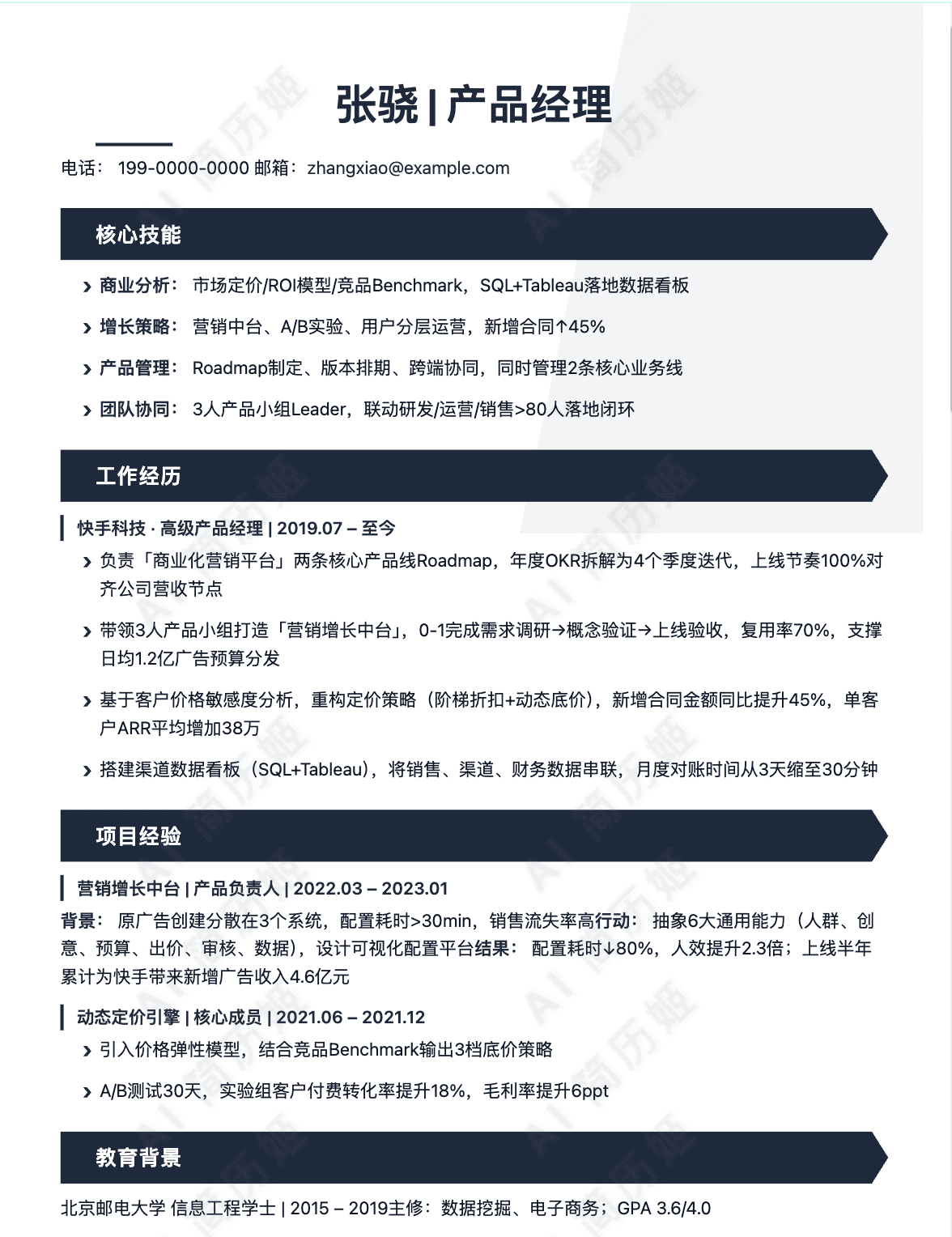
Properly Format Your Data Analyst Resume
A well-formatted resume is your first dataset for a hiring manager. It must be clean, easy to parse, and structured to highlight your most relevant skills and experiences. Poor formatting can obscure your qualifications, while a polished, professional layout ensures your data—your career history—is presented effectively.
Resume Length: The One-Page Standard
For most data analysts, especially those with less than 10 years of experience, a one-page resume is the expected standard. Recruiters and hiring managers often spend only seconds on an initial scan, so conciseness is key. A two-page resume is acceptable for senior-level analysts with extensive project portfolios, publications, or a long history of leadership.
Recommended Resume Format: Chronological
The reverse-chronological format is the gold standard for data analysts and is highly favored by Applicant Tracking Systems (ATS). This format lists your work experience in reverse order, starting with your most recent job. It effectively showcases your career progression and the direct application of your skills.
Senior Data Analyst, XYZ Corp (2022 - Present)
Data Analyst, ABC Inc (2020 - 2022)
While functional (skills-based) or combination (hybrid) formats exist, they can be confusing for ATS software and may raise red flags about employment gaps. Stick with chronological for the best results.
Font, Margins, and Spacing
Your resume's readability depends on these core design elements. Use a professional, sans-serif font that is easy on the eyes and scans well on both screen and paper. Maintain consistent margins and use white space strategically to separate sections and prevent a cluttered look.
Margins: 0.5 to 1 inch on all sides.
Spacing: Use single or 1.15 line spacing with clear breaks between sections.
File Format: Always PDF
Always save and send your resume as a PDF file (.pdf). This preserves your formatting across different devices and operating systems, ensuring that every hiring manager sees the resume exactly as you designed it. A Microsoft Word document (.docx) can have its formatting altered when opened on another computer.
ATS Optimization Basics
Most companies use Applicant Tracking Systems (ATS) to screen resumes before a human ever sees them. To get past this digital gatekeeper, your resume must be machine-readable.
- Use Standard Section Headings: "Work Experience," "Skills," "Education." Avoid creative titles like "My Journey" or "Where I've Been."
- Incorporate Keywords: Carefully mirror the language from the job description. If the ad asks for "proficiency in Tableau and SQL," ensure those exact terms are in your resume.
- Avoid Graphics and Columns: Charts, images, and text boxes are often unreadable by ATS and should be avoided.
Good Example: Properly Formatted Header
Data Analyst
(123) 456-7890 | jane.doe@email.com | linkedin.com/in/janedoe | github.com/janedoe
Bad Examples: Common Formatting Mistakes
2. Inconsistent bullet point styles and random spacing between job entries, creating a messy, unorganized appearance.
3. Including a headshot photo or using a multi-column layout with text boxes, which confuses most ATS software.
One‑click format & basics check
Auto‑check contacts, links and layout; generate an ATS‑friendly header.
Write a Strong Data Analyst Resume Summary or Objective
Summary vs. Objective: What's the Difference?
A resume summary is a brief, 2-4 sentence snapshot of your professional experience, skills, and key accomplishments. It's designed for candidates who have relevant work history in the field. In contrast, a resume objective focuses on your career goals, enthusiasm, and transferable skills, making it ideal for those new to the workforce, such as recent graduates or career changers.
When to Use a Summary vs. an Objective
Your choice between a summary and an objective depends entirely on your career stage. If you have one or more years of direct experience as a Data Analyst or in a closely related role (like Business Intelligence Analyst or Data Specialist), you should always use a summary. It immediately demonstrates your value and expertise to a hiring manager. If you are an entry-level candidate, a recent graduate, or transitioning from a different field, an objective is the appropriate choice. It allows you to frame your potential and express your career ambitions.
Key Elements to Include
Whether you write a summary or an objective, it must be packed with relevant keywords and a clear value proposition. For a summary, include your years of experience, core technical competencies (e.g., SQL, Python, Tableau), and a quantifiable achievement that demonstrates your impact. For an objective, state your career goal, highlight your relevant educational background and key skills (including academic projects), and explain how you can contribute to the specific company.
Optimal Length and Structure
Recruiters often scan resumes quickly, so your summary or objective should be concise and powerful. Aim for 2 to 4 sentences or 3-5 bullet points. The goal is to provide a high-level overview that encourages the reader to continue through the rest of your resume. Avoid long, dense paragraphs and focus on clarity and impact.
How to Tailor It to the Job Posting
A generic summary or objective is a missed opportunity. To make a strong impression, carefully review the job description and mirror its language. Identify the key skills, tools, and responsibilities mentioned. If the job emphasizes "data visualization with Power BI" and "driving business strategy," your summary or objective should explicitly mention Power BI and your ability to inform strategy. This tailoring shows you've done your research and are a precise fit for the role.
Good Resume Summary Examples
Here are examples of effective summaries for experienced professionals:
Good Resume Objective Examples
Here are examples of effective objectives for entry-level candidates:
Bad Resume Examples to Avoid
Here are common mistakes that can weaken your resume's introduction:
Explanation: This is far too vague. It lacks experience, specific skills, and any value proposition. It states the obvious ("looking for a job") and uses weak, unsubstantiated clichés ("hard worker").
Explanation: This is a generic, "one-size-fits-all" objective that could apply to any role in any industry. It fails to mention data analysis, any specific skills, or what value the candidate brings.
Explanation: This is a weak summary that simply lists job duties instead of showcasing achievements. It uses passive language and provides no quantification or demonstration of impact.
Explanation: While creative, these informal titles are unprofessional and not taken seriously by most recruiters and Applicant Tracking Systems (ATS). It focuses on personality over substance and measurable skills.
Generate skills list / summary
Extract hard/soft skills from the JD and create 3 summary variants.
Include Your Best Hard and Soft Skills as a Data Analyst
A well-crafted skills section is a critical component of any Data Analyst resume. It provides a quick, scannable overview of your capabilities for recruiters and hiring managers. Effectively presenting both your technical (hard) and interpersonal (soft) skills demonstrates that you are not only proficient with data but can also communicate, collaborate, and drive business impact.
Hard Skills vs. Soft Skills
Hard Skills are the specific, teachable technical abilities and knowledge required for the job. They are often quantifiable and learned through education, training, or certification. For a Data Analyst, this includes programming languages, database tools, and statistical methods.
Soft Skills are the interpersonal attributes and personality traits you need to succeed in the workplace. They relate to how you work, communicate, solve problems, and manage your work. They are crucial for collaborating with stakeholders and translating data into actionable insights.
Essential Hard Skills for a Data Analyst
Your hard skills should reflect the full data analysis lifecycle, from extraction to presentation. Here are 8-12 essential technical skills for the role:
- SQL (Structured Query Language): The fundamental tool for querying and manipulating data in relational databases.
- Programming for Analysis (Python or R): Python (with libraries like Pandas, NumPy, Scikit-learn) or R for data cleaning, statistical analysis, and machine learning.
- Data Visualization: Proficiency with tools like Tableau, Power BI, or Looker to create insightful dashboards and reports.
- Spreadsheet Proficiency: Advanced skills in Microsoft Excel or Google Sheets (PivotTables, functions, data models) for quick analysis and modeling.
- Statistical Analysis: A solid understanding of descriptive and inferential statistics (e.g., hypothesis testing, regression).
- Database Management: Knowledge of database systems like PostgreSQL, MySQL, SQL Server, or BigQuery.
- ETL (Extract, Transform, Load): Experience with processes and tools (e.g., Alteryx, Talend, dbt) to move and prepare data.
- Data Warehousing Concepts: Understanding of data warehouse structures like star schemas and snowflake schemas.
- Version Control (Git): Using Git and GitHub/GitLab for tracking changes in code and collaboration.
- Cloud Platforms: Familiarity with services from AWS (Redshift, S3), Google Cloud (BigQuery), or Microsoft Azure (Synapse Analytics).
Relevant Soft Skills for a Data Analyst
Technical skills get your foot in the door, but soft skills open the most important ones. Here are 4-6 key professional skills:
- Critical Thinking & Problem-Solving: The ability to approach problems logically, question assumptions, and develop data-driven solutions.
- Communication (Verbal & Written): Translating complex technical findings into clear, actionable insights for non-technical stakeholders.
- Attention to Detail: Ensuring accuracy and integrity in data analysis, from initial querying to final reporting.
- Business Acumen: Understanding the industry and business goals to ask the right questions and provide relevant analysis.
- Collaboration & Teamwork: Working effectively with cross-functional teams, including marketing, sales, and engineering.
- Storytelling with Data: Structuring your analysis in a compelling narrative that influences decision-making.
How to Organize Your Skills Section
A categorized format is far more effective than a simple list, as it helps recruiters quickly find the skills they are looking for.
Technical Skills
- Programming & Databases: SQL, Python (Pandas, NumPy), R, PostgreSQL, MySQL
- Data Visualization & BI: Tableau, Power BI, Google Data Studio
- Cloud & Big Data: Google BigQuery, AWS S3, Snowflake
- Tools & Methods: Git, ETL, Statistical Analysis, A/B Testing
Professional Skills
- Critical Thinking & Problem-Solving
- Data Storytelling & Communication
- Stakeholder Management
- Business Acumen
Skills
- Microsoft Office
- Good communicator
- SQL
- Hard worker
- Python
- Team player
- Detail-oriented
This format is disorganized, mixes hard and soft skills arbitrarily, and uses generic, unverifiable terms.
Matching Skills with Job Description Keywords
Tailor your skills section for every job application. Carefully read the job description and identify the specific hard and soft skills mentioned. Incorporate these keywords directly into your resume. If a job asks for "proficiency in Tableau and SQL for dashboard creation," ensure both "Tableau" and "SQL" are prominently listed in your hard skills. This not only shows you are a good fit but also helps your resume pass through Applicant Tracking Systems (ATS) that scan for these keywords.
AI‑assisted bullet quantification
Rewrite bullets using STAR/metrics and auto‑fill numbers and verbs to highlight impact.
Describe Your Work Experience and Key Projects as a Data Analyst
Senior Data Analyst | TechGrowth Inc. | San Francisco, CA | Jan 2021 – Present
Data Analyst | Global Retail Corp. | Chicago, IL | Jun 2018 – Dec 2020
Junior Data Analyst | DataInsight Solutions | Boston, MA | Jul 2016 – May 2018
Examples of Poor Work Experience Descriptions
Highlighting Key Projects Within Work Experience
The following example shows how to effectively detail a significant project within a job description.
Project experience quantifier
Split goals, actions and results; auto‑suggest metrics and format project cards.
Include Action Words to Make Your Data Analyst Resume Pop
In a competitive job market, your data analyst resume needs to immediately capture a recruiter's attention, often by first passing through an Applicant Tracking System (ATS). Action verbs are the engine that drives your resume, transforming it from a passive list of duties into a dynamic story of your accomplishments. Using strong, targeted action words helps your resume rank higher in ATS searches and demonstrates proactivity, impact, and skill to hiring managers, making you a more compelling candidate.
Categorized Action Verbs for Data Analysts
To effectively showcase your diverse skill set, use action verbs from different categories that align with the various facets of a data analyst's role. This strategy ensures you present a well-rounded and powerful professional profile.
Leadership & Management: Spearheaded, Orchestrated, Championed, Directed, Managed, Mentored, Supervised
Technical Implementation: Engineered, Developed, Programmed, Automated, Deployed, Streamlined, Optimized, Integrated
Problem-Solving: Diagnosed, Resolved, Remedied, Troubleshot, Rectified, Deciphered
Collaboration: Partnered, Liaised, Coordinated, Facilitated, Aligned, Advised
Achievement & Impact: Accelerated, Amplified, Boosted, Conserved, Slashed, Maximized, Minimized
Analysis & Research: Analyzed, Interpreted, Evaluated, Investigated, Quantified, Validated, Audited
Innovation: Pioneered, Innovated, Devised, Architected, Formulated, Conceptualized
Avoiding Repetition and Weak Language
A common resume mistake is overusing generic verbs like "Responsible for," "Worked on," or "Helped with." These phrases are weak, passive, and focus on duties rather than achievements. They also become repetitive quickly. By consciously replacing these with a diverse set of strong, specific action verbs from the categories above, you create a more engaging and impactful narrative of your career.
Before and After: Transforming Your Resume Bullets
See how replacing weak language with powerful action verbs and quantifiable results can dramatically improve your resume's effectiveness.
Weak: Was responsible for analyzing sales data.
Strong: Analyzed sales data to identify a 15% growth opportunity in the Midwest region.
Weak: Helped with making reports for the marketing team.
Strong: Engineered automated Tableau dashboards for the marketing team, slashing manual reporting time by 10 hours per week.
Weak: Did data cleaning and validation.
Strong: Validated and cleansed a 5-million-record dataset, improving data integrity by 25% for a key customer analytics project.
Weak: Worked on a project to find cost-saving opportunities.
Strong: Investigated operational inefficiencies and recommended a process change that conserved $50K in annual expenses.
Weak: In charge of the new data system implementation.
Strong: Spearheaded the implementation of a new CRM data system, orchestrating a cross-functional team to a successful on-time launch.
Examples of Strong Action Verb Usage
Here are complete resume bullet points that effectively utilize strong action verbs to convey skill and impact.
Pioneered a new machine learning model for customer churn prediction, boosting forecast accuracy by 30%.
Orchestrated the migration of the company's data warehouse to a cloud-based solution, amplifying query performance by 40%.
Diagnosed the root cause of a 5% drop in user engagement by quantifying key behavioral metrics and presenting findings to leadership.
Partnered with the product management team to formulate an A/B testing strategy that maximized feature adoption rates.
3 summary versions in seconds
Combine role highlights and strengths to generate concise, confident and specific summaries.
Make Your Education Section Count
Essential Components of Your Education Section
Your education section should provide a clear and concise snapshot of your academic qualifications. Always include your degree (e.g., Bachelor of Science), your major or field of study, the name of the university, and your graduation date. For recent graduates, placing this section near the top of the resume is advisable, as it is one of your primary qualifications. For experienced professionals with a robust work history, the education section typically moves toward the bottom.
Leveraging Relevant Coursework
If you are an entry-level candidate or a recent graduate, including relevant coursework is an excellent way to demonstrate your foundational knowledge in data analysis. This is particularly useful if your degree title doesn't immediately convey a technical focus. List 3-5 key courses that are directly related to the data analyst role you are targeting.
GPA and Academic Honors
Including your Grade Point Average (GPA) is recommended if it is 3.5 or higher on a 4.0 scale. If your GPA is below this threshold, it is generally best to omit it. However, always include any academic honors, scholarships, or awards you received, such as Cum Laude, Dean's List, or subject-specific scholarships. These achievements signal a strong work ethic and academic excellence.
Highlighting Projects and Thesis Work
For candidates with limited professional experience, academic projects, capstones, or a thesis can be powerful substitutes. Briefly describe a relevant project, the tools you used, and the outcome or insight you generated. This provides concrete evidence of your analytical and technical skills in action.
Good Education Section Examples
For a Recent Graduate:
Master of Science in Data Analytics
University of Tech, Graduated: May 2024 | GPA: 3.9/4.0
Relevant Coursework: Machine Learning, Big Data Analytics, SQL for Data Science, Statistical Programming in R, A/B Testing
Awards: Summa Cum Laude, Graduate Research Fellowship
Thesis: "Optimizing E-commerce Recommendations with Collaborative Filtering"
For an Experienced Professional:
Bachelor of Business Administration, Major in Information Systems
State University, Graduated: 2015
Certifications: Google Data Analytics Professional Certificate, Microsoft Certified: Data Analyst Associate
Bad Education Section Examples
Here are examples of poorly formatted or ineffective education sections to avoid.
Went to college from 2020 to 2024. Got a degree in something with data. I took a lot of classes.
University of Example City (2021-2023)
Did not finish my degree.
Courses: Intro to Psychology, World Literature, Pottery 101
B.S. in Data Science
The University, 2023
GPA: 2.4
No awards or relevant courses listed.
Education: Yes
Degree: B.A.
Major: Undecided for three years
Auto‑format education & certifications
Normalize titles, dates and bullets — ATS‑safe by default.
Select the Perfect Extra Sections for Your Data Analyst Resume
While the core sections of your resume (Experience, Education, Skills) are essential, strategically chosen extra sections can be the deciding factor that sets you apart. These optional components allow you to showcase a broader range of competencies, demonstrate passion, and fill potential gaps, ultimately presenting a more holistic and compelling picture to hiring managers.
1. Technical Projects
This section is invaluable for entry-level candidates, career changers, or anyone looking to demonstrate practical, hands-on skills beyond their professional experience. It shows initiative, passion for the field, and the ability to apply technical knowledge to solve real-world problems. Include personal projects, academic capstones, or coursework that involved data collection, cleaning, analysis, and visualization. For each project, briefly describe the objective, the tools and technologies you used (e.g., Python, SQL, Tableau), and the outcome or insights generated.
2. Publications & Speaking Engagements
This section is typically reserved for senior-level data analysts, data scientists, or those in research-oriented roles. Having a publication in a reputable journal, writing a well-regarded blog post, or presenting at a industry conference establishes you as a thought leader and an expert in your niche. It demonstrates strong communication skills and a commitment to contributing to the wider data community. List these items formally, similar to an academic CV, with full citations for publications and the event name, date, and title for speaking engagements.
3. Languages
In an increasingly globalized market, fluency in multiple languages is a significant asset. This is especially true for data analyst roles in multinational corporations or in specific geographic regions. Only include this section if you know a second (or third) language, and be honest about your proficiency level (e.g., Native, Fluent, Professional Working Proficiency, Limited Working Proficiency). Avoid listing languages you only have a basic understanding of.
4. Professional Affiliations
Listing memberships in professional organizations, such as the Data Management Association (DAMA) or a local data science meetup group, signals a genuine interest in your profession and a desire for continuous learning. It shows you are engaged with the latest industry trends and network with other professionals. This section is a subtle way to reinforce your commitment to your career. Simply list the organization's name and, if applicable, your membership status or any leadership roles you hold.
5. Volunteer Experience
Include volunteer experience only if it is relevant to the data analyst role or demonstrates transferable skills. For example, if you volunteered to analyze donation data for a non-profit or built a dashboard for a charity event, it's absolutely worth including. Even if not directly related, volunteer work can showcase soft skills like project management, teamwork, and problem-solving. Format it similarly to your professional experience, focusing on accomplishments and skills used.
Sections to AVOID on Your Data Analyst Resume
Being selective is as important as knowing what to include. Some sections can clutter your resume, waste valuable space, or even introduce bias. Avoid the following:
"Hobbies and Interests": Unless a hobby directly demonstrates a relevant skill (e.g., competitive Kaggle ranking), it is generally irrelevant and unprofessional. It can also unconsciously bias the reader.
"References Available Upon Request": This is a given and uses up precious space. Employers will ask for references later in the process; your resume should focus on selling your own skills and experience.
An "Objective" Statement: For most professionals, an objective is outdated. Replace it with a powerful "Professional Summary" that highlights your value proposition and key achievements upfront.
Irrelevant Personal Information: Do not include your marital status, age, political affiliation, or a photograph. This information is not relevant to your ability to perform the job and helps prevent discrimination.
Pitfalls check
Detect formatting/wording pitfalls and suggest instant rewrites and formatting.
How to Tailor Your Data Analyst Resume for a Specific Job Description
In a competitive job market, a generic resume is often insufficient. Tailoring your data analyst resume for a specific job description is the single most effective way to demonstrate your fit for a role. It shows the hiring manager that you have taken the time to understand their unique needs and that your skills are a direct match for their requirements. This process moves your application from being one of many to being a targeted solution.
Why Tailoring Your Resume is Non-Negotiable
Tailoring your resume is not just about adding keywords. It's a strategic process of aligning your proven experience with the company's stated problems and goals. A tailored resume passes through Applicant Tracking Systems (ATS) more effectively and immediately shows the human reviewer a clear connection between your background and the job at hand. It answers the hiring manager's most pressing question: "Can this person solve our specific data challenges?"
Step 1: Analyze the Job Description Meticulously
Your first step is to dissect the job description like a data set. Don't just read it; analyze it. Use a highlighter or create a separate document to identify and categorize key elements. Look for specific technical skills (e.g., SQL, Python, Tableau, Power BI), tools (e.g., Snowflake, Salesforce, Google Analytics), and methodologies (e.g., A/B testing, regression analysis, ETL processes). Also, pay close attention to the soft skills and business competencies mentioned, such as "communicating insights to non-technical stakeholders" or "driving business strategy."
Step 2: Map Your Experience to the Requirements
Once you have a clear list of the job's requirements, create a mapping table. In one column, list the key requirements from the job description. In the adjacent column, list a specific accomplishment or experience from your background that demonstrates that skill. This exercise forces you to find concrete examples and ensures you don't miss any crucial connections. For instance, if the job requires "reducing customer churn through predictive modeling," you would note a project where you built a model that identified at-risk customers, leading to a X% reduction in churn.
Step 3: Customize Key Resume Sections
With your mapping complete, strategically inject these connections throughout your resume.
Resume Summary
Your summary is the first thing a recruiter reads. A generic summary is forgettable, while a tailored one grabs attention immediately.
Before (Generic): "Detail-oriented Data Analyst with 4 years of experience. Skilled in SQL, Excel, and data visualization. Seeking a challenging role to utilize my skills."
After (Tailored for a role emphasizing marketing analytics and Tableau): "Data Analyst with 4 years of experience specializing in transforming complex marketing data into actionable insights. Proficient in SQL for data extraction and Tableau for building interactive dashboards that have directly influenced customer acquisition strategy and reduced CPA by 15%."
Skills Section
Reorder your skills to highlight the most relevant ones first. If the job description heavily emphasizes Python and machine learning, ensure those are at the top of your list, even if you have other skills. Mirror the language used in the job description (e.g., use "Power BI" if that's what they use, not just "data visualization").
Professional Experience
This is where your mapping exercise pays off. Rewrite your bullet points to reflect the language and priorities of the job description.
Before (Generic): "Analyzed sales data to find trends."
After (Tailored for a role requiring actionable insights and cross-functional collaboration): "Leveraged SQL and Python to analyze sales data, identifying a 20% untapped market segment; presented findings to the marketing and sales teams, leading to a targeted campaign that increased revenue by 8%."
Common Mistakes to Avoid in Resume Tailoring
While tailoring is critical, it must be done with integrity and strategy. Avoid these common pitfalls:
Over-Tailoring or Misrepresenting Skills: Never claim proficiency in a skill you don't possess. You can, however, mention a skill you are actively learning. Honesty is paramount, as you will be expected to demonstrate these skills in an interview.
Keyword Stuffing: Naturally integrate keywords into your sentences. A resume that is just a list of keywords is unreadable and can be flagged by an ATS as spam.
Losing Your Core Narrative: Your resume should still tell a coherent story about your career. Tailoring enhances this story; it shouldn't completely reinvent a false persona. Ensure the core of your experience and achievements remains consistent and truthful.
Forgetting to Proofread: When you are customizing multiple resumes, it's easy to leave a company name or detail from a previous application. Always do a final, careful proofread specific to the company and role you are applying for.
The Final Check: Aligning with Company Culture
Before you submit, take one more look at the company's website and values. If they emphasize "innovation" or "data-driven decision making," find a way to subtly weave that language into your summary or cover letter. This final layer of customization shows you're not just a fit for the job, but for the company as a whole.
Pick the right template and apply
Recommend templates by industry and seniority; auto‑map existing content.
Data Analyst Resume Examples (Complete Samples)
Apply example in one click
Pick an example and auto‑adapt to your experience and skills.
Frequently Asked Questions (FAQ)
How long should a Data Analyst resume be?
For most Data Analysts, a one-page resume is ideal, especially for candidates with less than 10 years of experience. If you have extensive, highly relevant experience, a second page may be acceptable. The key is to be concise and prioritize the most impactful information for the reader.
What's the best format for a Data Analyst resume?
The reverse-chronological format is highly recommended as it clearly showcases your career progression. A clean, well-organized layout with clear section headings is crucial. Avoid complex designs and focus on readability, using bullet points and white space to make your skills and experience easy to scan.
Should I include a photo on my Data Analyst resume?
No, it is generally not recommended to include a photo on your resume in the US, Canada, or UK. This helps prevent unconscious bias and keeps the focus on your qualifications. Recruiters expect a professional document centered on your skills and experience, not your appearance.
What are the most important technical skills to include on a Data Analyst resume?
Prioritize SQL, as it is fundamental for data extraction. Include a programming language like Python or R, and data visualization tools such as Tableau, Power BI, or Looker. Be specific about libraries you use, for example, listing "Pandas, NumPy, Matplotlib" is more impactful than just "Python."
How should I list soft skills on my resume?
Instead of just listing soft skills like "communication," demonstrate them through your accomplishments. For example, write "Effectively communicated complex data insights to non-technical stakeholders, leading to a 10% reduction in operational costs." This provides concrete proof of your abilities.
How do I describe my work experience to sound impactful?
Use the STAR (Situation, Task, Action, Result) method as a guide. Focus on action verbs and quantify your achievements. For instance, instead of "Responsible for building reports," write "Developed and automated 5 Tableau dashboards, reducing manual reporting time by 15 hours per week."
Should I include personal projects on my Data Analyst resume?
Yes, personal projects are excellent for demonstrating initiative and practical skills, especially for entry-level candidates. Include a link to your GitHub portfolio and describe a project's goal, the tools you used, and the outcome or insights you generated.
How many years of work history should I include?
Generally, include the last 10-15 years of relevant experience. If you have older roles that are highly significant to the data analyst position, you can mention them briefly in an "Early Career" section without detailed bullet points.
How do I write a Data Analyst resume with no direct experience?
Focus on transferable skills from other roles, relevant coursework, and personal projects. Create a strong "Projects" section to showcase your technical abilities. Emphasize skills like data cleaning, analysis, and visualization that you've used in academic, volunteer, or personal contexts.
Should I include my GPA on my Data Analyst resume?
You can include your GPA if you are a recent graduate (within the last 3 years) and it is 3.5 or higher. Once you have gained professional work experience, your accomplishments on the job become more important, and the GPA should be removed to save space.
What if I'm changing careers to become a Data Analyst?
Create a strong summary at the top that clearly states your career objective and highlights your transferable skills. Prioritize a "Skills" section and a "Projects" section above your work history. Within your professional experience, focus on quantifiable achievements and any data-related tasks you performed, even if it wasn't your primary role.
How can I tailor my resume for a specific Data Analyst job?
Carefully review the job description and identify key keywords and required skills. Mirror this language throughout your resume, especially in your summary and skills section. Prioritize the experiences and projects that are most relevant to the specific role and industry you are applying for.