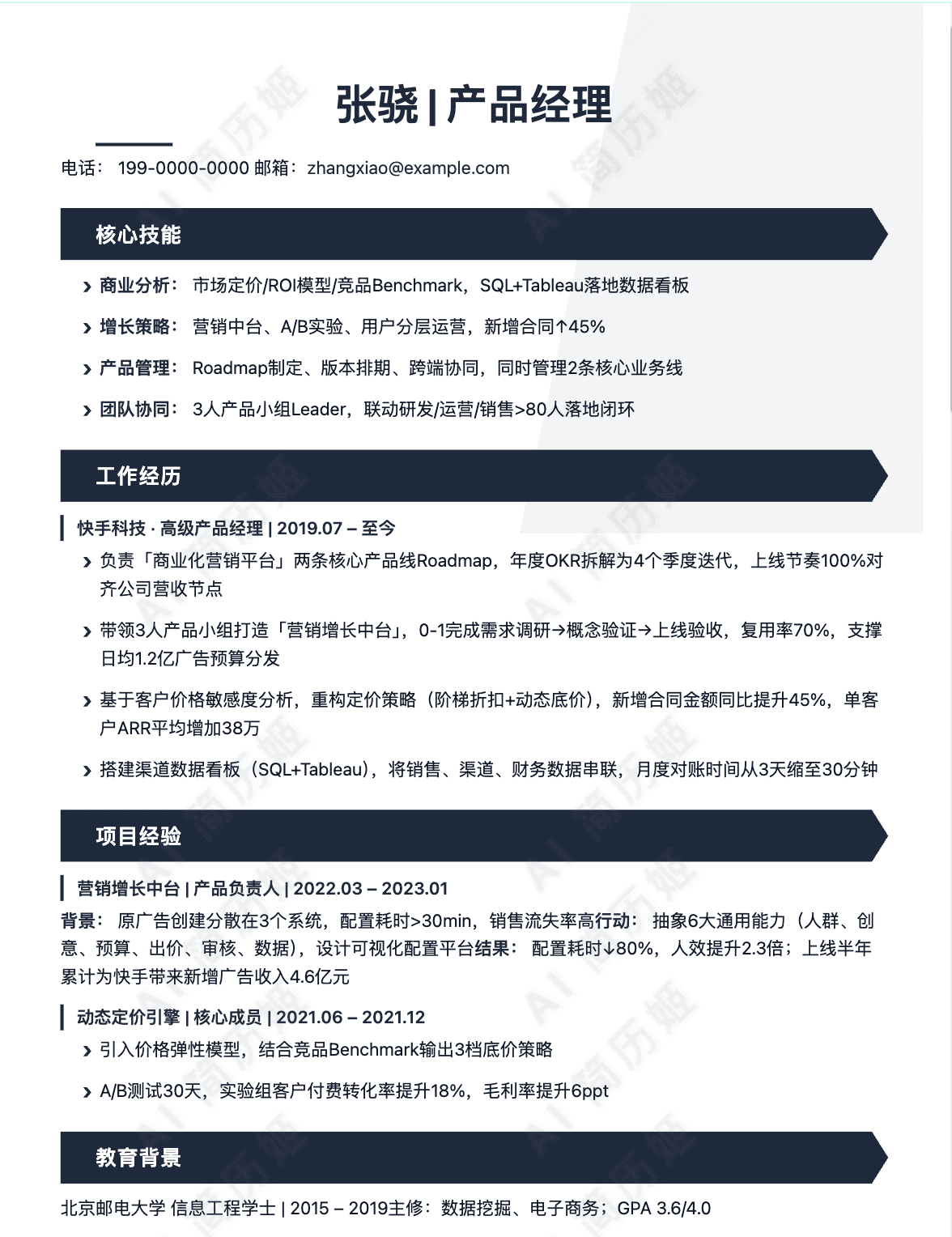
Properly Format Your Sales Representative Resume
A well-formatted resume is your first sales pitch. It needs to be visually appealing, easy to read, and strategically designed to pass through both automated systems and human reviewers. A cluttered or poorly structured document can undermine even the most impressive sales achievements.
Resume Length: The One-Page Rule
For most sales representatives, especially those with less than 10 years of experience, a one-page resume is the standard. Recruiters and hiring managers are often pressed for time, and a concise, impactful one-pager demonstrates your ability to prioritize and communicate effectively. A two-page resume is acceptable for senior-level sales professionals with an extensive history of leadership, major account management, or a long list of relevant achievements.
Recommended Resume Formats
Choosing the right format is crucial for presenting your experience in the best light. For sales roles, the following formats are most common:
Chronological Format: This is the most widely accepted and ATS-friendly format. It lists your work history in reverse-chronological order, emphasizing career progression and stability. This is the ideal choice for sales reps with a consistent employment history in the field.
Combination/Hybrid Format: This format blends the best of the chronological and functional styles. It starts with a skills summary section, followed by a reverse-chronological work history. This is excellent for showcasing a strong skill set while providing the employment timeline that recruiters prefer.
Font, Margins, and Spacing Standards
Professionalism and readability are paramount. Your goal is to guide the reader's eye effortlessly through your accomplishments.
Fonts: Use clean, professional, and widely available fonts like Calibri, Arial, Georgia, or Garamond. Font size should be between 10 and 12 points for body text, with your name and section headers slightly larger.
Margins: Set all margins (top, bottom, left, right) to between 0.5 inches and 1 inch. Margins smaller than 0.5 inches make the document look cramped and unprofessional.
Spacing: Use white space strategically to create visual separation. Ensure there is consistent spacing between sections, and use single or 1.15 line spacing within sections.
File Format: PDF vs. Word
Always save and send your resume as a PDF (.pdf) file. A PDF preserves your formatting across all devices and operating systems, ensuring that every recruiter sees the resume exactly as you designed it. It also appears more professional and final. Before sending, double-check that the file is not password-protected and that the text is selectable (not just an image scan).
ATS (Applicant Tracking System) Optimization Basics
Most companies use Applicant Tracking Systems (ATS) to screen resumes before a human ever sees them. To get past this digital gatekeeper, follow these guidelines:
Use standard, recognizable section headings like "Work Experience," "Skills," and "Education." Avoid creative titles like "My Journey" or "Where I've Been." Incorporate keywords from the job description naturally throughout your resume, especially in your skills and experience sections. Avoid using images, charts, graphics, or columns, as these can confuse the ATS parser.
Good Resume Header Example
JANE DOE
Senior Sales Representative
(123) 456-7890 | jane.doe@email.com | linkedin.com/in/janedoe | Chicago, IL
Common Formatting Mistakes to Avoid
- Using an unprofessional email address like "partyanimal123@email.com".
- Inconsistent use of bold, italics, or underlining, making the resume look messy and disorganized.
- Including a headshot or other photos, which can lead to unconscious bias and is often discouraged in many regions.
One‑click format & basics check
Auto‑check contacts, links and layout; generate an ATS‑friendly header.
Write a Strong Sales Representative Resume Summary or Objective
The resume summary or objective is the first thing a hiring manager reads. This brief section, placed at the top of your resume, must immediately capture attention and convince the reader that you are a strong candidate. It sets the tone for the entire document.
Summary vs. Objective: Which One Should You Use?
While often used interchangeably, summaries and objectives serve different primary purposes. Your choice depends largely on your level of experience in sales.
Resume Summary: Use this if you have one or more years of relevant sales experience. A summary is a concise recap of your career achievements, skills, and the value you bring to a company. It focuses on what you have already accomplished.
Resume Objective: Use this if you are an entry-level candidate, a recent graduate, or someone transitioning into a sales role from a different field. An objective states your career goals and explains what you aim to achieve in the position, emphasizing your transferable skills and enthusiasm.
Key Elements to Include
Whether you write a summary or an objective, it must be packed with relevant, impactful information. Aim for 2-4 concise, powerful sentences that include:
1. Years of Experience: Quantify your experience immediately to establish credibility.
2. Core Competencies: Mention 2-3 key sales skills relevant to the job (e.g., "prospecting," "relationship management," "CRM software," "negotiation").
3. Value Proposition & Achievements: This is the most critical part. Include 1-2 quantifiable achievements that demonstrate your ability to drive results. Use numbers, percentages, and dollar amounts to prove your impact.
Optimal Length and Structure
Your summary or objective should be a brief, scannable paragraph, not a dense block of text. The ideal length is 3-5 lines or approximately 2-4 sentences. The structure should follow a logical flow: who you are, what you can do, and what you have achieved (for a summary) or what you aim to achieve (for an objective).
How to Tailor It to the Job Posting
A generic summary is easily overlooked. To make a strong impression, tailor this section for each job you apply for. Carefully read the job description and identify keywords related to skills, software, and responsibilities. Then, incorporate these specific keywords into your summary or objective. This shows the hiring manager you have paid attention and that your experience is a direct match for their needs.
Good Examples to Follow
For Experienced Professionals (Resume Summary):
For Entry-Level Candidates (Resume Objective):
Bad Examples to Avoid
Too Vague and Generic:
Explanation: This provides no specific skills, experience, or measurable results. It uses clichés and offers no value to the reader.
Focused on What You Want, Not What You Offer:
Explanation: This is all about the candidate's desires, not how they can solve the company's problems or contribute to its goals. It comes across as self-centered.
Overly Long and Dense:
Explanation: This is a run-on sentence that reads like a story. It's difficult to scan and the key achievement ("increase in sales") is not quantified, making it weak and unimpressive.
Lacking Sales-Specific Keywords:
Explanation: This frames the experience in an operational or service context, not a revenue-generating one. It fails to use powerful sales language like "exceed quota," "generate revenue," or "close deals."
Generate skills list / summary
Extract hard/soft skills from the JD and create 3 summary variants.
Include Your Best Hard and Soft Skills as a Sales Representative
In the competitive field of sales, your resume must immediately demonstrate that you possess the right blend of technical prowess and interpersonal abilities. A well-crafted skills section acts as a quick-reference guide for hiring managers, proving you can both execute the process and connect with clients. Mastering this section involves understanding the distinction between hard and soft skills and presenting them effectively.
Hard Skills vs. Soft Skills: What's the Difference?
Hard Skills are the teachable, measurable technical abilities required for the job. They are often specific to the sales role and can be quantified or proven with certifications. Soft Skills are the interpersonal, character traits, and communication abilities that determine how you interact with prospects, handle rejection, and collaborate with your team. While hard skills get your foot in the door, soft skills are often what close the deal and build lasting client relationships.
Essential Hard Skills for a Sales Representative
Your hard skills showcase your proficiency with the tools and methodologies of modern sales. Be specific and include relevant technologies to pass through Applicant Tracking Systems (ATS) and catch the eye of a recruiter.
- CRM Software:
Salesforce, HubSpot, Zoho CRM, Microsoft Dynamics 365 - Sales Prospecting:
LinkedIn Sales Navigator, ZoomInfo, Apollo, LeadIQ - Sales Enablement & Automation:
Outreach, Salesloft, Mailchimp, Marketo - Video Conferencing & Communication:
Zoom, Microsoft Teams, Slack - Social Selling & Digital Outreach
- Contract Management & Proposal Software:
PandaDoc, DocuSign, Proposify - Data Analysis & Reporting:
Microsoft Excel (PivotTables, VLOOKUP), Salesforce Dashboards, Google Analytics - Sales Methodologies:
MEDDIC, SPIN Selling, Challenger Sale, Consultative Selling - Objection Handling & Negotiation
- Product Demonstration & Presentation Skills
Critical Soft Skills for a Sales Representative
These are the intangible qualities that define a top performer. They are harder to measure but are frequently cited as the key differentiator between good and great sales reps.
- Communication (Verbal & Written)
- Empathy & Active Listening
- Resilience & Persistence
- Adaptability & Problem-Solving
- Time Management & Organization
- Collaboration & Teamwork
How to Organize Your Skills Section
Instead of a long, unorganized list, categorizing your skills makes them easier to digest and shows a structured approach. A two-column format is highly effective for readability.
Skills
| Hard Skills | Soft Skills |
|---|---|
|
|
Matching Skills with Job Description Keywords
Carefully review the job description and mirror its language. If the ad emphasizes "MEDDIC sales methodology" and "Salesforce CRM," ensure those exact terms are in your skills section. This is crucial for both ATS algorithms and human recruiters scanning for a match.
Job Description Keywords: "Leverage Salesforce to manage pipeline," "Utilize Challenger Sale methodology," "Prospect with LinkedIn Sales Navigator."
Your Skills Section Includes: "Salesforce CRM," "Challenger Sale Methodology," "LinkedIn Sales Navigator."
Common Mistakes to Avoid in Your Skills Section
Avoid these pitfalls to ensure your skills section strengthens your application rather than weakening it.
Using a vague, unformatted list that is hard to read.
- Skills: sales, communication, CRM, Microsoft Office, talking to people, organized, good at computers.
Listing irrelevant or outdated skills that don't pertain to a modern sales role.
- Skills: Cold calling, Fax machine, Paper filing, Typewriting (65 WPM).
Failing to include specific tools and technologies mentioned in the job description.
Job Description asks for: "Experience with Salesloft and ZoomInfo." Your Resume says: "Experience with sales automation tools."
AI‑assisted bullet quantification
Rewrite bullets using STAR/metrics and auto‑fill numbers and verbs to highlight impact.
Describe Your Work Experience and Key Projects as a Sales Representative
Your work experience section is the core of your resume. It should tell a compelling story of your career progression, quantifiable impact, and key contributions. Use strong action verbs and the CAR/STAR method to structure your bullet points, focusing on the challenges you faced, the actions you took, and the measurable results you achieved.
Work Experience Examples (Good)
Here are examples of effective work experience entries for different seniority levels.
Senior Account Executive | TechFlow Solutions | San Francisco, CA | Jan 2020 – Present
• Secured a landmark $500,000 ARR contract with a Fortune 500 client by building a multi-threaded relationship across IT, Operations, and Finance departments, navigating a complex 9-month sales cycle.
• Surpassed annual sales quota by 155% in 2022 by strategically managing a $3M+ pipeline and consistently closing deals with an average contract value 20% above company targets.
• Mentored three junior sales representatives, providing coaching on negotiation tactics and CRM management, resulting in a 25% increase in their collective quarterly performance.
Sales Representative | Innovate Corp | Austin, TX | Mar 2017 – Dec 2019
• Spearheaded a key project to redesign the sales presentation deck, incorporating client testimonials and ROI calculators, which reduced the sales cycle length by 15%.
• Consistently ranked in the top 10% of the 50-person sales team for quarterly quota attainment, achieving an average of 118% over 8 consecutive quarters.
• Negotiated and closed a 3-year enterprise service agreement worth $150,000, upselling two additional product modules from the initial $80,000 proposal.
Junior Sales Development Representative | DataDyne Inc. | Boston, MA | Jun 2016 – Feb 2017
• Exceeded monthly lead generation targets by an average of 30%, contributing to a pipeline valued at over $1.5 million for the Account Executive team.
• Authored a new email sequence for the Nordic market that improved response rates by 18% and was adopted by the entire SDR team.
Work Experience Examples (Bad)
Avoid these common mistakes that create vague and unimpressive descriptions.
Highlighting Key Projects Within Work Experience
Integrating key projects directly into your work experience shows initiative and the ability to drive impact beyond your daily responsibilities. Frame them using the same CAR/STAR methodology.
Account Manager | Global Connect Ltd. | Chicago, IL | Apr 2018 – Present
• Key Project: Led a 6-month "Client Onboarding Process Improvement" initiative after identifying a 30% churn rate within the first 90 days of new client partnerships.
• - Challenge: The existing onboarding was disjointed, leading to low product adoption and client frustration.
• - Action: Designed and implemented a standardized, multi-touchpoint onboarding program including kick-off calls, dedicated training webinars, and a 30-60-90 day success plan.
• - Result: Reduced early-stage churn by 50% and increased product adoption metrics by 40% within the first year of rollout.
• Revitalized a dormant account, "XYZ Manufacturing," by uncovering unmet needs, resulting in a new $75,000 annual contract for a previously unused service module.
Project experience quantifier
Split goals, actions and results; auto‑suggest metrics and format project cards.
Include Action Words to Make Your Sales Representative Resume Pop
In a competitive job market, your resume needs to do more than just list your duties; it needs to showcase your impact. Action verbs are the engine of a powerful resume. They transform passive descriptions of your responsibilities into dynamic proof of your achievements. Using strong, targeted action words is crucial for two key reasons: they help you pass through Applicant Tracking Systems (ATS) that scan for relevant keywords, and they immediately capture a recruiter's attention by painting a picture of a proactive, results-oriented candidate.
Categorized Action Verbs for Sales Representatives
To effectively showcase the full spectrum of your skills, organize your action verbs by function. This ensures you highlight different strengths throughout your resume, from leadership to technical prowess.
Leadership & Management: Spearheaded, Orchestrated, Championed, Mobilized, Directed, Mentored, Headed
Technical Implementation: Engineered, Automated, Implemented, Optimized, Streamlined, Leveraged, Deployed
Problem-Solving: Resolved, Remedied, Troubleshot, Rectified, Diagnosed, Overcame, Revitalized
Collaboration: Collaborated, Partnered, Aligned, Fostered, Liaised, Unified, Negotiated
Achievement & Impact: Accelerated, Amplified, Boosted, Capitalized, Maximized, Secured, Surpassed
Analysis & Research: Analyzed, Assessed, Evaluated, Identified, Forecasted, Quantified, Validated
Innovation: Pioneered, Initiated, Conceptualized, Revamped, Transformed, Redesigned, Launched
Avoiding Repetition and Weak Language
A common mistake is overusing generic verbs like "Responsible for," "Worked on," or "Helped with." These phrases are weak and focus on duties, not accomplishments. They dilute your impact and can make your resume seem unimpressive. By having a diverse arsenal of action verbs from the categories above, you can avoid this repetition and create a more engaging and professional narrative.
Before and After: Transforming Your Resume Bullets
See how replacing weak language with powerful action verbs and quantifiable results can dramatically improve your resume's impact.
Weak: Was responsible for sales in the Northeast territory.
Strong: Spearheaded sales for the Northeast territory, exceeding quota by 35% for three consecutive quarters.
Weak: Helped with the implementation of a new CRM system.
Strong: Engineered the implementation of a new CRM system, automating lead tracking and boosting team productivity by 20%.
Weak: Did customer service and handled complaints.
Strong: Resolved complex client escalations, securing contract renewals and improving customer satisfaction scores by 15 points.
Weak: Worked with the marketing team on campaigns.
Strong: Collaborated with the marketing department to pioneer a new lead generation campaign that amplified qualified leads by 40%.
Weak: In charge of analyzing sales data.
Strong: Analyzed sales performance data to identify untapped market opportunities, resulting in a new vertical that generated $500k in new revenue.
Examples of Strong Action Verb Usage
Here are complete resume bullet points that effectively utilize strong action verbs to demonstrate value and achievement.
1. Orchestrated a cross-functional initiative with product and engineering teams to capitalize on a market gap, launching a new service line that captured 15% market share within six months.
2. Negotiated and secured a multi-year enterprise contract valued at $1.2M, the largest in the company's history for the region.
3. Optimized the sales funnel by implementing a new lead scoring system, which increased the lead-to-opportunity conversion rate by 25%.
4. Mentored and trained three junior sales representatives, resulting in a 50% faster ramp-up time and a collective $750k in new business.
3 summary versions in seconds
Combine role highlights and strengths to generate concise, confident and specific summaries.
Make Your Education Section Count
Your education section is more than just a formality; it's a chance to showcase your foundational knowledge, work ethic, and relevant skills. How you present this information can significantly impact a hiring manager's perception, especially if you are new to the sales field.
Essential Information to Include
At a minimum, your education section should be clear and easy to scan. Always include the following for each degree you list:
- Degree: e.g., Bachelor of Science, Associate of Arts
- Major: Your specific field of study.
- University: The name of the institution.
- Graduation Date: Month and Year (e.g., May 2023). If you are a current student, you can put "Expected Graduation: May 2026".
Placement: Top or Bottom of the Resume?
Where you place your education section depends heavily on your professional experience.
Place it at the top if: You are a recent graduate (within the last 1-2 years) with limited relevant work experience. This highlights your most current and relevant academic achievements.
Place it at the bottom if: You have several years of proven sales experience. In this case, your professional accomplishments are more impactful and should be the first thing a recruiter sees.
Enhancing Your Education for Entry-Level Roles
If you lack extensive sales experience, you can strengthen your resume by adding relevant details to your education section.
Relevant Coursework: List 3-5 courses that are directly related to the sales role. This demonstrates foundational knowledge in key areas.
Relevant Coursework: Consumer Behavior, Marketing Principles, Business Communications, Public Speaking, Statistics
Academic Projects & Thesis Work: Did you complete a major project analyzing market trends or a thesis on consumer psychology? Briefly describe it to showcase applied skills in research, analysis, and presentation.
Senior Thesis: "The Impact of Social Media Marketing on Brand Loyalty," involving primary research, data analysis, and a 40-page paper.
GPA, Honors, and Awards
GPA: The general rule of thumb is to include your GPA only if it is 3.5 or higher on a 4.0 scale. If your major GPA is significantly higher than your cumulative GPA, you can list that instead (e.g., "Major GPA: 3.7/4.0"). If it's below 3.5, it's best to omit it.
Bachelor of Arts in Communications, University of Example | GPA: 3.8/4.0, Magna Cum Laude
Academic Honors & Scholarships: Always include academic honors like Cum Laude, Dean's List, or specific scholarships. These are concrete validations of your dedication and performance.
Dean's List (All Semesters 2020-2023), Recipient of the Merit-Based Excellence in Business Scholarship
Good Examples in Action
For a Recent Graduate
Bachelor of Science in Business Administration
State University, Anytown, USA
Graduated: May 2023 | GPA: 3.7/4.0 | Magna Cum Laude
Relevant Coursework: Professional Sales, Negotiations, Consumer Psychology, Marketing Analytics
Honors: Dean's List (6 Semesters), 1st Place, University Annual Sales Pitch Competition (2022)
Senior Capstone Project: Developed a comprehensive go-to-market sales strategy for a local startup, resulting in a 15% projected increase in lead generation.
For an Experienced Professional
Master of Business Administration (MBA) - University of Chicago, Booth School of Business - 2015
Bachelor of Arts in Economics - Northwestern University - 2010
Certifications: Certified Professional Sales Person (CPSP), Strategic Negotiations
Bad Examples to Avoid
EDUCATION: Went to college and got a degree in stuff. It was cool.
University of Texas - Bachelor's Degree - 2015-2019 - GPA: 2.1
College
A.S. in General Studies
Community College
(No graduation date provided)
Education
High School Diploma
Anytown High School
(For anyone with a college degree, listing your high school is unnecessary and takes up valuable space.)
Auto‑format education & certifications
Normalize titles, dates and bullets — ATS‑safe by default.
Select the Perfect Extra Sections for Your Sales Representative Resume
While the core sections of your resume (Experience, Skills, Education) are non-negotiable, the strategic inclusion of extra sections can be what truly sets you apart. These optional areas allow you to showcase a broader range of competencies, demonstrate cultural fit, and fill potential gaps, ultimately presenting a more dynamic and compelling picture to a hiring manager.
Recommended Extra Sections to Elevate Your Resume
Choose sections that are relevant to the job you're targeting and that highlight strengths not covered elsewhere. Here are the most impactful options for a sales representative.
1. Technical Projects
This section is incredibly valuable for entry-level candidates, career changers from a technical field, or sales professionals targeting tech-heavy industries like SaaS. It demonstrates problem-solving skills, technical aptitude, and the ability to manage a project from start to finish. You should include this section if you have completed relevant academic, personal, or freelance projects that involved technical tools, software, or complex data analysis. Format it professionally by listing the project name, the tools/software used, and a brief description of the project's goal and your specific, quantifiable role in its success.
2. Publications & Speaking Engagements
This section is best suited for senior-level sales professionals, thought leaders, or industry experts. It establishes your credibility and authority within your field, showing that you are a recognized voice and a trusted source of information. Include this if you have written articles for industry journals, blogs, or company publications, or if you have been invited to speak at conferences, webinars, or panels. Format it by listing the title of the publication or presentation, the name of the publisher or event, and the date. You can optionally include a link for easy verification.
3. Languages
In today's global economy, fluency in additional languages is a significant asset, especially for roles involving international clients or diverse markets. This section should be included if you have professional proficiency or higher in a language other than your native tongue. Be honest about your level of fluency (e.g., Native, Fluent, Professional Working Proficiency, Limited Working Proficiency). Only list languages where you can comfortably conduct business; do not include a language you only know at a basic conversational level.
4. Professional Affiliations
Listing memberships in professional organizations shows that you are actively engaged in your industry, committed to continuous learning, and serious about networking. This is a strong addition for any sales professional, from entry-level to executive. Include organizations like the American Association of Inside Sales Professionals (AA-ISP), Sales & Marketing Executives International (SMEI), or other industry-specific groups. List the organization's name, your membership level (e.g., Member, Board Member), and the dates of your involvement.
5. Volunteer Experience
Volunteer experience can be a powerful addition if it is relevant to the sales role or demonstrates key soft skills. It showcases leadership, teamwork, and community involvement, which can be a significant culture-add for many companies. Include this section if your volunteer work utilized skills like fundraising (directly related to sales), project management, team leadership, or public speaking. If the experience is not relevant, it's better to leave it off to conserve space for more impactful content.
Sections to AVOID on Your Sales Resume
Knowing what to exclude is just as important as knowing what to include. Avoid cluttering your resume with irrelevant or personal information that does not contribute to your candidacy.
References Available Upon Request: This is a given and wastes valuable space. Employers will ask for references when they need them.
An Objective Statement: For most sales professionals, a Professional Summary is far more effective. An objective focuses on what you want, while a summary sells what you can offer the company.
Irrelevant Hobbies: Unless a hobby directly demonstrates a sales-relevant skill (e.g., competitive debating for negotiation skills, marathon running for persistence), it does not belong on a professional resume.
Personal Information: Avoid including details like your marital status, political affiliation, religious beliefs, or a photograph (unless specifically requested in your country). This information is irrelevant to your ability to perform the job and helps prevent unconscious bias.
High School Information: Once you have a college degree, your high school details are no longer necessary and can make your resume appear dated or unprofessional.
Pitfalls check
Detect formatting/wording pitfalls and suggest instant rewrites and formatting.
How to Tailor Your Sales Representative Resume for a Specific Job Description
In the competitive field of sales, a generic resume is often a one-way ticket to the rejection pile. Hiring managers are looking for candidates who have taken the time to understand their specific needs and demonstrate a clear fit. Tailoring your resume for each job application is not just a recommendation; it's a necessity to stand out and land more interviews.
Reading and Analyzing Job Descriptions Effectively
The first and most crucial step is to move beyond simply reading the job description and start analyzing it. Treat it as a blueprint for your resume. Look for recurring themes, specific software mentioned, and the core challenges the company is facing. Pay close attention to the language they use—are they focused on "hunting" new business, "managing key accounts," or "driving SaaS adoption"? This vocabulary will become the foundation for your tailored resume.
Identifying Key Requirements and Qualifications
Break the job description down into two categories: must-haves and nice-to-haves. Must-haves are the non-negotiable qualifications, such as "5+ years of B2B sales experience" or "proven track record of exceeding quota." Nice-to-haves are skills that give you a competitive edge, like "experience with Salesforce CRM" or "knowledge of the fintech industry." Your goal is to prove you meet all the must-haves and as many nice-to-haves as possible.
Matching Your Experience to Job Requirements
This is where you connect the dots for the hiring manager. Don't just list your job duties; reframe your accomplishments to mirror the job description's requirements. If the role emphasizes "new client acquisition," highlight your success in "securing 30+ new enterprise clients in 2023." By directly linking your experience to their needs, you make it easy for them to see you as the ideal candidate.
Customizing Resume Summary and Keywords
Your professional summary is the first thing a recruiter reads, so it must be customized. Incorporate key phrases from the job description to immediately signal a strong fit. Furthermore, many companies use Applicant Tracking Systems (ATS) to screen resumes. By strategically including relevant keywords (e.g., "CRM," "pipeline management," "quarterly quota"), you increase the chances of your resume being seen by human eyes.
Avoiding Over-Tailoring or Misrepresenting Skills
While tailoring is essential, it's important to remain authentic. Never claim expertise in a skill you don't possess. Over-tailoring can lead to a resume that feels disingenuous or, worse, gets you into an interview for a role you're not qualified for. The goal is to frame your genuine experience in the most relevant light, not to fabricate a new identity.
Step-by-Step Process for Tailoring Your Resume
Follow this simple, three-step process for every job application to ensure your resume is perfectly aligned.
1. Analyze the Job Description
Grab a highlighter or create a new document. Identify and note all the key skills, technologies, action verbs, and qualifications. Create a list of these keywords and requirements that you will need to address.
2. Map Your Experience
Review your master resume. For each keyword from the job description, find a corresponding achievement, skill, or experience from your background. Be specific and quantify your results wherever possible (e.g., "increased sales by 25%," "managed a portfolio of 50 accounts").
3. Customize Key Sections
Rewrite your professional summary to reflect the role's primary focus. Then, carefully edit your professional experience bullet points to prioritize and phrase your accomplishments using the language from the job description. Ensure the most relevant information is prominent and easy to find.
Example: Generic vs. Tailored Resume
Here is a before-and-after example of a resume bullet point, tailored for a job description seeking a candidate to "expand market share in the SaaS segment by leveraging CRM data to drive strategic sales."
Generic Bullet Point:
• Responsible for managing sales in a specific territory.
Tailored Bullet Point:
• Drove a 15% increase in SaaS market share by analyzing Salesforce CRM data to identify untapped opportunities and guide strategic sales initiatives in the Northeast territory.
Common Mistakes to Avoid in Resume Tailoring
Many well-intentioned candidates undermine their efforts with these common errors. Be sure to avoid them.
Keyword Stuffing: Naturally integrating keywords is effective; stuffing them awkwardly into sentences is obvious and off-putting.
Forgetting to Quantify: Saying you "increased sales" is weak. Saying you "exceeded quota by 120% in Q3" is powerful and specific.
Using One Generic Resume: Sending the same resume to every opening is a passive strategy that yields minimal results.
Ignoring the Company's "Voice": If the job description is energetic and modern, your resume's tone should match, rather than sounding overly formal and corporate.
Lying or Exaggerating: This is the most critical mistake. It will damage your credibility and can cost you the job, even if discovered after hiring.
Pick the right template and apply
Recommend templates by industry and seniority; auto‑map existing content.
Sales Representative Resume Examples (Complete Samples)
Apply example in one click
Pick an example and auto‑adapt to your experience and skills.
Frequently Asked Questions (FAQ)
How long should a Sales Representative resume be?
For most Sales Representatives, a one-page resume is ideal and expected. If you have over 10 years of highly relevant and successful experience, a second page may be justified. Recruiters value brevity and the ability to concisely present your most impactful achievements.
What's the best format for a Sales Representative resume?
The reverse-chronological format is highly recommended as it highlights your career progression and most recent accomplishments first. This format is easily scannable by hiring managers and Applicant Tracking Systems (ATS), ensuring your key sales metrics and promotions are seen immediately.
Should I include a photo on my Sales Representative resume?
No, it is generally not recommended to include a photo on your resume in the US and Canada, as it can introduce unconscious bias. Focus the valuable space on your quantifiable sales achievements and skills. The exception is if you are applying for a role in a region or industry where it is a standard practice.
What are the most important skills to include on a Sales Representative resume?
Focus on a blend of hard and soft skills. Essential hard skills include CRM software (e.g., Salesforce, HubSpot), prospecting tools, and negotiation. Critical soft skills are communication, relationship building, and resilience. Always tailor your skills to match the keywords found in the job description you are targeting.
Should I include a "Skills" section on my resume?
Yes, a dedicated "Skills" section is crucial for both ATS scanners and human readers. It allows you to list key technical proficiencies and sales methodologies in a clean, easy-to-find format. This section complements the evidence of these skills you provide in your experience bullet points.
How do I quantify my achievements if my company doesn't share exact numbers?
You can use percentages, rankings, or other relative metrics. For example, instead of a specific revenue number, you could write "Exceeded sales quota by 150% for three consecutive quarters" or "Ranked #2 in sales performance out of a 15-person regional team." These still demonstrate success without disclosing confidential data.
How many years of work history should I include on my resume?
Typically, include the last 10-15 years of your work history, as this is most relevant to your current capabilities. If you have older experience that is highly significant (e.g., you opened a new market), you can mention it briefly in a "Career Note" or "Early Career" section without detailed bullet points.
Should I include non-sales work experience?
Yes, if you can frame it to highlight transferable skills. For example, experience in hospitality demonstrates customer service, and serving demonstrates upselling and working in a fast-paced environment. Focus on the skills gained rather than the tasks performed to show your suitability for a sales role.
How do I write a Sales Representative resume with no direct experience?
Focus on transferable skills from other jobs, volunteer work, or academics. Use a strong summary to highlight your motivation and aptitude for sales. Emphasize achievements in customer service, communication, persuasion, and goal-setting from any context, and consider a "Summary of Qualifications" section instead of a purely chronological one.
Should I include my GPA on my Sales Representative resume?
Generally, only include your GPA if you recently graduated (within the last 3 years) and it is 3.5 or higher. Once you have professional sales experience, your on-the-job performance and quota attainment become far more important metrics of success than your academic record.
What if I'm changing careers to become a Sales Representative?
Create a powerful summary that clearly states your objective and passion for sales. In your experience section, re-frame your past responsibilities to highlight sales-adjacent skills like client management, negotiation, influencing, and achieving targets. Networking and a compelling cover letter are also critical for a successful career change.
How should I handle employment gaps on my resume?
Be prepared and honest. You can list the years of employment (e.g., 2019 – 2022) instead of months to de-emphasize short gaps. If the gap was for skill development, caring for family, or other valid reasons, you can address it briefly in your cover letter or frame it positively in your resume (e.g., "Professional Development and Career Reflection").