Properly Format Your Marketing Manager Resume
A polished and professional resume format is your first marketing campaign—with you as the product. It must be visually appealing, easy to navigate, and strategically designed to pass through both automated systems and human reviewers. Proper formatting highlights your qualifications and makes a strong first impression.
Resume Length: The One-Page vs. Two-Page Rule
For most Marketing Managers, a one-page resume is the standard and expected format. It forces conciseness and highlights your most impactful achievements. However, if you have over 10-15 years of highly relevant experience, or an extensive history of publications, major campaigns, and certifications, a two-page resume is acceptable. The key is that every line must add value.
Choosing the Right Resume Format
The format you choose structures your experience and guides the reader's eye. For Marketing Managers, the following formats are most common:
Chronological Format: This is the most widely accepted and ATS-friendly format. It lists your work experience in reverse-chronological order, emphasizing career progression and stability. This is ideal if you have a strong, linear career path in marketing.
Combination/Hybrid Format: This format blends the chronological and functional styles. It starts with a skills summary section, followed by a reverse-chronological work history. This is excellent for highlighting a specific skill set (like SEO or marketing automation) while still providing a solid employment record.
Font, Margins, and Spacing Standards
Clarity and readability are paramount. Your resume should be clean, uncluttered, and professional.
Fonts: Use professional, easy-to-read sans-serif fonts like Calibri, Arial, or Helvetica. Serif fonts like Georgia or Garamond are also acceptable. Font size should be between 10 and 12 points for body text, with your name and section headers slightly larger.
Margins: Set all margins to between 0.5 inches and 1 inch. Uniform margins create a balanced, professional frame for your content.
Spacing: Use white space strategically to separate sections and improve readability. Ensure consistent spacing between bullet points, jobs, and sections.
File Format: PDF vs. Word
Always save and send your resume as a PDF (.pdf) file. A PDF preserves your formatting across all devices and operating systems, ensuring it looks exactly as you intended to every recruiter. It also appears more professional and is the standard for modern job applications. Only use a Word document (.docx) if the job application system specifically requests it.
ATS Optimization Basics
Most companies use Applicant Tracking Systems (ATS) to scan and filter resumes before a human sees them. To get past this digital gatekeeper:
Use standard, recognizable section headings like "Work Experience," "Skills," and "Education." Avoid creative titles like "My Journey" or "Where I've Been."
Incorporate keywords from the job description naturally throughout your resume, especially in your skills section and job bullet points.
Avoid graphics, images, tables, and columns, as these are often unreadable by an ATS.
Good and Bad Formatting Examples
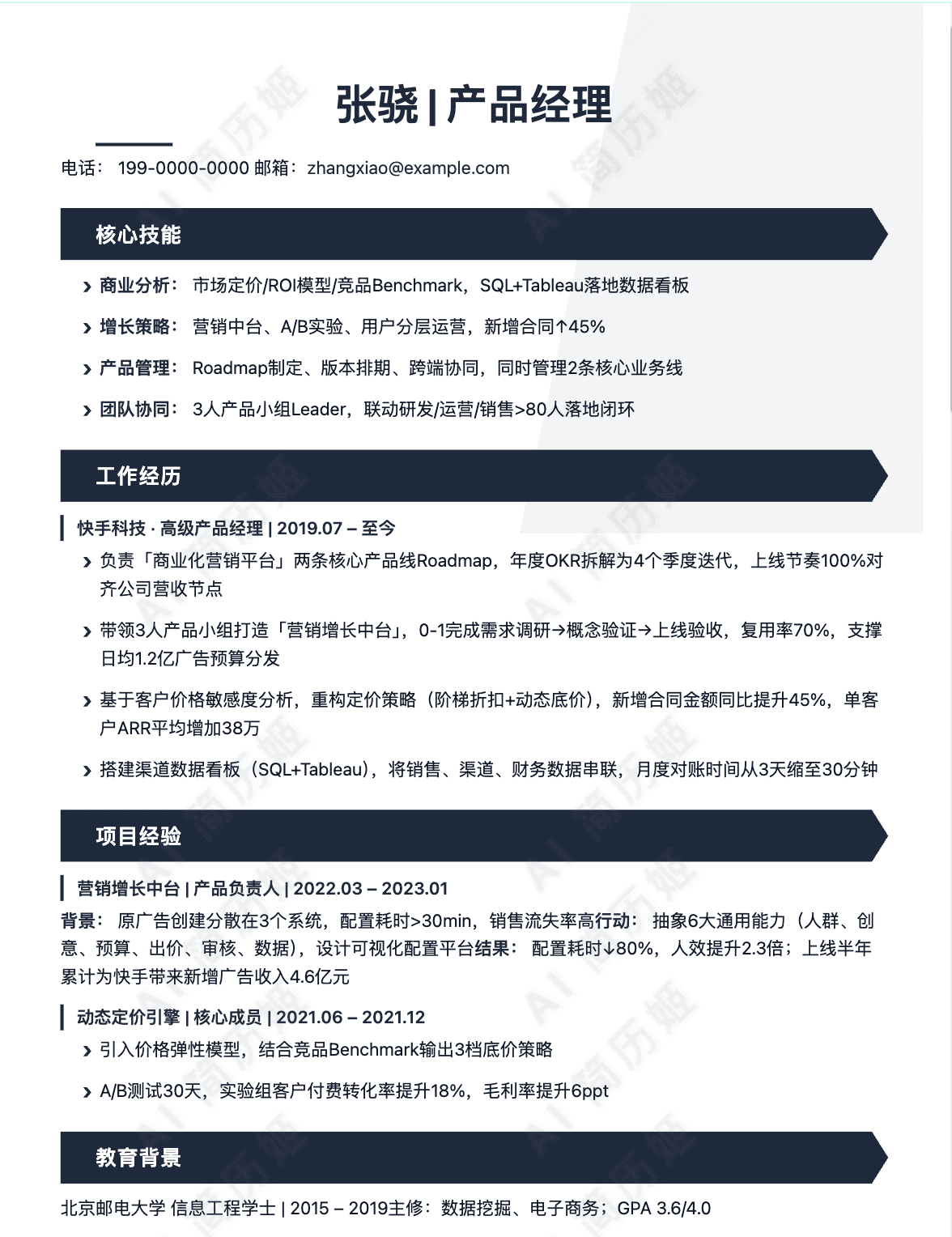
Here is a clear example of a well-formatted resume header and common mistakes to avoid.
One‑click format & basics check
Auto‑check contacts, links and layout; generate an ATS‑friendly header.
Write a Strong Marketing Manager Resume Summary or Objective
Summary vs. Objective: What's the Difference?
A resume summary is a brief, 2-4 sentence snapshot of your professional achievements, skills, and experience. It's designed for candidates who have a proven track record in their field. In contrast, a resume objective states your career goals and highlights your relevant skills and education. It's best suited for those new to the workforce, such as recent graduates, or those making a significant career change.
When to Use a Summary or an Objective
Your career level is the primary factor in deciding which to use. If you have more than two years of relevant marketing experience, you should always use a resume summary. It allows you to immediately showcase your value to a potential employer. If you are an entry-level candidate, a recent graduate, or changing careers, a resume objective is the appropriate choice. It focuses on your potential, ambition, and transferable skills rather than your professional history.
Key Elements to Include
Whether you write a summary or an objective, it must be packed with relevant keywords and concrete information. For a summary, lead with your years of experience, mention 2-3 core competencies (e.g., digital strategy, brand management, SEO/SEM), and include a quantifiable achievement that demonstrates your value. For an objective, state your career goal, mention your relevant degree or certifications, and highlight key skills or knowledge areas that align with the job.
Optimal Length and Structure
The ideal summary or objective is between 2-4 concise, powerful sentences. Recruiters often scan resumes quickly, so a dense block of text will be skipped. Use a structure that gets straight to the point: 1) Your professional title and years of experience (for a summary) or your goal (for an objective), 2) Your key skills and areas of expertise, and 3) A major accomplishment or statement of value.
How to Tailor It to the Job Posting
A generic summary or objective is a missed opportunity. To make a strong impression, carefully review the job description and mirror its language. Identify the most important keywords (e.g., "lead generation," "CRM management," "content strategy") and incorporate them naturally. If the job emphasizes "data-driven decision making," ensure your summary mentions your experience with analytics and reporting. This tailoring shows you've read the description and are a precise fit for the role.
Good Resume Summary Examples
Here are examples of strong, results-oriented summaries for experienced Marketing Managers.
Good Resume Objective Examples
These examples are ideal for entry-level candidates or career changers seeking a Marketing Manager role.
Bad Resume Summary and Objective Examples
Avoid these common mistakes that can cause your resume to be overlooked.
Why it's bad: Vague, focuses on what the candidate wants rather than what they offer, and uses clichés without providing any proof or specifics.
Why it's bad: This is a generic objective that could apply to anyone. It doesn't mention any specific skills, experience, education, or value for the employer.
Why it's bad: Uses unprofessional jargon ("guru," "wizard") and passive language ("responsible for"). It states a job duty but fails to showcase any measurable achievements or specific expertise.
Generate skills list / summary
Extract hard/soft skills from the JD and create 3 summary variants.
Include Your Best Hard and Soft Skills as a Marketing Manager
In the competitive field of marketing, your skills section is a strategic advertisement for your candidacy. It must convincingly showcase your ability to drive data-informed strategies while leading and inspiring teams. A well-crafted skills section clearly distinguishes between your technical, teachable abilities (hard skills) and your interpersonal, behavioral attributes (soft skills). This distinction helps hiring managers and applicant tracking systems (ATS) quickly identify you as a qualified and well-rounded leader.
Essential Hard Skills for a Marketing Manager
Hard skills are the specific, quantifiable abilities you've acquired through education, training, and experience. For a Marketing Manager, these are the technical competencies that prove you can execute campaigns, analyze performance, and manage budgets effectively. They are often the keywords that ATS are programmed to scan for.
Digital Marketing & Analytics: Search Engine Optimization (SEO) and Search Engine Marketing (SEM), Data Analysis and Interpretation (using Google Analytics, Tableau), Marketing Automation (using HubSpot, Marketo, Pardot), Customer Relationship Management (CRM) software (like Salesforce), Pay-Per-Click (PPC) Advertising (Google Ads, Microsoft Advertising).
Content & Channel Management: Content Management Systems (CMS) like WordPress, Social Media Marketing and Advertising (across Meta, LinkedIn, TikTok, etc.), Email Marketing (Klaviyo, Mailchimp).
Strategic & Business Acumen: Budget Management and Forecasting, A/B Testing and Conversion Rate Optimization (CRO), Market Research and Competitive Analysis.
Critical Soft Skills for a Marketing Manager
Soft skills are the personal attributes and interpersonal abilities that enable you to work effectively and harmoniously with others. For a manager, these are arguably as important as hard skills, as they dictate your leadership style, problem-solving approach, and ability to adapt to change.
Leadership: The ability to guide, motivate, and develop a team to achieve common goals.
Communication: Excellent verbal and written skills for presenting strategies, writing briefs, and collaborating with stakeholders.
Strategic Thinking: The capacity to see the big picture, anticipate market trends, and align marketing initiatives with broader business objectives.
Creativity & Problem-Solving: Innovating new campaign ideas and developing effective solutions to unforeseen challenges.
Adaptability: Thriving in a fast-paced environment and pivoting strategies quickly in response to data or market shifts.
How to Organize Your Skills Section
There are two primary ways to structure your skills section: a simple list or a categorized format. The categorized format is almost always more effective as it improves readability and scannability for hiring managers.
Good Example: Categorized Skills Section
Professional Skills
Digital Marketing & Analytics: SEO/SEM, Google Analytics 4, Google Ads, Meta Ads Manager, HubSpot, A/B Testing, Data Storytelling
Content & CRM: WordPress, Salesforce, Klaviyo, Social Media Strategy, Content Strategy
Management & Strategy: Budget Management, Market Research, Team Leadership, Strategic Planning, Cross-Functional Collaboration
Bad Examples: Common Mistakes to Avoid
Overly Vague List: Marketing, Social Media, Management, Microsoft Office, Communication. This lacks specificity and fails to demonstrate expertise with modern tools.
Unsubstantiated Claims: "Marketing Guru," "Social Media Wizard," "Proven Track Record." These are clichés. Instead, show your success with metrics in your experience section.
One Giant Paragraph: Listing all your skills in a single, dense block of text makes it difficult for a recruiter to quickly identify your key qualifications.
Matching Skills with Job Description Keywords
To maximize your resume's impact, you must tailor your skills section for each job application. Carefully read the job description and identify the specific hard and soft skills mentioned. Then, incorporate those exact keywords into your skills list.
AI‑assisted bullet quantification
Rewrite bullets using STAR/metrics and auto‑fill numbers and verbs to highlight impact.
Describe Your Work Experience and Key Projects as a Marketing Manager
Senior Marketing Manager | TechFlow Solutions | San Francisco, CA | Jan 2021 – Present
Marketing Manager | Bloom & Grow | Austin, TX | Mar 2018 – Dec 2020
Examples of Poor Work Experience Descriptions
Project experience quantifier
Split goals, actions and results; auto‑suggest metrics and format project cards.
Include Action Words to Make Your Marketing Manager Resume Pop
In a competitive job market, your resume needs to immediately capture a recruiter's attention and pass through an Applicant Tracking System (ATS). Generic phrases like "responsible for" or "helped with" are resume killers. They are vague, overused, and fail to convey your true impact. Using powerful, targeted action verbs at the beginning of each bullet point is a strategic way to demonstrate proactivity, quantify your achievements, and show the tangible value you brought to previous roles. Strong verbs make your accomplishments leap off the page and create a dynamic picture of you as a results-driven marketing leader.
Categories of Action Verbs for a Marketing Manager
To create a well-rounded and compelling resume, incorporate action words from various facets of the marketing manager role. This demonstrates a full spectrum of your capabilities, from strategic vision to hands-on execution.
Leadership & Management: Spearheaded, Orchestrated, Championed, Directed, Mentored, Mobilized, Headed, Supervised
Technical Implementation: Launched, Engineered, Executed, Deployed, Automated, Programmed, Optimized, Streamlined
Problem-Solving: Resolved, Remedied, Revitalized, Overhauled, Rectified, Troubleshot, Mitigated
Collaboration: Partnered, Aligned, Fostered, Liaised, Unified, Coordinated, Synergized
Achievement & Impact: Accelerated, Amplified, Boosted, Maximized, Capitalized, Grew, Expanded
Analysis & Research: Analyzed, Audited, Diagnosed, Evaluated, Assessed, Forecasted, Validated
Innovation: Pioneered, Conceptualized, Innovated, Transformed, Modernized, Revamped, Initiated
Avoiding Repetition and Choosing the Right Verb
A common mistake is finding one strong verb, like "managed," and using it for every bullet point. This dilutes its power and suggests a limited range of experience. To avoid this, read each bullet point and ask yourself, "What was the *essence* of that accomplishment?" Did you fix a broken process (Revitalized), create something from nothing (Pioneered), or work with another team to succeed (Partnered)? By matching the verb to the specific nature of the achievement, you create a more nuanced and impressive narrative of your career.
Before and After: Transforming Your Resume Bullets
See how replacing weak, passive language with powerful action verbs and quantifiable results transforms a resume from mediocre to exceptional.
Weak: Was responsible for social media campaigns.
Strong: Orchestrated a multi-channel social media campaign that increased engagement by 45%.
Weak: Helped with the launch of a new product.
Strong: Spearheaded the end-to-end launch of Product X, resulting in $2M in first-quarter revenue.
Weak: In charge of a team of marketing coordinators.
Strong: Mentored and led a 5-person marketing team, boosting team productivity by 20%.
Weak: Did an analysis of website traffic.
Strong: Analyzed web analytics to diagnose funnel drop-off, leading to a 15% increase in conversion rate.
Weak: Worked on improving the email marketing strategy.
Strong: Revitalized the email marketing strategy by implementing A/B testing, which amplified open rates by 30%.
Weak: Used SEO to get more visitors.
Strong: Optimized on-page and technical SEO, which grew organic traffic by 60% year-over-year.
Examples of Strong Action Verbs in Context
Here are complete resume bullet points that effectively utilize powerful action verbs to showcase a marketing manager's impact.
Pioneered a new account-based marketing (ABM) program, resulting in a 25% increase in qualified leads from target enterprise accounts.
Streamlined the content creation workflow by implementing a new project management tool, reducing campaign launch time by 10 days.
Forged a strategic partnership with an industry influencer, amplifying brand reach to an audience of over 1 million.
Diagnosed underperformance in the paid ad budget and reallocated spend, boosting ROI by 35% within one quarter.
3 summary versions in seconds
Combine role highlights and strengths to generate concise, confident and specific summaries.
Make Your Education Section Count
Your education section is more than just a formality; it's a chance to showcase your foundational knowledge and academic achievements. For a Marketing Manager, this section should be tailored to highlight the skills and credentials most relevant to the role, whether you're a recent graduate or a seasoned professional.
What to Include in Your Education Section
At a minimum, your education entry should be clear and easy to scan. Always include the following for each degree:
Degree: e.g., Bachelor of Science, Master of Business Administration (MBA)
Major: e.g., Marketing, Business Administration, Communications
University: The full name of the institution and its location.
Graduation Date: Use the month and year (e.g., May 2020). If you are a current student, you can list your expected graduation date.
Placement: Top or Bottom of the Resume?
Where you place your education section depends heavily on your level of professional experience.
Place it at the TOP if: You are a recent graduate (within the last 1-3 years) or have limited work experience in marketing. Your degree is currently your most significant and relevant qualification.
Place it at the BOTTOM if: You have several years of relevant marketing experience. Your work achievements and proven track record will be more compelling to a hiring manager than your academic history.
Including Relevant Coursework
Listing relevant coursework is highly recommended for entry-level candidates or those transitioning into marketing from another field. It demonstrates you have studied the core principles of the discipline.
Relevant Coursework: Consumer Behavior, Digital Marketing Strategy, Market Research & Analytics, Brand Management, Marketing Communications
Guidelines for Including Your GPA
Your Grade Point Average (GPA) can be a valuable data point, but only if it strengthens your candidacy.
Include your GPA if: You graduated within the last three years and have a GPA of 3.5 or higher on a 4.0 scale. You can list your cumulative GPA or your major-specific GPA if it is significantly higher.
Omit your GPA if: It is below 3.5, you graduated more than three years ago, or you have substantial work experience. At that point, your professional accomplishments are far more important.
Highlighting Honors, Awards, and Scholarships
Academic honors and awards provide third-party validation of your hard work and intellect. Don't be shy about including them.
Honors: summa cum laude, Dean's List (All Semesters 2019-2021), Beta Gamma Sigma Honor Society
Awards & Scholarships: University Marketing Excellence Award, National Merit Scholarship
Showcasing Projects and Thesis Work
For recent graduates, a relevant academic project or thesis can serve as a powerful substitute for professional experience. Describe it using action-oriented language, just as you would a job.
Senior Thesis Project: "Developed and presented a comprehensive go-to-market strategy for a hypothetical product launch, including a full competitive analysis, target audience personas, and a multi-channel marketing plan with a $500,000 simulated budget."
Good Education Section Examples
Example 1: Recent Graduate
Master of Science in Marketing
Northwestern University, Medill School of Journalism, Media, Integrated Marketing Communications – Evanston, IL
Graduated: May 2023 | GPA: 3.8/4.0
Honors: Dean's List, Medill Merit Scholarship
Relevant Coursework: Digital & Social Media Marketing, Marketing Analytics, Brand Development, Content Strategy
Thesis: "The Impact of Micro-Influencer Authenticity on Gen Z Purchasing Decisions"
Example 2: Experienced Professional
Master of Business Administration (MBA)
University of Michigan, Ross School of Business – Ann Arbor, MI
Bachelor of Arts in Communications
University of California, Los Angeles – Los Angeles, CA
Certifications: Google Analytics Certified, HubSpot Content Marketing Certified
Bad Education Section Examples
Bad Example 1: Vague and Lacking Detail
Went to college in Boston. Studied business. Graduated a few years ago.
Bad Example 2: Including Irrelevant or Poor Information
B.A. in Medieval Literature
Random University – Anytown, USA
Graduated: 2015 | GPA: 2.3
Relevant Coursework: Poetry of the 14th Century, Advanced Latin
Bad Example 3: Poor Formatting and Typos
edjucation: bachlors degree in mArketing from state univercity. dates: 2019-2022. gpa: 2.9
Bad Example 4: Cluttered and Hard to Read
University of Texas at Austin - Bachelor of Business Administration in Marketing, Minor in Psychology, Graduated May 2018, GPA 3.4, Dean's List Spring 2017, Member of Marketing Club, Studied abroad in Spain, Relevant Courses: Marketing Research, Consumer Behavior, International Marketing, Strategic Management, Business Finance, Organizational Behavior
Auto‑format education & certifications
Normalize titles, dates and bullets — ATS‑safe by default.
Select the Perfect Extra Sections for Your Marketing Manager Resume
While your core resume sections—like work experience and education—form the foundation, strategic extra sections can be the deciding factor that lands you an interview. These optional components allow you to showcase a unique blend of skills, industry engagement, and personal drive that sets you apart from other qualified candidates. The key is to be selective and include only those sections that add tangible value and relevance to your application.
Recommended Extra Sections to Elevate Your Resume
Carefully consider which of these sections align with your career level, the specific job you're targeting, and the story you want to tell about your professional profile.
1. Technical Projects
This section is ideal for entry-level candidates, career changers, or any marketer looking to demonstrate hands-on technical and analytical prowess. Use it to detail projects where you built a website, executed an A/B testing campaign, managed a CRM migration, or developed an automation workflow. For each project, briefly describe the goal, the specific tools you used (e.g., Google Analytics, SQL, HubSpot, WordPress), and the measurable outcome. This provides concrete proof of your ability to execute beyond theory.
2. Publications & Speaking Engagements
This is a powerful section for senior-level Marketing Managers and Directors aiming to establish thought leadership and industry authority. List articles you've published in reputable industry blogs, journals, or magazines, including the publication name and date. For speaking engagements, include the conference or event name, the title of your presentation, and the date. This demonstrates your ability to influence the wider marketing community and positions you as a respected expert in your field.
3. Languages
In today's global economy, fluency in additional languages is a significant asset. Include this section if you are proficient in another language, especially if the role involves international markets, diverse teams, or multilingual campaigns. Clearly state your proficiency level (e.g., Native, Fluent, Professional Working Proficiency, Limited Working Proficiency). Only include languages in which you have a functional business ability, as you may be tested during the interview process.
4. Professional Affiliations
Listing memberships in professional organizations (e.g., American Marketing Association, Product Marketing Alliance, Social Media Examiner) shows a genuine commitment to your career and a dedication to staying current with industry trends. It also provides valuable networking opportunities. Simply list the organization's name and, if applicable, your membership level or any leadership roles you've held within the group.
5. Volunteer Experience
Volunteer experience can be a valuable addition if it demonstrates leadership, project management, or skills relevant to the marketing role you are seeking. For example, managing the social media for a non-profit or organizing a fundraising campaign directly relates to marketing competencies. If the experience is not directly relevant, it can still showcase positive character traits, but it should be prioritized lower than other sections.
How to Format Additional Sections Professionally
Consistency is crucial for a professional appearance. Format these sections with the same clean, reverse-chronological structure you use for your work experience. For each entry, include a clear title, the organization or platform name, dates of involvement, and a brief, impactful bullet point or description of the accomplishment or role. Ensure the formatting—such as fonts, spacing, and alignment—matches the rest of your resume for a seamless and polished document.
Sections to AVOID on Your Marketing Manager Resume
Knowing what to exclude is just as important as knowing what to include. Avoid cluttering your resume with irrelevant or personal information that does not contribute to your candidacy.
References Available Upon Request: This is considered outdated and wastes valuable space. Employers assume you will provide references if asked.
An "Hobbies" or "Interests" Section: Generally, avoid this unless a hobby demonstrates a skill directly relevant to the job (e.g., competitive data analysis for a analytics role, photography for a content creation role).
Personal Information: Do not include your marital status, age, religious or political affiliations, or a photograph. Including this information can lead to unconscious bias and is often discouraged by hiring laws in many countries.
An "Objective" Statement: For a Marketing Manager, a resume summary or professional profile is far more effective. An objective focuses on what you want, while a summary showcases what you can offer the company.
Irrelevant or Dated Certifications/Awards: Only include certifications and awards that are current and reinforce your marketing expertise. An outdated software certification or a high school award has no place on a professional manager's resume.
Pitfalls check
Detect formatting/wording pitfalls and suggest instant rewrites and formatting.
How to Tailor Your Marketing Manager Resume for a Specific Job Description
In today's competitive job market, a generic, one-size-fits-all resume is unlikely to capture a hiring manager's attention. Tailoring your Marketing Manager resume for a specific job description is the single most effective strategy to land an interview. This process involves aligning your skills, experiences, and achievements directly with the company's stated needs, demonstrating that you are the ideal solution to their challenges.
Reading and Analyzing Job Descriptions Effectively
The first step is to move beyond a quick skim and conduct a deep analysis of the job description. Read it at least twice. On the first pass, get a general sense of the role, company culture, and overall objectives. On the second pass, actively deconstruct it. Look for the "why" behind the role—what business problem are they trying to solve? Are they launching a new product, entering a new market, or reviving a stagnant brand? Understanding this context allows you to frame your experience more strategically.
Identifying Key Requirements and Qualifications
As you analyze the description, create two lists: "Must-Haves" and "Nice-to-Haves." Must-haves are the non-negotiable qualifications, such as "8+ years of marketing experience" or "Proven expertise in SEO/SEM." Nice-to-haves are desirable skills that can give you a competitive edge, like "Experience with Marketing Automation Platform X" or "Background in the B2B SaaS industry." Pay close attention to action verbs and repeated keywords, as these are clues to what the hiring manager values most.
Matching Your Experience to Job Requirements
With the key requirements identified, it's time to perform a gap analysis against your own career history. For each requirement listed, find a corresponding accomplishment or responsibility from your past roles. Don't just list your duties; reframe your achievements to mirror the language and focus of the job description. If they need someone to "grow market share," highlight a bullet point where you "Increased market share by 15% in 12 months through a targeted competitive campaign."
Customizing Resume Summary and Keywords
Your professional summary is the first thing a recruiter reads, so it must be customized. Incorporate the job title, the company's name, and 2-3 of the most critical "must-have" skills or objectives mentioned in the description. Furthermore, strategically sprinkle relevant keywords throughout your resume, especially in the skills and experience sections. This not only shows a strong fit for a human reader but also helps your resume pass through Applicant Tracking Systems (ATS).
Avoiding Over-Tailoring or Misrepresenting Skills
While tailoring is crucial, authenticity is paramount. Avoid the temptation to over-tailor by fabricating experiences or skills you don't possess. This will be uncovered in the interview stage and will immediately disqualify you. The goal is to highlight the most relevant parts of your genuine experience, not to create a fictional candidate. Focus on framing your existing accomplishments in the most compelling light for this specific opportunity.
A Step-by-Step Process for Tailoring Your Resume
Follow this simple, three-step process to efficiently tailor your application for every job.
Step 1: Analyze the Job Description
Deconstruct the job description by highlighting all action verbs, required skills, software, and qualifications. Note the company's tone and any mentioned challenges or goals. This forms the blueprint for your tailored resume.
Step 2: Map Your Experience
Go through your master resume and identify every bullet point, project, and skill that aligns with the highlighted elements from Step 1. Create a new document and only bring over the most relevant content, rephrasing it to echo the job description's language.
Step 3: Customize Key Sections
Rewrite your professional summary to be a direct response to the job ad. Then, ensure your "Key Skills" section is a near-perfect match for the required and preferred qualifications. Finally, edit your "Professional Experience" bullet points to lead with your most relevant achievements.
Example: Generic vs. Tailored Resume
Here is a practical example showing how a generic resume bullet point can be transformed into a powerful, tailored one.
Job Description Requirement: "Seeking a Marketing Manager to develop and execute multi-channel marketing campaigns to drive lead generation and increase brand awareness."
Generic Resume Bullet (Before):
• Managed marketing campaigns.
Tailored Resume Bullet (After):
• Developed and executed a multi-channel campaign (email, social, PPC) that generated over 2,500 qualified leads and increased brand awareness by 30% within one quarter.
Common Mistakes to Avoid in Resume Tailoring
Many qualified candidates undermine their own applications by making these common errors:
• Keyword Stuffing: Irresponsibly loading your resume with keywords in a way that hurts readability.
• Submitting the Same Resume Everywhere: Failing to customize for different roles or companies.
• Ignoring the Company's "Voice": Using formal language for a creative startup or casual language for a corporate giant.
• Forgetting to Proofread: Introducing typos or company name errors after customization, which shows a lack of attention to detail.
• Hiding Your Greatest Achievements: Burying your most relevant accomplishments deep within the resume instead of featuring them prominently.
Pick the right template and apply
Recommend templates by industry and seniority; auto‑map existing content.
Marketing Manager Resume Examples (Complete Samples)
Apply example in one click
Pick an example and auto‑adapt to your experience and skills.
Frequently Asked Questions (FAQ)
How long should a Marketing Manager resume be?
For most Marketing Managers, a one-page resume is ideal if you have less than 10 years of experience. If you have an extensive career history with numerous relevant achievements, a second page is acceptable. The key is to be concise and only include the most impactful information to hold the recruiter's attention.
What's the best format for a Marketing Manager resume?
The reverse-chronological format is highly recommended as it clearly showcases your career progression and recent accomplishments. A hybrid format, which blends chronological experience with a strong skills section, is also effective. Avoid functional resumes, as they can raise red flags about employment gaps.
Should I include a photo on my Marketing Manager resume?
No, you should not include a photo on your resume in the US, Canada, or UK to avoid potential bias and comply with equal opportunity employment standards. Your skills and experience should be the sole focus. In some other countries, it may be customary, so always research local norms.
What are the most important skills to include on a Marketing Manager resume?
Focus on a mix of hard and soft skills. Essential hard skills include Digital Marketing (SEO/SEM, email marketing, social media analytics), CRM platforms (like HubSpot or Salesforce), and data analysis. Critical soft skills are leadership, strategic planning, communication, and cross-functional collaboration.
Should I list certifications on my Marketing Manager resume?
Yes, relevant certifications can significantly strengthen your resume. Include certifications like Google Analytics, Google Ads, HubSpot Inbound Marketing, Facebook Blueprint, or a PMP. Place them in a dedicated "Certifications" section or within your "Skills" summary for high visibility.
How do I describe my work experience without just listing duties?
Use the Challenge-Action-Result (CAR) method to frame your experience. For each bullet point, describe a challenge you faced, the specific actions you took, and the quantifiable results you achieved. For example: "Developed and executed a new social media strategy (Action) that increased lead generation by 25% in 6 months (Result)."
How many years of work history should I include?
Generally, include the last 10-15 years of relevant work experience. This provides a strong, modern snapshot of your expertise. For roles from early in your career that are no longer relevant, you can summarize them or omit them entirely to save space and maintain focus.
Should I include projects on my Marketing Manager resume?
Absolutely. A dedicated "Key Projects" or "Campaign Highlights" section is excellent for showcasing specific, high-impact initiatives. This is particularly useful if you've led successful product launches, rebranding efforts, or major digital campaigns that demonstrate strategic thinking and execution.
How do I write a Marketing Manager resume with no direct experience?
Focus on transferable skills from other roles, such as project management, data analysis, or communication. Create a strong summary that highlights your marketing aptitude and feature a "Projects" section detailing relevant academic, volunteer, or freelance work. Emphasize your education and any marketing certifications.
Should I include my GPA on my Marketing Manager resume?
Only include your GPA if you are a recent graduate (within the last 3 years) and it is 3.5 or higher. For experienced Marketing Managers, your professional accomplishments far outweigh your academic performance, so it's best to remove your GPA to free up valuable space.
What if I'm changing careers to become a Marketing Manager?
Use a hybrid resume format with a powerful professional summary that clearly states your career transition objective. Highlight transferable skills like budget management, team leadership, and strategic planning from your previous career. Supplement your experience with relevant marketing projects and certifications to build credibility.
How should I handle an employment gap on my resume?
Be transparent but positive. You can list the reason for the gap (e.g., "Career Break for Family" or "Professional Development") as its own line item. Use that time to highlight any relevant activities you undertook, such as freelance work, volunteering, online courses, or certifications that kept your skills sharp.