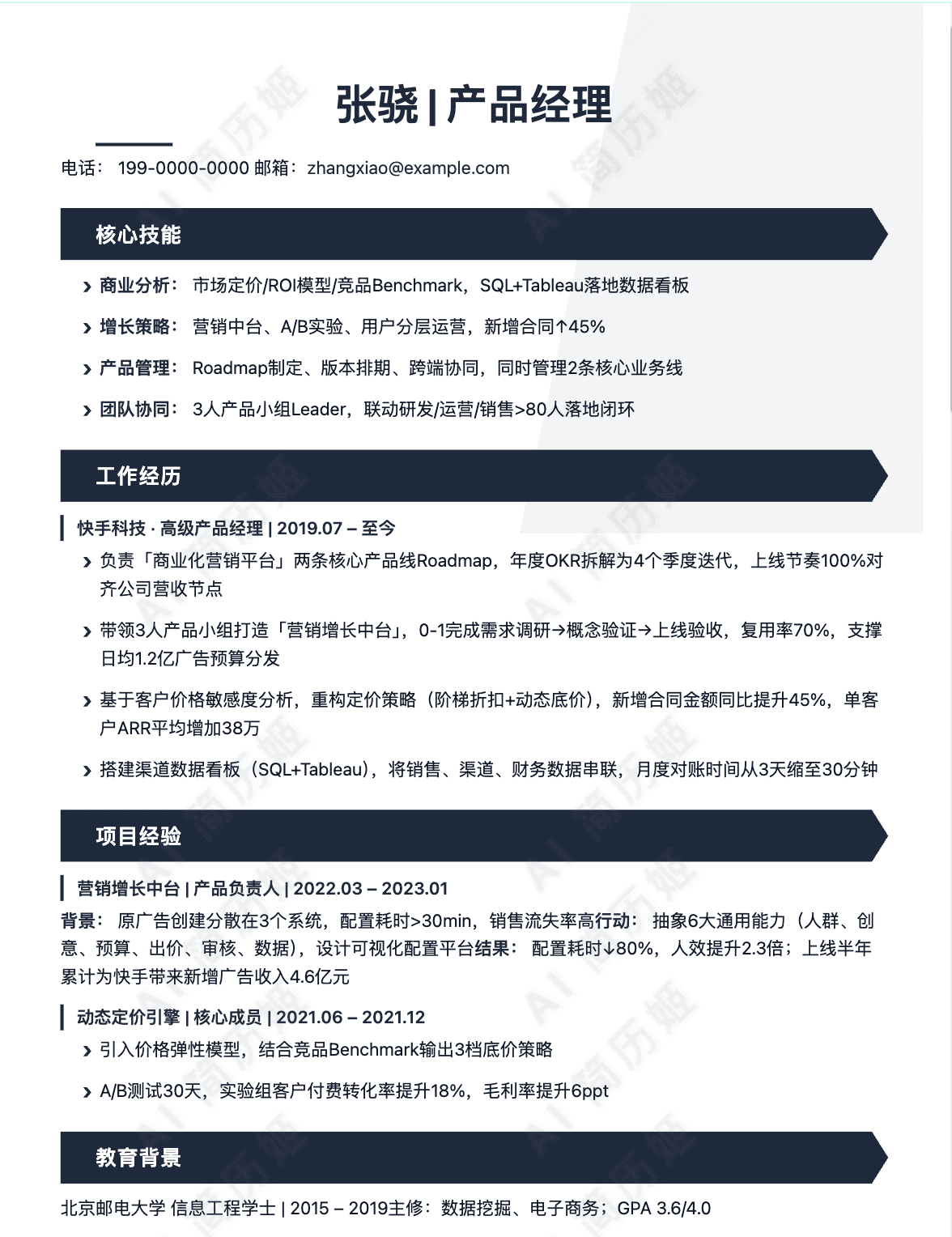
Properly Format Your Product Manager Resume
A well-structured resume is your first product deliverable to a hiring manager. It demonstrates your ability to organize information logically, prioritize key details, and present a clear, compelling narrative. Proper formatting ensures your achievements are easily scannable and makes a strong professional impression.
Resume Length: The One-Page Rule
For most Product Managers, a one-page resume is the standard and expected format. It forces you to be concise and highlight only your most impactful achievements. A two-page resume may be acceptable if you have over 10-15 years of highly relevant experience, but it must be exceptionally compelling and well-organized. Recruiters spend an average of just a few seconds on an initial scan, so brevity is critical.
Recommended Resume Formats
Product management is a role built on a track record of success. The chronological format is the most widely accepted and ATS-friendly choice because it emphasizes your career progression and work history.
- Chronological: Lists your work experience in reverse-chronological order. This is the highly recommended format for Product Managers.
- Functional: Focuses on skills rather than work history. Not recommended as it can raise red flags about employment gaps.
- Combination/Hybrid: Blends chronological and functional, starting with a skills summary. This can be effective for career changers but should still include a clear chronological work history.
Font, Margins, and Spacing Standards
Your resume should be clean, professional, and easy to read. Consistency is key to a polished look.
- Fonts: Use a professional, sans-serif font like Calibri, Arial, or Helvetica. Serif fonts like Garamond or Georgia are also acceptable. Font size should be between 10-12 points for body text, with your name slightly larger.
- Margins: Set margins to 0.5" to 1" on all sides. This maximizes space while keeping the document from looking cramped.
- Spacing: Use white space strategically to separate sections and improve readability. Ensure spacing before and after headings and between bullet points is consistent throughout the document.
File Format: Always PDF
Always save and send your resume as a PDF file (.pdf). This preserves your formatting across different devices and operating systems, ensuring that every hiring manager sees the resume exactly as you designed it. A Word document (.docx) can have its formatting altered when opened on another computer.
ATS (Applicant Tracking System) Optimization
Most companies use Applicant Tracking Systems (ATS) to screen resumes before they ever reach a human. To get past this digital gatekeeper:
- Use Standard Section Headings: Use common headings like "Work Experience," "Skills," and "Education." Avoid creative titles like "My Journey" or "Where I've Been."
- Incorporate Keywords: Carefully review the job description and mirror its language. If it asks for "roadmap prioritization," "A/B testing," and "Stakeholder Management," ensure those exact phrases are in your resume.
- Avoid Graphics and Columns: Tables, columns, images, and graphics often get parsed incorrectly by an ATS, scrambling your information. Keep the layout simple.
Good Resume Header Example
JANE DOE
Product Manager | Strategy & Growth
(123) 456-7890 | jane.doe@email.com | linkedin.com/in/janedoe | github.com/janedoe
Common Formatting Mistakes to Avoid
- Using an unprofessional email address like `productguru123@email.com`.
- Inconsistent use of bold, italics, or underlining, making the resume visually chaotic.
- Including personal information like marital status, age, or a photograph, which is not standard in many regions and can introduce bias.
One‑click format & basics check
Auto‑check contacts, links and layout; generate an ATS‑friendly header.
Write a Strong Product Manager Resume Summary or Objective
The resume summary or objective is the first substantive section a recruiter reads. It's your 15-second elevator pitch to capture their attention and convince them you are a compelling candidate. A well-crafted opening can be the difference between landing an interview and being passed over.
Resume Summary vs. Objective: What's the Difference?
A resume summary is a brief, 2-4 sentence snapshot of your professional experience, key skills, and major accomplishments. It's designed for candidates with relevant work experience in the field.
A resume objective, on the other hand, states your career goals and explains what you aim to achieve in the role you're applying for. It's best suited for those new to the workforce, career changers, or recent graduates.
When to Use a Summary vs. an Objective
Use a Resume Summary if: You have one or more years of direct Product Management experience, or significant transferable experience in a related role (e.g., Project Management, Business Analysis, Engineering). The summary should focus on your proven track record.
Use a Resume Objective if: You are an entry-level candidate, a recent graduate, or transitioning from a different career. The objective should focus on your relevant skills, education, and enthusiasm, while clearly stating your career goal.
Key Elements to Include
Regardless of whether you choose a summary or objective, it must be packed with value. Include these key elements:
Years of Experience: Quantify your experience immediately (e.g., "8+ years," "Seasoned professional").
Core Competencies: Mention 2-3 key PM skills relevant to the job, such as "product strategy," "roadmap prioritization," "Agile methodologies," "data-driven decision-making," or "user story creation."
Value Proposition & Metrics: This is the most critical part. Briefly state what you have achieved, using numbers to prove your impact. Think in terms of revenue growth, cost reduction, user engagement, or efficiency gains.
Optimal Length and Structure
Your summary or objective should be a tight, scannable paragraph of 2 to 4 concise sentences. Recruiters spend mere seconds on an initial scan, so every word must count. Avoid fluff and focus on hard facts and keywords from the job description.
How to Tailor It to the Job Posting
A generic summary is a missed opportunity. Carefully review the job description and identify keywords related to required skills, technologies, and responsibilities. Then, mirror that language in your summary. If the job emphasizes "Go-to-Market strategy" and "A/B testing," ensure those terms are featured in your text.
Good Resume Summary Examples
Here are examples of strong, results-oriented summaries for experienced professionals:
Good Resume Objective Examples
Here are examples of effective objectives for those with less direct experience:
Bad Resume Summary & Objective Examples
Avoid these common mistakes that can cause your resume to be quickly dismissed.
Why it's bad: This is generic, cliché, and provides zero substance. It doesn't mention experience, skills, or any measurable value. It's all about what the candidate wants, not what they can offer.
Why it's bad: The language is vague and unprofessional ("for a while," "many things," "successful"). It lacks specific metrics, concrete skills, and confident action verbs. It fails to demonstrate impact.
Why it's bad: This objective is entirely self-serving. It focuses on what the company can do for the candidate (salary, benefits, title) rather than how the candidate can contribute to the company's success.
Generate skills list / summary
Extract hard/soft skills from the JD and create 3 summary variants.
Include Your Best Hard and Soft Skills as a Product Manager
A compelling skills section is a critical component of a Product Manager's resume. It serves as a quick-reference guide for recruiters, highlighting your qualifications and demonstrating your fit for the role. Effectively showcasing a blend of hard (technical, teachable) and soft (interpersonal, behavioral) skills proves you have both the tactical expertise and the leadership qualities necessary for success.
Hard Skills vs. Soft Skills
Hard Skills are the specific, teachable abilities and knowledge sets required for the job. They are often technical and measurable. For a Product Manager, these include competencies in data analysis, prototyping, and understanding technical architecture.
Soft Skills are the interpersonal attributes and personality traits that determine how you work and interact with others. They are harder to quantify but are equally vital for leading cross-functional teams, negotiating priorities, and understanding user needs.
Essential Hard Skills for a Product Manager
Your hard skills should reflect the end-to-end product lifecycle. Here are 8-12 role-specific technical skills and tools to consider:
1. Product Strategy & Roadmapping (e.g., Aha!, Productboard, Roadmunk)
2. Data Analysis & A/B Testing (e.g., SQL, Google Analytics, Amplitude, Optimizely)
3. Market & User Research (e.g., User Interviews, Surveys, Competitor Analysis)
4. Prototyping & Wireframing (e.g., Figma, Sketch, Balsamiq, InVision)
5. Agile & Scrum Methodologies (e.g., Jira, Confluence, Trello, Asana)
6. Financial Modeling & Business Case Development (e.g., Excel, Financial Forecasting)
7. Technical Acumen (e.g., APIs, Databases, System Architecture)
8. Metrics & KPIs (e.g., Defining and tracking OKRs, North Star Metric, LTV, CAC)
9. Prioritization Frameworks (e.g., RICE, WSJF, Value vs. Effort)
10. Go-to-Market (GTM) Strategy & Product Launch
11. Writing User Stories & Acceptance Criteria
12. Customer Development & Journey Mapping
Relevant Soft Skills for a Product Manager
While hard skills get your foot in the door, soft skills often seal the deal. Highlight 4-6 of the most critical ones:
1. Leadership & Influence (without direct authority)
2. Communication (Written & Verbal)
3. Empathy & User-Centric Mindset
4. Critical Thinking & Problem-Solving
5. Collaboration & Stakeholder Management
6. Prioritization & Decision-Making
How to Organize Your Skills Section
A categorized format is far more effective than a simple list. It helps recruiters quickly find the skills they are looking for and presents your qualifications in a structured, digestible manner.
Product Manager Skills
Product Strategy & Analysis: A/B Testing, Data Analysis (SQL, Amplitude), Market Research, Competitive Analysis, Financial Modeling, KPI Definition, Product Roadmapping (Aha!), Go-to-Market Strategy
Technical & Development: Agile & Scrum (Jira, Confluence), APIs, Technical Acumen, User Stories & Acceptance Criteria, Prototyping (Figma)
Leadership & Collaboration: Cross-Functional Leadership, Stakeholder Management, Prioritization Frameworks (RICE), User Empathy, Strategic Communication, Conflict Resolution
Skills
SQL, Jira, Communication, Leadership, Figma, Data Analysis, Problem Solving, Agile, Roadmapping, Teamwork, Scrum, Prioritization
Matching Skills with Job Description Keywords
Carefully review the job description and mirror its language. If the description emphasizes "data-driven decision making," use that exact phrase and list relevant tools like "SQL" and "Amplitude." This not only shows you are a good fit but also helps your resume pass through Applicant Tracking Systems (ATS) that scan for specific keywords.
Job Description Asks For: "Experience driving product strategy based on user research and data analysis."
Your Skills Section Includes: "Data-Driven Decision Making (SQL, A/B Testing), User Research (User Interviews, Survey Design), Product Strategy & Roadmapping"
Job Description Asks For: "Expert in Agile methodologies and leading Scrum ceremonies."
Your Skills Section Includes: "Agile, Scrum" (This is too vague and doesn't demonstrate expertise or leadership.)
AI‑assisted bullet quantification
Rewrite bullets using STAR/metrics and auto‑fill numbers and verbs to highlight impact.
Describe Your Work Experience and Key Projects as a Product Manager
Your work experience section is the core of your product manager resume. It should tell a compelling story of your career progression, impact, and the value you've delivered. Use strong action verbs, quantify your achievements, and structure your bullet points using frameworks like CAR (Challenge-Action-Result) or STAR (Situation-Task-Action-Result) to demonstrate your problem-solving skills.
How to Structure Your Work Experience
For each position, use a clear and consistent header format. List your experiences in reverse chronological order, starting with your most recent role. For each bullet point, focus on what you accomplished, not just your responsibilities. Use metrics to provide concrete evidence of your success.
Good Work Experience Examples
Senior Product Manager | TechFlow Inc. | San Francisco, CA | Jan 2021 - Present
Spearheaded the "Project Nexus" initiative to overhaul the user onboarding flow, addressing a 70% drop-off rate in the first week; resulted in a 40% increase in user activation and a 25% reduction in churn within 6 months. Defined and prioritized a new data analytics feature set based on extensive user research and competitive analysis; drove $2.5M in new ARR in its first year and became a key differentiator in enterprise sales cycles. Managed a cross-functional team of 15 engineers and designers, implementing agile processes that increased team velocity by 20% and improved feature predictability. Championed a customer-centric roadmap by integrating NPS and CSAT feedback, leading to a 15-point increase in overall product satisfaction score.
Product Manager | DataSolve Corp. | Austin, TX | Mar 2018 - Dec 2020
Identified a market gap for real-time collaboration and initiated "Project Synergy"; shipped the feature 2 months ahead of schedule, capturing 15% of a new market segment and securing three major enterprise contracts. Optimized the pricing and packaging model for the core product, introducing a new tier that increased conversion rates from free to paid by 30%. Acted as the product lead for a key integration with Salesforce; the launch contributed to a 50% increase in up-sell opportunities for the sales team.
Associate Product Manager | StartupGrid | Remote | Jun 2016 - Feb 2018
Conducted A/B tests on the landing page and sign-up process, leading to copy and UI changes that improved free trial conversion by 18%. Analyzed user behavior data to identify key friction points in the mobile app; proposed and shipped UX improvements that reduced support tickets by 35%. Managed the backlog for the mobile development squad, ensuring 100% of committed stories were delivered per sprint for 6 consecutive quarters.
Bad Work Experience Examples
Avoid these common pitfalls: using weak language, listing only responsibilities, being vague, and failing to show impact.
Responsible for the product roadmap. (This is a duty, not an achievement. What did you *do* with the roadmap?)Worked with engineering and design teams. (Too vague. How did you work with them? What was the outcome of that collaboration?)Helped improve user engagement. (Weak action verb and no quantification. By how much? What did you specifically do to "help"?)Launched several new features. (Which features? Why did they matter? What was their impact on the business or user?)Was in charge of a product that made money. (Unprofessional language and lacks any specific, quantifiable result.)
Highlighting Key Projects Within Your Experience
Integrating key projects directly into your work experience bullet points is the most effective method. It provides context and shows how your initiatives contributed to your role's overall impact. Use the project name as a natural part of the CAR/Story narrative.
Example from the Senior PM role above:
This approach clearly links the project ("Project Nexus") to a specific challenge (70% drop-off), your action (overhauling the flow), and a quantifiable result (40% increase in activation).
Project experience quantifier
Split goals, actions and results; auto‑suggest metrics and format project cards.
Include Action Words to Make Your Product Manager Resume Pop
In a competitive job market, your resume needs to immediately capture a recruiter's attention and pass through an Applicant Tracking System (ATS). Action verbs are the engine that drives your resume, transforming it from a passive list of duties into a dynamic story of your accomplishments. Using strong, targeted verbs helps you stand out, demonstrates proactivity, and quantifiably showcases the impact you've made.
Why Action Verbs Are Critical for Your PM Resume
Action verbs serve two crucial purposes. First, they are essential for ATS optimization. These systems are programmed to scan for keywords that indicate competence and experience; weak, generic language can cause your resume to be filtered out. Second, for the human recruiter or hiring manager who spends mere seconds on an initial scan, powerful verbs like "orchestrated" or "spearheaded" create a much stronger impression of leadership and results than "was responsible for." They make your achievements pop off the page.
Categories of Action Verbs for Product Managers
To create a well-rounded and compelling resume, incorporate action verbs from these key functional areas relevant to product management.
Leadership & Management
These verbs demonstrate your ability to guide a product and a team from vision to reality. Use them to describe your experience in driving strategy and leading cross-functional efforts.
Charted, Championed, Directed, Orchestrated, Spearheaded, Galvanized, Piloted, Governed, Mobilized, Steered
Technical Implementation
Showcase your hands-on role in the product development lifecycle and your ability to work effectively with engineering teams.
Architected, Engineered, Integrated, Optimized, Streamlined, Automated, Debugged, Modeled, Scaled, Synthesized
Problem-Solving
Highlight your analytical skills and your capacity to overcome challenges and turn obstacles into opportunities.
Diagnosed, Remedied, Resolved, Reconciled, Simplified, Deciphered, Rectified, Troubleshot, Overhauled, Corrected
Collaboration
Emphasize your soft skills and your ability to work across departments to align stakeholders and build consensus.
Aligned, Fostered, Liaised, Partnered, Synergized, Unified, Mediated, Coordinated, Bridged, Facilitated
Achievement & Impact
This is where you prove your value. Use these powerful verbs to lead into your quantifiable results and business outcomes.
Accelerated, Amplified, Boosted, Capitalized, Drove, Expanded, Maximized, Slashed, Yielded, Grew
Analysis & Research
Demonstrate your data-driven and user-centric decision-making process by detailing how you gather and interpret information.
Analyzed, Validated, Quantified, Assessed, Interpreted, Mined, Audited, Surveyed, Benchmarked, Forecasted
Innovation
Show that you are a forward-thinker who contributes to the company's competitive edge and future growth.
Pioneered, Conceptualized, Innovated, Revolutionized, Transformed, Ideated, Incubated, Launched, Formulated, Envisioned
Avoiding Repetition and Weak Language
A common mistake is overusing a single strong verb like "managed" throughout the resume. This dilutes its impact. Instead, pull from the various categories above to create a rich and varied narrative. More importantly, actively replace weak, passive phrases with their powerful counterparts.
Before and After: Weak vs. Strong Action Verbs
Weak: Was responsible for the launch of a new mobile app.
Strong: Orchestrated the end-to-end launch of a new mobile app, coordinating efforts across 3 teams.
Weak: Worked with engineering to make the feature better.
Strong: Partnered with engineering to optimize the feature, resulting in a 40% reduction in load time.
Weak: In charge of the product roadmap.
Strong: Charted the product roadmap by synthesizing market data and customer feedback.
Weak: Helped to increase user engagement.
Strong: Amplified user engagement by 25% by pioneering a new gamification system.
Weak: Did analysis on user behavior to find problems.
Strong: Diagnosed key UX friction points by mining and interpreting user behavior data.
Weak: My duties included talking to stakeholders.
Strong: Aligned key stakeholders by facilitating weekly sprint reviews and roadmap presentations.
Examples of Strong Action Verbs in Context
Here is how you can weave these powerful verbs into compelling bullet points on your resume:
Spearheaded the development and GTM strategy for a new SaaS platform, capturing 15,000 users within the first 6 months.
Orchestrated a complete product overhaul that slashed customer churn by 18% and boosted NPS by 30 points.
Architected a scalable data infrastructure to automate reporting, freeing up 20+ engineering hours per week.
Pioneered a user research program that validated product assumptions and informed a pivot that drove a 200% increase in conversion.
3 summary versions in seconds
Combine role highlights and strengths to generate concise, confident and specific summaries.
Make Your Education Section Count
Your education section is a foundational element of your product manager resume. While experience often takes precedence, your academic background can be a powerful differentiator, especially for career-changers or those new to the field. How you present this information should be tailored to your level of professional experience.
What to Include in Your Education Entry
At a minimum, each degree you list should include the following four pieces of information. Consistency in formatting is key to a professional appearance.
- Degree: e.g., Bachelor of Science, Master of Business Administration
- Major: e.g., Computer Science, Economics, Product Design
- University: Name of the institution and its location.
- Graduation Date: Use the month and year (e.g., May 2020). If you are a current student, you can list your expected graduation date.
Positioning: Top or Bottom of the Resume?
The placement of your education section is a strategic decision based on your experience level.
Place it at the top if: You are a recent graduate (within the last 1-3 years) or are transitioning into product management with limited direct PM experience. This highlights your most relevant and recent qualifications.
Place it at the bottom if: You have several years of relevant product management experience. Your professional accomplishments will be more impactful to hiring managers, so education becomes a supporting detail.
Including Relevant Coursework
Listing relevant coursework is highly recommended for recent graduates and those in entry-level positions. It demonstrates foundational knowledge in areas critical to product management, such as business, technology, and user-centric design.
Relevant Coursework: Software Development Lifecycle, Data Structures & Algorithms, Consumer Psychology, Statistics for Decision Making, Digital Marketing Strategy, Technical Project Management.
GPA, Honors, and Awards
Including your Grade Point Average (GPA) is optional and should be guided by a simple rule: if it's a 3.5 or higher on a 4.0 scale, consider including it. If it's lower, it's best to omit it. You can also list your GPA as "Major GPA" if it is significantly higher than your cumulative GPA.
Always include academic honors, scholarships, and awards (e.g., Magna Cum Laude, Dean's List, Departmental Honors, National Merit Scholarship). These provide third-party validation of your capabilities and work ethic.
Bachelor of Science in Information Systems | University of Washington, Seattle, WA | May 2023
GPA: 3.8/4.0, Magna Cum Laude
Awards: Dean's List (All Semesters), Anderson Scholarship for Academic Excellence
Projects and Thesis Work
If you completed a significant capstone project, thesis, or research directly related to product strategy, user research, data analysis, or a specific industry, it deserves a mention. This is a fantastic way to demonstrate applied skills and can serve as a talking point in an interview.
Thesis: "Quantifying User Engagement: A/B Testing Methodologies for Mobile App Onboarding Flows"
Capstone Project: Led a 4-person team to develop a functional MVP for a community-based task management app, conducting user interviews and defining the product roadmap.
Good Education Section Examples
Example 1: Recent Graduate
Master of Business Administration (MBA) | Stanford Graduate School of Business, Stanford, CA | June 2024
Concentration: Product Management & Strategy | GPA: 3.7/4.0
Relevant Coursework: Product Launch Studio, Data-Driven Decision Making, Leading Organizations, Venture Capital Financing.
Capstone: Developed a go-to-market strategy and financial model for a Series A health-tech startup, resulting in a pilot program with a major hospital network.
Example 2: Experienced Professional
Bachelor of Arts in Economics | University of Michigan, Ann Arbor, MI | 2015
Certifications: Pragmatic Institute Certification (PMC-V), Certified ScrumMaster (CSM)
Bad Education Section Examples
Bad Example 1: Vague and Lacking Detail
Went to college in Boston. Studied business stuff. Graduated a while ago.
Bad Example 2: Including an Irrelevant or Low GPA
Associate of Arts in General Studies | Community College, Anytown, USA | 2010
GPA: 2.1/4.0
Bad Example 3: Poor Formatting and Inconsistent Dates
UNIVERSITY OF TEXAS - B.S. in Marketing - 2008-2012
MS in Computer Science, Georgia Tech, 2023
Bad Example 4: Cluttered with Irrelevant Information
High School Diploma - Lincoln High School - 2008
Relevant Coursework: Introduction to Sociology, World History 101, Physical Education
Member of the Ski Club and Intramural Dodgeball Team
Auto‑format education & certifications
Normalize titles, dates and bullets — ATS‑safe by default.
Select the Perfect Extra Sections for Your Product Manager Resume
While your core resume sections—like experience, education, and skills—form the foundation, strategic extra sections can be the differentiator. They provide a more holistic view of your capabilities, demonstrate passion, and fill potential gaps, making your application stand out in a competitive field.
Recommended Extra Sections to Elevate Your Resume
Including one or two of these sections can add significant value, but they must be relevant and professionally presented. Always tailor your choices to the specific role and company you are targeting.
1. Technical Projects
This section is invaluable for entry-level candidates, career changers, or any PM looking to substantiate their technical credibility. It allows you to showcase hands-on experience with technologies relevant to product development, even if it wasn't part of your formal job description.
When to Include: Ideal if you lack direct product management experience, are transitioning from a technical role, or have completed significant personal projects (e.g., building a mobile app, creating a web tool).
How to Format: Treat it like a work experience section. For each project, list the project name, your role, dates, and 1-2 bullet points describing the project's goal, the technologies/tools you used, and the outcome or what you learned.
2. Publications & Speaking
This section positions you as a thought leader and an expert in your domain. It demonstrates your ability to articulate complex ideas, contribute to the community, and stay engaged with industry trends.
When to Include: Best suited for senior-level Product Managers, Directors, or VPs. Include articles in industry publications (e.g., Mind the Product), blog posts with significant traction, podcasts you've been featured on, or presentations at notable conferences.
How to Format: List the title of the article or talk, the name of the publication or event, and the date. You can optionally include a brief, one-line description for context.
3. Languages
In an increasingly global market, fluency in additional languages is a tangible asset. It can be crucial for roles in multinational companies or for products targeting specific international markets.
When to Include: Include this section if you are proficient (intermediate level or higher) in a language relevant to the company's operations or target market. Be honest about your proficiency level (e.g., Native, Fluent, Professional Working Proficiency, Limited Working Proficiency).
How to Format: Keep it simple and clean. List the language and your proficiency level. Avoid overly creative or unverifiable terms.
4. Professional Affiliations
Membership in professional organizations shows a commitment to your craft and a desire for continuous learning and networking. It signals that you are an active participant in the product management community.
When to Include: Include if you are a member of groups like Product School, Product Tank, or the Association of International Product Marketing and Management (AIPMM). If you hold a leadership position (e.g., Chapter Lead), it's even more impactful.
How to Format: List the organization's name, your role (if applicable, e.g., "Member," "Volunteer," "Chapter Organizer"), and the duration of your membership.
5. Volunteer Experience
Volunteer work can demonstrate leadership, project management skills, and alignment with a company's values, especially if the work is relevant to their social initiatives.
When to Include: Include this section if the experience helped you develop skills applicable to product management (e.g., managing a project, leading a team, stakeholder communication) or if it strongly aligns with the hiring company's corporate social responsibility (CSR) focus.
How to Format: Format it similarly to your professional experience. List the organization, your role, the dates, and use action-oriented bullet points to describe your responsibilities and achievements.
Sections to Avoid on Your Product Manager Resume
Just as important as knowing what to include is knowing what to leave out. The following sections can clutter your resume, introduce bias, or are simply irrelevant to a hiring manager's decision.
Objective Statement: Outdated and self-centered. Replace it with a powerful Professional Summary that focuses on the value you can bring to the employer.
Hobbies & Interests (Irrelevant): Unless a hobby directly demonstrates a relevant skill (e.g., competitive coding, UX design contests), it wastes valuable space and does not influence the hiring decision.
References Available Upon Request: This is a given in the modern job market. It uses up a line unnecessarily. Have your references prepared separately and provide them when explicitly asked.
Personal Information: Avoid including photos, your marital status, date of birth, or religious affiliation. This information is irrelevant to your ability to perform the job and helps prevent unconscious bias in the screening process.
High School Information: Once you have a university degree, your high school details are no longer necessary. It makes your resume appear less professional and dated.
Pitfalls check
Detect formatting/wording pitfalls and suggest instant rewrites and formatting.
How to Tailor Your Product Manager Resume for a Specific Job Description
In a competitive job market, a generic, one-size-fits-all resume is unlikely to capture a recruiter's attention. Tailoring your Product Manager resume for a specific job description is the single most effective way to demonstrate that you are the ideal candidate for that particular role. It shows you've done your homework and that your skills and experience align directly with the company's needs.
Why Tailoring Your Resume is Non-Negotiable
Recruiters and hiring managers spend only a few seconds on an initial resume scan. They are looking for keywords, specific technologies, and quantifiable achievements that match the job description. A tailored resume passes through Applicant Tracking Systems (ATS) and immediately signals a strong fit, significantly increasing your chances of landing an interview.
Step 1: Analyze the Job Description
Begin by dissecting the job description with a highlighter or by taking notes. Your goal is to identify three key things: Core Responsibilities (what you'll be doing day-to-day), Required & Preferred Qualifications (skills, experience, and education), and Company Culture & Keywords (specific technologies, methodologies, and action verbs they use). Pay close attention to repeated terms and phrases, as these are high-priority keywords.
Step 2: Map Your Experience
With the job's requirements in hand, conduct an audit of your own experience. Create a two-column list: on one side, list the key requirements from the job description; on the other, list your corresponding skills, experiences, and accomplishments. Be specific. For every requirement like "experience with A/B testing," note a project where you "led A/B testing that improved user onboarding completion by 15%." This mapping exercise is the foundation for your tailored resume.
Step 3: Customize Key Sections
Now, integrate your findings directly into your resume. Focus on these critical sections:
Resume Summary/Objective: This is your elevator pitch. It should immediately reflect the language and priorities of the job description. Mention the company or industry and incorporate 2-3 of the most important keywords.
Professional Experience: Rephrase your bullet points to mirror the job description's language. If they value "data-driven decision-making," use that exact phrase to describe your work. Prioritize the most relevant accomplishments at the top of each job entry.
Skills Section: Ensure that the skills listed here are a direct match for the "Required Qualifications" you identified. Reorder them to highlight the most relevant ones first.
Example: Generic vs. Tailored Resume
Generic Bullet Point:
* Managed product roadmap and prioritized features.
Tailored for a Job Description emphasizing "Data-Driven Roadmaps" and "Cross-Functional Leadership":
* Developed a data-driven product roadmap by analyzing user behavior and market trends, resulting in a 20% increase in product engagement.
* Prioritized feature backlog in collaboration with Engineering and Design teams, improving release predictability by 30%.
Common Mistakes to Avoid in Resume Tailoring
While tailoring is crucial, there are pitfalls to avoid. Do not misrepresent your skills or experience; be honest about your level of proficiency. Avoid over-tailoring to the point of keyword stuffing, which makes your resume sound unnatural and can be flagged by ATS. Finally, do not ignore your unique value; while you are aligning with the job, you must still showcase what makes you a distinct and exceptional candidate beyond the basic requirements.
Striking the Right Balance
The ultimate goal of tailoring is to create a resume that feels both custom-made for the specific role and authentically you. It’s a strategic alignment of your proven capabilities with the company's stated needs. By investing time in this process, you transform your resume from a simple history of your work into a powerful, persuasive argument for why you should be hired.
Pick the right template and apply
Recommend templates by industry and seniority; auto‑map existing content.
Product Manager Resume Examples (Complete Samples)
Apply example in one click
Pick an example and auto‑adapt to your experience and skills.
Frequently Asked Questions (FAQ)
How long should a Product Manager resume be?
For most Product Managers, a one-page resume is ideal and expected by recruiters. If you have over 10 years of highly relevant experience, a second page may be acceptable. The key is to be concise and prioritize your most impactful achievements to fit the one-page standard.
What's the best format for a Product Manager resume?
The reverse-chronological format is the most effective for Product Managers. This format lists your most recent experience first, making it easy for recruiters to quickly see your career progression and recent accomplishments. It helps highlight your growth and the increasing responsibility you've held in product roles.
Should I include a photo on my Product Manager resume?
No, you should not include a photo on your resume in most regions, including the US and UK, to avoid potential bias and comply with professional norms. A photo uses valuable space that could be dedicated to showcasing your skills and achievements. Focus on the content that demonstrates your qualifications for the role.
What are the most important skills to include on a Product Manager resume?
Focus on a blend of technical, business, and soft skills. Essential skills include product strategy, roadmap planning, data analysis (e.g., SQL, A/B testing), Agile/Scrum methodologies, and stakeholder management. Also highlight leadership, communication, and prioritization skills, as they are critical for day-to-day product management.
Should I include certifications on my Product Manager resume?
Yes, relevant certifications can strengthen your resume, especially if you are early in your career or transitioning into product management. Prioritize well-recognized certifications like Pragmatic Marketing, Scrum Master (CSM), or Agile Certified Practitioner (PMI-ACP). Place them in a dedicated "Certifications" section near your education or skills.
How do I describe my work experience effectively?
Use bullet points that start with strong action verbs and focus on your impact, not just your duties. Quantify your results whenever possible. For example, instead of "Managed the product backlog," write "Prioritized and groomed the backlog, leading to a 15% increase in development team velocity and a 15% faster time-to-market for new features."
How many years of work history should I include?
Generally, include the last 10-15 years of your work history. This provides a strong, relevant snapshot of your career. For roles from much earlier in your career, you can summarize them in an "Early Career" section without detailed bullet points to save space for more recent, impactful experiences.
Should I include personal projects on my resume?
Yes, personal projects can be very valuable, especially for entry-level candidates or career-changers. A personal project where you identified a problem, defined a solution, and built/launched it demonstrates core PM skills. Describe it like a professional role, highlighting the process and any measurable outcomes or learnings.
How do I write a Product Manager resume with no direct experience?
Focus on transferable skills from your previous roles. Create a strong summary that articulates your product vision and passion. Highlight projects where you demonstrated leadership, market research, data-driven decision-making, or cross-functional collaboration, even if your title wasn't "Product Manager." Consider taking on a product-related side project to build a portfolio.
Should I include my GPA on my Product Manager resume?
Only include your GPA if you are a recent graduate (within the last 2-3 years) and it is 3.5 or higher. For experienced Product Managers, your professional accomplishments and work experience are far more important than your GPA, and it should be removed to free up space for more relevant information.
What if I'm changing careers to become a Product Manager?
Create a powerful summary that tells your story and clearly states your objective to transition into product management. Re-frame your past experience by emphasizing transferable skills like project management, data analysis, customer empathy, and influencing without authority. Highlight any product-adjacent responsibilities you held in previous roles.
How can I address gaps in my employment history?
Be transparent but positive. You can list the reason for the gap in your employment history line (e.g., "Career Break for Family") and use the time to highlight any productive activities, such as freelance work, volunteering, coursework, or independent learning related to product management. This shows initiative and continuous growth.