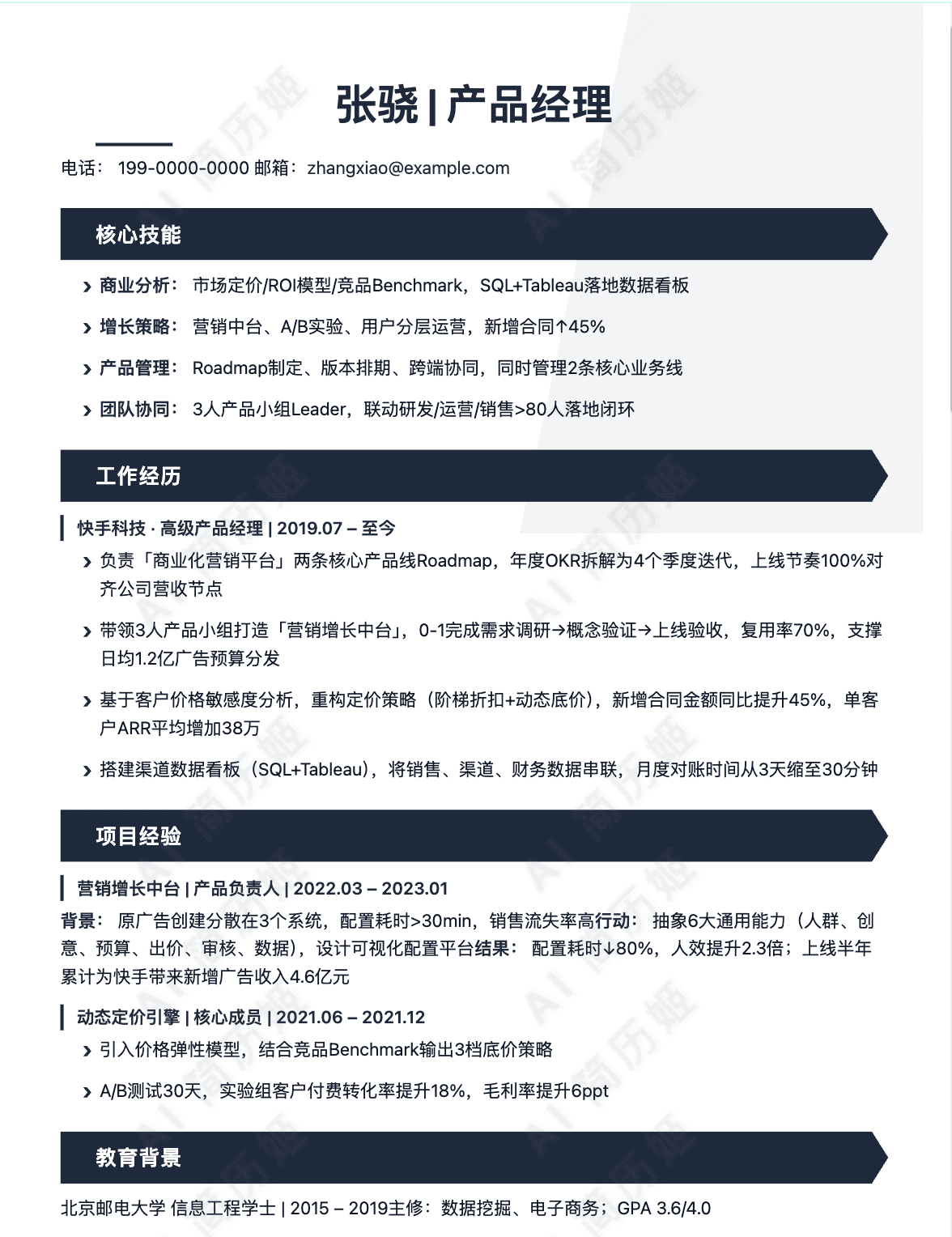
Properly Format Your Business Analyst Resume
A well-formatted resume is your first deliverable to a potential employer. For a Business Analyst, it demonstrates your attention to detail, clarity of communication, and understanding of structure—all core BA competencies. Follow these guidelines to ensure your resume is both human- and machine-readable.
Resume Length: The One-Page Standard
As a general rule, aim for a concise one-page resume if you have less than 10 years of experience. Senior BAs with extensive, relevant project histories may extend to two pages. Every line on a second page must provide substantial value. Recruiters spend seconds on an initial scan, so conciseness is key. Eliminate outdated roles and irrelevant details to prioritize recent and impactful achievements.
Choosing the Right Resume Format
The most effective format for a Business Analyst is the Combination (or Hybrid) Format. It blends the strengths of chronological and functional formats by starting with a skills summary, followed by a reverse-chronological work history. This highlights your relevant capabilities upfront while providing the concrete project and role evidence that employers and ATS systems expect.
Font, Margins, and Spacing for Readability
Use clean, professional, and ATS-friendly fonts like Calibri, Arial, Georgia, or Times New Roman. Font size should be between 10 and 12 points for body text, with your name slightly larger. Maintain margins of at least 0.5 inches on all sides. Use consistent spacing between sections and bullet points to create a clean, organized layout that guides the reader's eye. Bold section headings and job titles for clear visual hierarchy.
File Format: Always Submit a PDF
Unless the job posting specifically requests a Word document (.docx), always submit your resume as a PDF. A PDF preserves your formatting across all devices and operating systems, ensuring it looks exactly as you designed it. It also presents a more polished, final document. Name your file professionally: FirstName_LastName_BA_Resume.pdf.
ATS Optimization Basics
Most companies use Applicant Tracking Systems (ATS) to screen resumes. To pass this digital gatekeeper: use standard section headings (e.g., "Work Experience," "Skills," "Education"), incorporate keywords from the job description naturally (e.g., "stakeholder interviews," "user stories," "process modeling"), avoid headers/footers, tables, text boxes, and columns for critical content, and never rely on images or graphics to convey important information.
Good Formatting Example: Header
Certified Business Analyst | CBAP
San Francisco, CA | (123) 456-7890 | alex.chen@email.com | linkedin.com/in/alexchenba
Bad Formatting Mistakes to Avoid
One‑click format & basics check
Auto‑check contacts, links and layout; generate an ATS‑friendly header.
Write a Strong Business Analyst Resume Summary or Objective
The opening statement of your resume is your first and best chance to capture a hiring manager's attention. A well-crafted summary or objective frames your entire application and compels the reader to continue. This section should be a powerful, tailored snapshot of your value.
Summary vs. Objective: Knowing the Difference
A resume summary is a brief highlight reel of your career achievements, skills, and the value you bring. It is best suited for experienced professionals with a track record to showcase. An resume objective, on the other hand, states your career goals and what you aim to achieve in a role. It is typically used by those new to the field, such as recent graduates, career changers, or those with minimal direct experience.
When to Use a Summary vs. an Objective
Use a Summary if: You have more than 2-3 years of relevant Business Analyst experience. Your goal is to demonstrate a proven impact.
Use an Objective if: You are an entry-level candidate, recent graduate, or making a significant career transition into business analysis. Your goal is to connect your transferable skills and passion to the role's requirements.
Key Elements to Include
Whether writing a summary or objective, integrate these core components: Years of experience (for summaries), Core competencies (e.g., requirements elicitation, process modeling, Agile/Scrum, SQL, user stories), Industry knowledge (if relevant, like finance or healthcare), and a Value proposition that mentions quantifiable results (e.g., "improved efficiency," "reduced costs," "increased revenue").
Optimal Length and Structure
Keep your statement between 2 to 4 concise, impactful sentences. Avoid fluff and generic phrases. The first sentence should establish your professional identity, the middle sentences should highlight key skills and achievements, and the final sentence can note your target or the value you seek to provide.
How to Tailor It to the Job Posting
Carefully review the job description. Identify and mirror key terminology, required tools (e.g., Jira, Visio), methodologies (e.g., Waterfall, SAFe), and desired outcomes. If the role emphasizes "data-driven decision making," include that phrase and an example. This tailoring passes Applicant Tracking Systems (ATS) and shows genuine interest.
Good Examples for Your Resume
Bad Examples to Avoid
Explanation: Too vague, self-centered (focused on what *you* want), and offers no specific skills, experience, or value.
Explanation: Uses weak language ("done," "know how to"), states only basic job duties, and relies on overused clichés ("hard worker") without proof or impact.
Explanation: Filled with unprofessional buzzwords and jargon that sound impressive but convey no real, tangible skills or experience to a hiring manager.
Generate skills list / summary
Extract hard/soft skills from the JD and create 3 summary variants.
Include Your Best Hard and Soft Skills as a Business Analyst
A compelling skills section is the cornerstone of a strong Business Analyst resume. It must clearly demonstrate your unique blend of technical proficiency and interpersonal effectiveness. Recruiters and hiring managers scan this section quickly, so it's crucial to present a balanced, keyword-rich, and easy-to-digest overview of your capabilities.
Hard Skills vs. Soft Skills: The BA's Toolkit
Hard skills are the teachable, technical abilities and knowledge specific to the Business Analyst role. They are often quantifiable and learned through training, certification, or experience. Soft skills are the interpersonal and cognitive abilities that dictate how you work, communicate, and solve problems. For a BA, soft skills are equally critical, as they enable the effective application of technical knowledge to bridge the gap between stakeholders and solutions.
Essential Hard Skills for a Business Analyst
Your hard skills should reflect the full BA lifecycle, from discovery to delivery. Include specific methodologies, tools, and techniques.
- Requirements Elicitation & Management: Techniques like interviews, workshops, surveys, and user story creation. Tools: Jira, Confluence, Azure DevOps.
- Process Modeling & Documentation: Creating diagrams (BPMN, UML). Tools: Microsoft Visio, Lucidchart, draw.io.
- Data Analysis & SQL: Querying databases to inform requirements and validate solutions. Basic proficiency in SQL is often expected.
- Prototyping & Wireframing: Visualizing requirements. Tools: Figma, Balsamiq, Adobe XD.
- Methodology Knowledge: Practical understanding of Agile (Scrum, Kanban), Waterfall, and Hybrid frameworks.
- Testing & Validation: Writing acceptance criteria, conducting User Acceptance Testing (UAT), and creating test cases.
- Business Intelligence & Reporting: Translating data into insights. Tools: Microsoft Power BI, Tableau, Excel (PivotTables, advanced formulas).
- Basic System Architecture Understanding: Comprehending APIs, databases, and system integrations at a high level.
Critical Soft Skills for a Business Analyst
These skills enable you to navigate complex human and organizational dynamics.
- Communication & Stakeholder Management: Translating complex technical jargon for business users and vice versa, managing expectations, and facilitating consensus.
- Problem-Solving & Critical Thinking: Deconstructing complex business problems, analyzing root causes, and evaluating multiple solutions.
- Active Listening & Facilitation: Truly understanding stakeholder needs and effectively guiding meetings and workshops to productive outcomes.
- Adaptability & Learning Agility: Thriving in changing project environments and quickly grasping new business domains or technologies.
- Negotiation & Influence: Balancing conflicting priorities and persuading stakeholders towards the optimal solution for the project.
How to Organize Your Skills Section
A categorized format is vastly superior to a simple list. It improves scannability and demonstrates a structured thought process.
Skills
Business Analysis & Methodology: Agile/Scrum, Requirements Elicitation, User Story Creation, Process Modeling (BPMN), UAT
Tools & Technology: Jira, Confluence, SQL, Microsoft Visio, Power BI, Microsoft Excel (Advanced)
Analytical & Soft Skills: Stakeholder Management, Data-Driven Problem Solving, Workshop Facilitation, Cross-Functional Communication
Skills
Jira, Communication, SQL, Scrum, Good listener, Visio, PowerPoint, Problem-solving, Team player, Excel
Matching Skills with Job Description Keywords
Carefully review the job description and mirror its language. If it asks for "BPMN," use that exact term. If it emphasizes "Agile," list specific Agile practices you know. This strategy passes through Applicant Tracking Systems (ATS) and shows the hiring manager you are a precise fit.
Job Description asks for: "Experience eliciting requirements in an Agile environment using user stories and managing backlog in Jira."
Your resume includes: "Requirements Elicitation, User Story/Grooming, Agile/Scrum, Backlog Management (Jira)"
Job Description asks for: "Experience eliciting requirements in an Agile environment using user stories and managing backlog in Jira."
Your resume includes: "Talking to people, Software development, Project tools"
AI‑assisted bullet quantification
Rewrite bullets using STAR/metrics and auto‑fill numbers and verbs to highlight impact.
Describe Your Work Experience and Key Projects as a Business Analyst
This section should detail your professional journey, emphasizing the impact you've made. Structure each role clearly, use strong action verbs, and quantify your achievements using the CAR or STAR method to demonstrate your value.
Work Experience Examples
Below are examples of well-structured work experience entries for different seniority levels.
Senior Business Analyst | FinTech Solutions Inc. | New York, NY | Jan 2021 – Present
Business Analyst | Global Retail Corp. | Chicago, IL | Jun 2018 – Dec 2020
Examples of Poor Work Experience Descriptions
Avoid these common pitfalls that fail to demonstrate your skills or impact.
Highlighting Key Projects Within Work Experience
You can integrate key projects directly into your role description, as shown in the good examples. For particularly significant projects, you may choose to detail them in a separate "Key Projects" section. The principle remains the same: use CAR/STAR and quantify results.
Key Project: Enterprise CRM Implementation
Challenge: Sales, marketing, and support teams used disparate systems, leading to inconsistent customer data and missed cross-sell opportunities.
Action: Led the discovery phase, conducting workshops with 50+ users across 3 departments. Synthesized findings into a unified requirements document with 300+ prioritized features. Created user journey maps and wireframes for key workflows (lead-to-cash, service case management).
Result: Delivered a unified Salesforce platform that provided a 360-degree customer view. Increased sales team productivity by 20% through automated lead routing and improved customer retention by 5% via enhanced support insights.
Project experience quantifier
Split goals, actions and results; auto‑suggest metrics and format project cards.
Include Action Words to Make Your Business Analyst Resume Pop
In a competitive job market, your resume must immediately convey your value. Action verbs are the engine of your accomplishment statements, transforming passive job descriptions into dynamic proof of your impact. They are critical for both Applicant Tracking Systems (ATS), which scan for these powerful keywords, and human recruiters, who use them to quickly assess your initiative, skills, and results. Strong action words create a vivid picture of you as a proactive contributor.
Why Action Verbs Are Non-Negotiable
Generic phrases like "responsible for" or "worked on" are resume killers. They force the reader to guess your actual contribution. Strategic action verbs, by contrast, place you at the center of the achievement. They signal specific competencies—like leadership, analytical prowess, or technical skill—that hiring managers are actively seeking. By front-loading your bullet points with these words, you ensure your most relevant skills are seen and understood within seconds.
Curated Action Verbs for Business Analysts
To showcase the full spectrum of your capabilities, select verbs from these key functional categories:
Leadership & Management: Championed, Directed, Orchestrated, Spearheaded, Governed, Facilitated, Mobilized
Technical Implementation: Modeled, Configured, Migrated, Validated, Automated, Integrated, Translated
Problem-Solving: Diagnosed, Remediated, Resolved, Streamlined, Optimized, Rectified, Troubleshot
Collaboration: Liaised, Bridged, Aligned, Mediated, Synthesized, Coordinated, Partnered
Achievement & Impact: Accelerated, Amplified, Boosted, Reduced, Maximized, Yielded, Consolidated
Analysis & Research: Analyzed, Elicited, Assessed, Evaluated, Investigated, Mapped, Validated
Innovation: Pioneered, Engineered, Revamped, Redesigned, Conceptualized, Innovated, Modernized
Avoiding Repetition and Weak Language
Using the same verb (e.g., "worked on") multiple times suggests a limited range of experience. Draw from the categories above to create variety. Crucially, replace weak, passive language with strong, specific alternatives. This shift turns a simple task into a demonstrated achievement.
Before and After: Transforming Your Bullet Points
Weak: Was responsible for gathering requirements from stakeholders.
Strong: Elicited and documented 50+ functional requirements from cross-functional stakeholders through workshops and interviews.
Weak: Helped with testing the new system.
Strong: Validated system functionality against 200+ test cases, identifying and resolving 15 critical defects prior to launch.
Weak: In charge of improving a process.
Strong: Analyzed the order fulfillment workflow and redesigned two key stages, reducing processing time by 25%.
Weak: Worked with the IT team on a project.
Strong: Liaised between business units and development teams, translating business needs into technical user stories.
Weak: Made reports for management.
Strong: Synthesized complex data into executive dashboards, enabling data-driven decision-making that boosted quarterly sales by 8%.
Examples of Strong Action Verb Usage
1. Spearheaded the discovery phase for a new CRM, orchestrating JAD sessions that aligned sales, marketing, and support on a unified vision.
2. Modeled "as-is" and "to-be" process flows using BPMN, identifying bottlenecks that, when streamlined, saved 40 person-hours per month.
3. Championed the adoption of Agile methodologies, facilitating daily scrums and sprint planning that accelerated project delivery by 15%.
4. Diagnosed the root cause of a recurring data discrepancy by analyzing SQL queries and ETL logs, then remediated the issue to ensure 99.9% data accuracy.
3 summary versions in seconds
Combine role highlights and strengths to generate concise, confident and specific summaries.
Make Your Education Section Count
Your education section is more than a formality; it's a strategic tool to build credibility and highlight relevant skills. Tailoring this section to your career stage is crucial for making a strong impression.
Essential Components to Include
At a minimum, list your degree (e.g., Bachelor of Science), your major, the university name, and your graduation date. Use a consistent, clean format for easy scanning.
Strategic Placement: Top vs. Bottom
If you graduated within the last 2-3 years with limited relevant work experience, place the Education section near the top of your resume, just after your summary. For seasoned professionals with extensive experience, move it to the bottom, as your work achievements will be the primary focus.
Enhancing for Entry-Level Roles
New graduates should leverage relevant coursework to demonstrate foundational knowledge. List 3-5 courses directly related to business analysis, such as requirements engineering, data analytics, process modeling, or business intelligence.
GPA, Honors, and Awards
Include your GPA only if it is a 3.5 or higher on a 4.0 scale. Always list significant academic honors, scholarships, or awards (e.g., Magna Cum Laude, Dean's List, Departmental Award).
Projects and Thesis Work
If you completed a capstone project, thesis, or significant academic project involving requirements gathering, data analysis, or process improvement, include a brief description. This provides concrete evidence of your applied skills.
Examples of Poor Education Sections
Here are common mistakes to avoid that weaken your resume's impact.
Auto‑format education & certifications
Normalize titles, dates and bullets — ATS‑safe by default.
Select the Perfect Extra Sections for Your Business Analyst Resume
While the core sections of your resume (Experience, Skills, Education) are non-negotiable, strategically chosen extra sections can be the differentiator. They provide a more holistic view of your capabilities, demonstrate passion, and fill potential gaps, especially for career changers or those targeting senior roles. The key is to include only sections that add tangible value and relevance to your Business Analyst candidacy.
Recommended Extra Sections to Showcase Your Value
1. Technical Projects
Ideal for entry-level candidates, career changers, or those wanting to highlight hands-on technical aptitude beyond their daily work. Include academic, freelance, or personal projects where you performed BA-like duties: gathering requirements, creating user stories, mapping processes, or testing. Briefly describe the project goal, your specific BA-related actions, and the outcome.
2. Publications & Speaking
A powerful section for senior or lead Business Analysts establishing thought leadership. List articles in industry publications, blog posts on BA methodologies, or presentations at conferences (e.g., IIBA chapter meetings, tech meetups). This demonstrates deep expertise, communication skills, and a commitment to the profession.
3. Languages
Include this if you are proficient in more than one language, especially if the role involves global teams, stakeholders, or systems. Clearly state your proficiency level (e.g., Native, Fluent, Professional Working Proficiency). This is a direct asset for multinational companies or projects with specific regional focuses.
4. Professional Affiliations
Listing memberships in organizations like the International Institute of Business Analysis (IIBA) or the Project Management Institute (PMI) signals professionalism and a dedication to continuous learning. If you hold a certification (like CBAP or PMI-PBA), it belongs in your Skills or Education section, but the membership itself can be noted here.
5. Volunteer Experience
Include this if the work utilized or developed relevant BA skills such as process improvement, stakeholder management, or requirements gathering for a non-profit. It shows initiative and can be valuable experience, particularly for those with less formal work history. If it's not skill-relevant, it's best omitted.
How to Format Additional Sections Professionally
Maintain the same clean, consistent formatting used throughout your resume. For each section, use a clear subheading. List items in reverse-chronological order where applicable. Be concise: for projects and volunteer work, use bullet points to describe your actions and achievements, mirroring the style of your professional experience. For lists like languages or affiliations, a simple line-item format is sufficient.
Sections to AVOID on Your Business Analyst Resume
References Available Upon Request: This is assumed and wastes valuable space. Prepare a separate document with references.
Hobbies & Interests (unless highly relevant): Generic hobbies (e.g., reading, hiking) do not add professional value. Only include if they directly showcase relevant skills (e.g., competitive chess for strategic thinking, coding side projects for technical skill).
Objective Statement: An outdated practice. Replace it with a powerful professional summary that highlights your value proposition.
Personal Information: Avoid details like marital status, date of birth, or a personal photograph. This information is irrelevant to your job qualifications and helps prevent unconscious bias.
An "Interests" section filled with clichés: Phrases like "solving complex problems" are expected of a BA and should be demonstrated through achievements, not listed as a passive interest.
Pitfalls check
Detect formatting/wording pitfalls and suggest instant rewrites and formatting.
How to Tailor Your Business Analyst Resume for a Specific Job Description
In today's competitive job market, a generic resume is a fast track to the rejection pile. For Business Analysts, whose roles vary significantly across industries and companies, tailoring your resume is not just a recommendation—it's a necessity. It demonstrates your analytical skills, attention to detail, and genuine interest in the specific position, significantly increasing your chances of landing an interview.
Why Tailoring Your BA Resume is Critical
Tailoring your resume bridges the gap between your general qualifications and the employer's specific needs. It translates your experience into the exact language and priorities of the hiring company. This process helps you pass through Applicant Tracking Systems (ATS) that scan for keywords and shows the hiring manager, at a glance, that you are a precise fit for their unique problem set and team dynamics.
Step-by-Step Tailoring Process
1. Analyze the Job Description
Treat the job description as your primary requirements document. Print it out or open it in a text editor. Use a highlighter or different colors to identify: Core Responsibilities (e.g., "facilitate sprint planning," "develop user stories"), Required Skills & Tools (e.g., SQL, JIRA, BPMN, UML), Preferred Qualifications (e.g., CBAP, Agile certification), and Company Keywords & Culture (e.g., "data-driven," "customer-centric," "SAFe environment"). This visual dissection forms the foundation of your customization.
2. Map Your Experience
Create a two-column list. On the left, list the key requirements you identified. On the right, match each item with a specific accomplishment, project, or skill from your career. For example, if the JD asks for "experience improving operational efficiency," note a project where you "modeled AS-IS and TO-BE processes, leading to a 15% reduction in report generation time." This exercise ensures you have evidence for every claim.
3. Customize Key Resume Sections
With your analysis complete, strategically rewrite these sections: Professional Summary: Lead with 2-3 lines that mirror the job's primary focus and required expertise. Skills Section: Prioritize and reorder your skills to list the most relevant keywords from the JD first. Work Experience Bullets: Reframe your accomplishments to use the JD's terminology. Quantify results where possible, and lead with the most relevant points for *this* role.
Good Practice: Before and After Example
Generic Bullet Point:
• Was involved in a software implementation project.
Tailored Bullet Point (for a JD emphasizing Agile, user stories, and stakeholder management):
• Elicited and documented 50+ user stories by conducting JAD sessions with product owners and SMEs, creating a clear product backlog for a 2-sprint SaaS implementation that launched on schedule.
Bad Practice: Common Mistakes to Avoid
Over-Tailoring/Misrepresentation: Never claim skills or experience you don't possess. Tailoring is about framing, not fabricating.
Keyword Stuffing: Naturally integrate keywords into coherent sentences. A list of jargon is not persuasive.
Neglecting Transferable Skills: For roles in a new industry, highlight analytical, communication, and problem-solving skills that are universal to BA work.
Forgetting to Proofread: Customizing for multiple jobs increases errors. Always double-check company names, role titles, and that your content flows logically.
Maintaining a Master Resume
The most efficient way to tailor resumes is to maintain a comprehensive "Master Resume." This document contains every skill, tool, certification, and bullet point from all your roles and projects. When applying for a job, you create a targeted version by selecting and refining the most relevant content from this master document, ensuring consistency and saving time while achieving a perfect fit.
Pick the right template and apply
Recommend templates by industry and seniority; auto‑map existing content.
Business Analyst Resume Examples (Complete Samples)
Apply example in one click
Pick an example and auto‑adapt to your experience and skills.
Frequently Asked Questions (FAQ)
1. How long should a Business Analyst resume be?
For most professionals, a one-page resume is ideal. Senior BAs with over 10 years of highly relevant experience may extend to two pages. The key is conciseness; prioritize impactful achievements over listing every single task.
2. What's the best format for a Business Analyst resume?
The reverse-chronological format is highly recommended. It lists your most recent experience first, clearly showcasing your career progression and recent BA achievements, which is what recruiters expect to see immediately.
3. Should I include a photo on my Business Analyst resume?
No, you should not include a photo on your resume in the US, Canada, or UK. This is standard practice to avoid potential bias and focuses the reviewer's attention solely on your skills and qualifications.
4. What are the most important skills to include on a Business Analyst resume?
Include a balanced mix of technical and soft skills. Must-haves are requirements elicitation, process modeling, SQL, and user story creation. Also highlight crucial soft skills like stakeholder management, communication, and problem-solving.
5. Should I list certifications like CBAP or PMI-PBA on my resume?
Absolutely. Prominently list recognized certifications like CBAP, PMI-PBA, or Agile/Scrum certifications in a dedicated "Certifications" section and/or your summary. They provide immediate credibility and are often keywords in recruiter searches.
6. How do I describe my work experience effectively?
Use bullet points that start with strong action verbs and quantify results. Instead of "Wrote requirements," write "Elicited and documented 50+ user stories, reducing rework in the development phase by 20%." Focus on impact, not just duties.
7. Should I include non-BA projects or unrelated work experience?
You can include them if you can frame the experience to highlight transferable BA skills. For example, a retail job can demonstrate stakeholder interaction, process improvement, or conflict resolution. Keep descriptions brief and skill-focused.
8. How do I write a Business Analyst resume with no direct BA experience?
Focus on transferable skills from adjacent roles (e.g., Project Coordinator, Subject Matter Expert, Quality Assurance). Create a strong summary highlighting your analytical mindset, and detail projects where you performed BA-like tasks such as gathering requirements or analyzing data.
9. Should I include my GPA on my Business Analyst resume?
Generally, only include your GPA if you are a recent graduate (within 3 years) and it is 3.5 or higher. For experienced BAs, omit your GPA and instead emphasize your professional accomplishments and work experience.
10. What if I'm changing careers from a different field to become a Business Analyst?
Use a combination or functional resume format to lead with your transferable skills. Write a powerful career summary explaining your transition, obtain a foundational BA certification, and highlight any volunteer or freelance analysis work you've done to build relevant experience.
11. How many years of work history should I include on my BA resume?
Include 10-15 years of the most relevant experience. For roles older than that, you can summarize them in an "Early Career" section without detailed bullet points. This keeps the resume focused on your current, senior-level capabilities.
12. Is it necessary to include a summary or objective statement?
A professional summary is highly recommended, especially for experienced BAs or career changers. In 3-4 lines, state your years of experience, key specializations (e.g., Agile, SaaS), and a top achievement to immediately capture the hiring manager's interest.