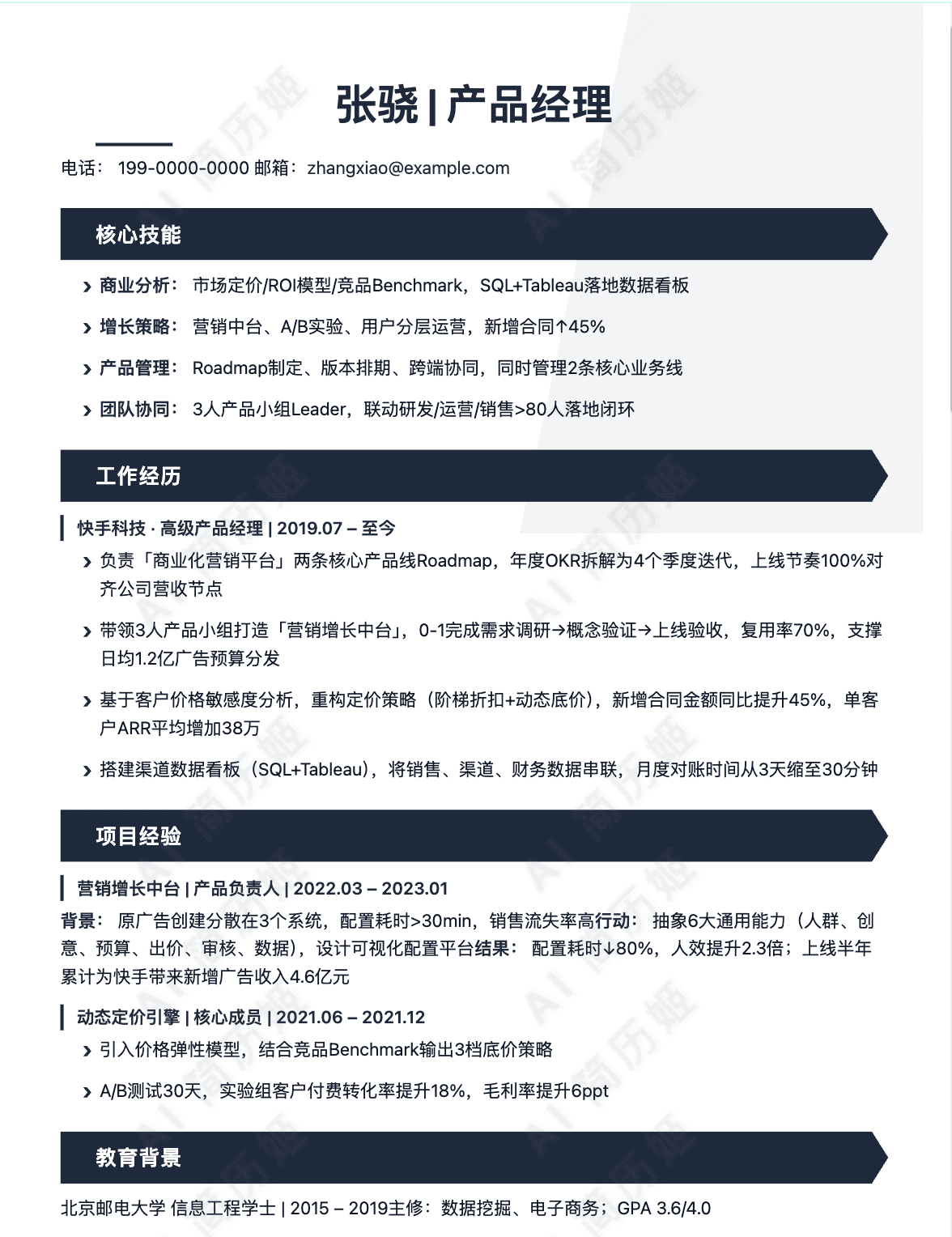
Properly Format Your DevOps Engineer Resume
A well-formatted resume is your first deployment to production in the job search process. For a DevOps Engineer, it signals attention to detail, an understanding of systems (like ATS), and professional clarity—all critical traits for the role.
Resume Length: The One-Page Standard
As a general rule, aim for a one-page resume if you have less than 10 years of relevant experience. Senior engineers, architects, or those with extensive open-source contributions and publications may effectively use two pages. Every line must demonstrate value; avoid fluff. Recruiters spend seconds on an initial scan, so conciseness is key.
Recommended Resume Format
The reverse-chronological hybrid format is the industry standard and highly ATS-friendly. It leads with a strong summary, followed by a technical skills section, then experience in reverse-chronological order, and finally education/certifications. This highlights your most recent and relevant achievements while ensuring critical keywords are easily found.
Font, Margins, and Spacing
Use clean, professional, and highly readable sans-serif fonts like Calibri, Arial, Helvetica, or Lato. Font size should be between 10-12pt for body text and 14-16pt for your name. Maintain margins of at least 0.5 inches on all sides. Use consistent spacing between sections and employ bullet points for readability. White space is your friend—it makes the document easy to scan.
File Format: Always PDF
Always submit your resume as a PDF file (e.g., John_Doe_DevOps_Resume.pdf). This preserves your formatting across all devices and operating systems. A Word document (.docx) can appear corrupted or reformatted on different machines.
ATS Optimization Basics
Most companies use Applicant Tracking Systems (ATS) to filter resumes. To pass: 1. Use standard section headings (e.g., "Work Experience," "Skills," "Education"). 2. Incorporate keywords from the job description (e.g., "Kubernetes," "CI/CD," "Terraform," "AWS"). 3. Avoid headers/footers, tables, text boxes, columns, and graphics, as they often confuse ATS parsers. 4. Spell out acronyms once if space allows (e.g., "Continuous Integration/Continuous Deployment (CI/CD)").
Good Formatting Example: Header & Sections
San Francisco, CA | (123) 456-7890 | alex.chen@email.com | linkedin.com/in/alexchen | github.com/alexchen
SUMMARY
DevOps Engineer with 5+ years of experience building scalable, resilient cloud infrastructure on AWS. Proven skill in automating CI/CD pipelines with Jenkins and GitLab, and implementing IaC using Terraform. Passionate about site reliability and fostering a culture of collaboration between development and operations teams.
TECHNICAL SKILLS
Cloud & Platforms: AWS (EC2, S3, RDS, IAM, Lambda), Docker, Kubernetes
CI/CD & Automation: Jenkins, GitLab CI, Ansible, Terraform
Monitoring & Logging: Prometheus, Grafana, ELK Stack
Scripting & Languages: Python, Bash, YAML
Bad Formatting Mistakes to Avoid
One‑click format & basics check
Auto‑check contacts, links and layout; generate an ATS‑friendly header.
Write a Strong DevOps Engineer Resume Summary or Objective
The top section of your resume is prime real estate. A compelling summary or objective immediately tells a hiring manager who you are and the value you bring, setting the tone for the rest of your application.
Summary vs. Objective: Which One to Use?
A resume summary is a brief, impactful statement highlighting your career achievements, skills, and experience. It's best for professionals with relevant work history in DevOps or related fields.
A resume objective focuses on your career goals, enthusiasm, and transferable skills. It's ideal for career changers, recent graduates, or those with minimal direct DevOps experience.
Key Elements to Include
Whether you choose a summary or objective, it should be a concise 2-4 sentences containing: your years of experience (if applicable), core technical and methodological competencies (e.g., CI/CD, IaC, cloud platforms), and a clear value proposition (how you solve problems or benefit a team).
How to Tailor It to the Job
Never use a generic statement. Carefully review the job description and mirror its language. If the ad emphasizes AWS, Kubernetes, and security, those keywords must be featured in your summary/objective. This shows you've done your homework and pass through Applicant Tracking Systems (ATS).
Good Examples
For Experienced Professionals (Resume Summary):
For Entry-Level / Career Changers (Resume Objective):
Bad Examples to Avoid
1. Being Too Vague or Generic:
Explanation: This provides no specific skills, experience, or value. It's all filler words that could apply to anyone.
2. Using Clichés and Buzzwords Without Substance:
Explanation: These are overused phrases that don't convey tangible skills. What specific actions did you take? What tools did you use?
3. Making It All About Your Wants, Not Their Needs:
Explanation: The focus is entirely on what you want from the company, not on what you can offer to solve their problems.
4. Listing Duties Instead of Achievements:
Explanation: This reads like a job description snippet. A strong summary should hint at outcomes, such as "reduced deployment time by 40%" or "improved system uptime to 99.9%."
Generate skills list / summary
Extract hard/soft skills from the JD and create 3 summary variants.
Include Your Best Hard and Soft Skills as a DevOps Engineer
A compelling skills section is the backbone of any effective DevOps engineer resume. It must clearly demonstrate your technical prowess (hard skills) and your collaborative, problem-solving abilities (soft skills). Recruiters and hiring managers often scan this section first to see if you match the role's requirements.
Hard Skills vs. Soft Skills
Hard Skills are the technical, teachable abilities specific to the DevOps domain. They are often tied to specific tools, platforms, and methodologies. Soft Skills are the interpersonal and cognitive abilities that determine how you work, collaborate, and solve problems within a team. A top-tier DevOps engineer seamlessly blends both.
Essential Hard Skills for a DevOps Engineer
Your hard skills should reflect the entire software delivery lifecycle. Here are 8-12 critical areas with associated technologies:
1. Cloud Platforms: AWS, Azure, or Google Cloud Platform (GCP).
2. Infrastructure as Code (IaC): Terraform, AWS CloudFormation, Pulumi.
3. Configuration Management: Ansible, Chef, Puppet.
4. CI/CD Pipeline Orchestration: Jenkins, GitLab CI, GitHub Actions, CircleCI.
5. Containerization & Orchestration: Docker, Kubernetes, Amazon ECS.
6. Version Control Systems: Git (with platforms like GitHub, GitLab, Bitbucket).
7. Monitoring & Observability: Prometheus, Grafana, ELK Stack, Datadog, New Relic.
8. Scripting & Programming: Python, Bash, Go, or PowerShell.
9. Operating Systems: Linux/Unix system administration.
10. Networking & Security: Understanding of VPCs, firewalls, SSL/TLS, and security best practices (DevSecOps).
11. Database Management: Basic knowledge of SQL/NoSQL databases and their deployment.
Relevant Soft Skills for a DevOps Engineer
Technical skill is useless if you can't apply it effectively in a team. Highlight these 4-6 professional skills:
1. Collaboration & Communication: Bridging the gap between development, operations, and other stakeholders.
2. Problem-Solving & Troubleshooting: A systematic approach to diagnosing and resolving complex system issues.
3. Adaptability & Continuous Learning: The tech landscape evolves rapidly; a passion for learning is non-negotiable.
4. Ownership & Accountability: Taking responsibility for the health and performance of systems.
5. Process Improvement Mindset: Constantly seeking to automate and optimize workflows.
How to Organize Your Skills Section
A categorized format is vastly superior to a simple list. It improves readability and helps Applicant Tracking Systems (ATS) parse your information. Group your skills into logical buckets.
Skills
Cloud & Infrastructure: AWS (EC2, S3, IAM, VPC), Terraform, Docker, Kubernetes
CI/CD & Automation: Jenkins, GitHub Actions, Ansible, Python, Bash Scripting
Monitoring & Observability: Prometheus, Grafana, ELK Stack, Datadog
Soft Skills: Cross-functional Collaboration, Incident Response & Troubleshooting, Agile/Scrum Methodology, Effective Documentation
Skills
Linux, Docker, AWS, Python, Kubernetes, Jenkins, Communication, Ansible, Problem-solving, Terraform, GitHub, Teamwork
Matching Skills with Job Description Keywords
Carefully review the job description and mirror its language. If the job asks for "GitLab CI," don't just list "CI/CD tools." If it emphasizes "site reliability engineering (SRE) principles," include that phrase. This direct matching is crucial for both human readers and ATS filters.
Job Description asks for: "Build and maintain CI/CD pipelines using Jenkins, experience with infrastructure as code (Terraform preferred)."
Your Resume includes: CI/CD & IaC: Jenkins Pipeline, Terraform, GitHub Actions
Job Description asks for: "Proficient in AWS and container orchestration."
Your Resume includes: Cloud: Microsoft Azure, Virtualization
AI‑assisted bullet quantification
Rewrite bullets using STAR/metrics and auto‑fill numbers and verbs to highlight impact.
Describe Your Work Experience and Key Projects as a DevOps Engineer
This section should detail your professional journey, emphasizing hands-on experience with tools, processes, and cultural shifts. Structure each role clearly, use strong action verbs, and quantify your impact using the CAR/STAR method to show how you solved real problems.
Senior DevOps Engineer | TechScale Inc. | San Francisco, CA | 2021 - Present
Key Project: Cloud-Native Platform Migration
DevOps Engineer | Global Retail Corp. | Austin, TX | 2019 - 2021
Key Project: CI/CD Pipeline Standardization
Junior DevOps Engineer | StartupFlow LLC | Boston, MA | 2018 - 2019
Examples of Poor Work Experience Descriptions
Critique: Vague, passive language ("was responsible for," "helped with"). No specific tools or technologies are mentioned in context. Lacks metrics, challenges, and clear results.
Critique: Describes duties, not achievements. Uses weak verbs ("maintained," "responded"). No quantification or sense of impact. Doesn't connect to modern DevOps principles.
Critique: Extremely vague ("better," "faster"). No mention of scale, specific technologies, challenges faced, or measurable outcomes. Doesn't follow the CAR method.
Critique: Uses outdated "duties included" phrasing and first-person "I." Focuses on responsibilities, not projects or results. "Successfully completed" is a hollow claim without proof.
Project experience quantifier
Split goals, actions and results; auto‑suggest metrics and format project cards.
Include Action Words to Make Your DevOps Engineer Resume Pop
In a competitive job market, your DevOps engineer resume must immediately communicate your value and expertise. Strategic use of powerful action verbs is crucial for two key reasons: they help you pass Applicant Tracking Systems (ATS) that scan for relevant keywords, and they capture the attention of recruiters and hiring managers by painting a vivid picture of your contributions and impact. Weak or repetitive language can make even the most impressive experience seem mundane.
Why Action Verbs Are Non-Negotiable
Action verbs transform passive job descriptions into dynamic achievements. Instead of stating you were "responsible for" a task, strong verbs like orchestrated or spearheaded demonstrate leadership and ownership. They shift the focus from your duties to your tangible results, making your resume more compelling and memorable. This is essential for roles like DevOps, where initiative, impact, and technical prowess are paramount.
Categories of Action Verbs for DevOps
Organizing your verbs by function ensures you highlight the full spectrum of your skills. Use these categories to tailor your bullet points:
Leadership & Management: Architected, Championed, Directed, Governed, Orchestrated, Spearheaded, Streamlined, Supervised.
Technical Implementation: Automated, Containerized, Deployed, Engineered, Integrated, Migrated, Provisioned, Scripted, Secured.
Problem-Solving: Debugged, Diagnosed, Mitigated, Remediated, Resolved, Troubleshot.
Collaboration: Aligned, Bridged, Coordinated, Facilitated, Fostered, Partnered, Unified.
Achievement & Impact: Accelerated, Boosted, Curtailed, Enhanced, Maximized, Optimized, Reduced, Slashed.
Analysis & Research: Analyzed, Audited, Evaluated, Monitored, Simulated, Validated.
Innovation: Devised, Innovated, Pioneered, Revolutionized, Transformed.
Avoiding Repetition and Weak Language
Using the same verb (e.g., "managed") repeatedly dilutes your resume. Pull from the categories above to create variety. Crucially, replace weak, passive, or vague verbs with strong, specific alternatives. The goal is to show, not just tell.
Before and After: Weak vs. Strong Verb Examples
Weak: Was responsible for the CI/CD pipeline.
Strong: Engineered a scalable CI/CD pipeline using Jenkins and GitLab, reducing deployment time by 40%.
Weak: Did work on cloud infrastructure.
Strong: Architected and provisioned cloud infrastructure on AWS using Terraform, supporting a microservices architecture.
Weak: Helped with monitoring and alerts.
Strong: Implemented a comprehensive monitoring stack with Prometheus and Grafana, diagnosing issues 70% faster.
Weak: In charge of team collaboration.
Strong: Bridged development and operations teams by facilitating daily stand-ups and championing DevOps culture.
Weak: Used Docker and Kubernetes.
Strong: Containerized 15+ legacy applications using Docker and orchestrated their deployment on Kubernetes.
Strong Action Verb Usage Examples
1. Leadership & Impact: "Spearheaded the migration from a monolithic to a microservices architecture, boosting system resilience and developer velocity."
2. Technical Implementation & Achievement: "Automated infrastructure provisioning with Terraform, slashing environment setup time from days to minutes."
3. Problem-Solving & Collaboration: "Diagnosed and remediated a critical database performance bottleneck, coordinating with development and DBA teams to restore service in under one hour."
4. Innovation & Analysis: "Pioneered the adoption of a GitOps workflow, streamlining deployment processes and enhancing rollback capabilities."
3 summary versions in seconds
Combine role highlights and strengths to generate concise, confident and specific summaries.
Make Your Education Section Count
Your education section is more than just a formality; it's a strategic component that can be tailored to highlight your foundational knowledge and academic achievements. For a DevOps Engineer, this section should emphasize your technical and systems-thinking background.
Essential Information to Include
At a minimum, list your degree, major, university, and graduation date. This provides a clear, scannable snapshot of your academic credentials.
Strategic Placement on Your Resume
Placement depends on your experience level. Recent graduates or career changers with less than 5 years of relevant experience should place the Education section near the top, just after the summary. Experienced professionals with a strong work history should move it to the bottom, as their proven experience becomes the primary focus.
Leveraging Relevant Coursework (Entry-Level)
If you are new to the field, listing relevant coursework can bridge the gap between academic theory and the skills required for a DevOps role. Focus on subjects that align with DevOps principles.
Relevant Coursework: Cloud Computing Architecture, Distributed Systems, Linux/Unix Systems Programming, Network Security, Software Engineering, Database Management, Agile Project Management.
GPA, Honors, and Awards
Include your GPA only if it is strong (generally 3.5 or higher on a 4.0 scale). Otherwise, omit it. Academic honors, scholarships, and awards (like Magna Cum Laude or Departmental Honors in Computer Science) are always worth including as they demonstrate excellence.
Projects and Thesis Work
If you completed a significant academic project or thesis directly related to automation, infrastructure, CI/CD, or cloud technologies, consider featuring it in a separate "Projects" section or briefly note it under the relevant degree. This provides concrete evidence of your applied skills.
Capstone Project: "Automated CI/CD Pipeline for Microservices using Jenkins, Docker, and Kubernetes." Designed and implemented a full pipeline with automated testing, containerization, and deployment to a cloud cluster, reducing deployment time by 70%.
Examples of Poor Education Sections
Education: Went to college for computer stuff. Graduated a while ago.
University of the State Degree in something with computers 2001-2005
B.S. Computer Science | GPA: 2.1 | Relevant Coursework: Intro to Programming, Calculus I, English 101, Art History, Psychology 101
EDUCATION: - Devops Bootcamp Certificate - High School Diploma - Bachelor of Arts in History (unrelated degree with no explanation of transition)
Auto‑format education & certifications
Normalize titles, dates and bullets — ATS‑safe by default.
Select the Perfect Extra Sections for Your DevOps Engineer Resume
While your core resume sections (Experience, Skills, Education) are essential, strategically chosen extra sections can differentiate you from other candidates. These optional areas allow you to showcase depth, passion, and a well-rounded professional profile that aligns perfectly with a DevOps culture of collaboration and continuous learning.
1. Technical Projects
This section is invaluable for entry-level candidates, career changers, or anyone wanting to demonstrate hands-on skills beyond their job description. Include personal, open-source, or freelance projects that utilized relevant tools (e.g., Terraform, Kubernetes, CI/CD pipelines). Describe the problem, your specific actions, and the measurable outcome. This proves initiative and practical ability.
2. Publications & Speaking
Ideal for senior or principal-level engineers aiming to establish thought leadership. List technical blog posts, articles, whitepapers, or conference/meetup talks. This demonstrates deep expertise, communication skills, and a commitment to contributing to the community. Include titles, publication/platform names, and dates.
3. Languages
Beyond programming languages, list human languages if you are proficient. This is particularly useful for roles in multinational companies or remote teams. Format clearly, stating the language and your competency level (e.g., Spanish: Professional Working Proficiency).
4. Professional Affiliations
Membership in organizations like the Linux Foundation, ACM, or specific technology groups (e.g., AWS Community Builders, CNCF Ambassadors) shows active engagement with your field. It indicates you stay current with trends and network with other professionals.
5. Volunteer Experience (If Relevant)
Include this if the work utilized or developed skills pertinent to a DevOps role, such as mentoring in a coding bootcamp, maintaining IT infrastructure for a non-profit, or contributing tech expertise to a community project. It highlights soft skills like leadership and empathy, which are crucial for DevOps collaboration.
How to Format Additional Sections Professionally
Maintain the same clean, consistent formatting as the rest of your resume. Use reverse-chronological order where applicable. Keep descriptions concise and results-oriented. Place these sections after your core experience and skills, but before interests or references. Ensure every item you add reinforces your candidacy for the specific role.
Sections to AVOID and Why
"Hobbies & Interests": Generally avoid unless a hobby directly demonstrates a relevant skill (e.g., competitive coding, homelab administration). It consumes valuable space without adding professional weight.
"References Available Upon Request": This is an outdated convention. Employers assume you will provide references if asked.
An "Objective" Statement: For most DevOps roles, a professional summary or profile is more effective than a generic objective, which often states the obvious (that you want the job).
Irrelevant Early Career Experience: Avoid listing unrelated part-time jobs from decades ago. Focus on a cohesive narrative that showcases your technical trajectory.
Personal Information: Do not include photos, marital status, date of birth, or religious/political affiliations. This information is irrelevant to hiring decisions and can introduce bias.
Pitfalls check
Detect formatting/wording pitfalls and suggest instant rewrites and formatting.
How to Tailor Your DevOps Engineer Resume for a Specific Job Description
In the competitive DevOps job market, a generic resume is a fast track to the rejection pile. Hiring managers and Applicant Tracking Systems (ATS) are looking for candidates who specifically address their team's needs. Tailoring your resume for each application is not just recommended; it's essential. This process demonstrates your genuine interest and shows how your unique skills solve their specific problems.
Step 1: Analyze the Job Description
Begin by thoroughly dissecting the job posting. Look beyond the job title. Print it out or copy it into a document and highlight or underline every requirement, skill, tool, and qualification mentioned. Categorize them into: Must-Have Core Technologies (e.g., AWS, Kubernetes, Terraform), Process & Methodology (e.g., CI/CD, Infrastructure as Code, Agile), Soft Skills (e.g., collaboration, incident management), and Preferred/Nice-to-Have items. This analysis becomes your blueprint for the entire tailoring process.
Step 2: Map Your Experience
With the job description's requirements clearly outlined, audit your own experience. For each key requirement, identify a specific project, responsibility, or achievement from your past roles that demonstrates that skill. Think in terms of the STAR method (Situation, Task, Action, Result). This mapping exercise ensures you have concrete evidence to support your claims and helps you decide which of your many experiences are most relevant to this specific role.
Step 3: Customize Key Sections
Now, strategically inject your mapped experience into your resume. Start with your Professional Summary at the top. Mention the company name and 2-3 of their most critical requirements. Next, weave the keywords and phrases from the job description into your Work Experience bullet points. Quantify your achievements using metrics relevant to their needs (e.g., "Reduced deployment time by 40%" aligns with a need for CI/CD efficiency). Finally, ensure your Skills Section mirrors the technologies and tools listed, prioritizing those mentioned in the job description.
Good Practice: Before and After Example
Generic Bullet Point: "Responsible for managing cloud infrastructure and CI/CD pipelines."
Tailored Bullet Point (for a job emphasizing AWS, IaC, and reliability): "Designed and deployed scalable AWS infrastructure (EC2, RDS, S3) using Terraform (IaC), establishing CI/CD pipelines with Jenkins that reduced deployment failures by 30% and improved system uptime to 99.9%."
The tailored version uses specific keywords, demonstrates a relevant methodology, and provides a quantifiable result that speaks directly to common DevOps goals.
Bad Practice: Common Mistakes to Avoid
Avoid these pitfalls when tailoring your resume: Over-Tailoring or Keyword Stuffing: Don't list skills you don't genuinely possess. It's easily uncovered in interviews. Misrepresenting Your Role: Exaggerating your level of contribution or responsibility can damage your credibility. Ignoring the "How": Focusing only on tools without describing the process or collaborative impact (e.g., "worked with Docker" vs. "containerized applications with Docker to standardize environments across dev and ops teams"). Forgetting to Proofread: Leaving another company's name in your summary or making inconsistent edits looks careless and undermines your effort.
Tailoring your DevOps resume requires an investment of time for each application, but the return is significantly higher. It transforms your resume from a general list of duties into a targeted value proposition, clearly answering the hiring manager's most important question: "What can you do for *us*?"
Pick the right template and apply
Recommend templates by industry and seniority; auto‑map existing content.
DevOps Engineer Resume Examples (Complete Samples)
Apply example in one click
Pick an example and auto‑adapt to your experience and skills.
Frequently Asked Questions (FAQ)
How long should a DevOps Engineer resume be?
For most DevOps professionals, a one-page resume is ideal, especially with under 10 years of experience. Senior engineers or architects with extensive relevant experience can justify two pages. Prioritize conciseness and relevance, as recruiters often scan quickly.
What's the best format for a DevOps Engineer resume?
A reverse-chronological hybrid format is highly effective. It emphasizes your work history while incorporating a strong "Technical Skills" or "Core Competencies" section at the top. Avoid overly creative templates; focus on clean, scannable layouts with clear section headers.
What are the most important skills to include on a DevOps Engineer resume?
Include a balanced mix of technical and soft skills. Technically, prioritize CI/CD tools (e.g., Jenkins, GitLab CI), cloud platforms (AWS/Azure/GCP), IaC (Terraform, CloudFormation), and containerization (Docker, Kubernetes). Also highlight collaboration, problem-solving, and communication skills.
Should I list certifications like AWS Certified Solutions Architect on my resume?
Yes, relevant certifications are highly valuable and should be included in a dedicated "Certifications" section or alongside your skills. They provide tangible proof of your cloud and platform expertise, which is often a key requirement for hiring managers.
How should I describe my work experience to stand out?
Use strong action verbs and the STAR (Situation, Task, Action, Result) method. Quantify your impact with metrics, such as "Reduced deployment time by 40% using Jenkins pipelines" or "Improved system availability to 99.95% through automated monitoring."
Should I include personal or open-source projects on my resume?
Absolutely, especially if they demonstrate relevant technical skills. Create a "Projects" section to showcase automation scripts, infrastructure code repositories, or CI/CD pipelines you've built. This is particularly crucial for those with less professional experience.
How do I write a DevOps Engineer resume with no direct experience?
Focus on transferable skills, relevant projects, and any adjacent experience (e.g., system administration, development, or cloud support). Emphasize your technical skills section, contribute to open-source projects, and obtain entry-level certifications to build credibility.
Should I include my GPA on my DevOps Engineer resume?
Generally, no, unless you are a recent graduate (within the last 2-3 years) and your GPA is exceptionally high (e.g., 3.5+ on a 4.0 scale). For experienced professionals, your work achievements and skills far outweigh academic performance.
How many years of work history should I include?
Include the last 10-15 years of relevant experience. For roles prior to that, you can summarize them in a brief "Earlier Career" section without detailed bullet points. This keeps the focus on your most current and impactful DevOps contributions.
What if I'm changing careers from software development to DevOps?
Reframe your development experience through a DevOps lens. Highlight your experience with automation, scripting, understanding of SDLC, and any exposure to deployment or infrastructure tasks. Showcase projects where you implemented CI/CD or worked with cloud services.
Is it beneficial to include a link to my GitHub or LinkedIn profile?
Yes, including links to your professional online presence is highly recommended. Place clickable links in the header. A GitHub profile with clean, well-documented code and infrastructure projects serves as a powerful portfolio for a DevOps engineer.
Should I use a summary or objective statement?
A professional summary is strongly preferred. In 2-3 lines, summarize your years of experience, key technical specialties (e.g., cloud migration, SRE), and a major career achievement. Avoid generic objective statements that state what you want from an employer.