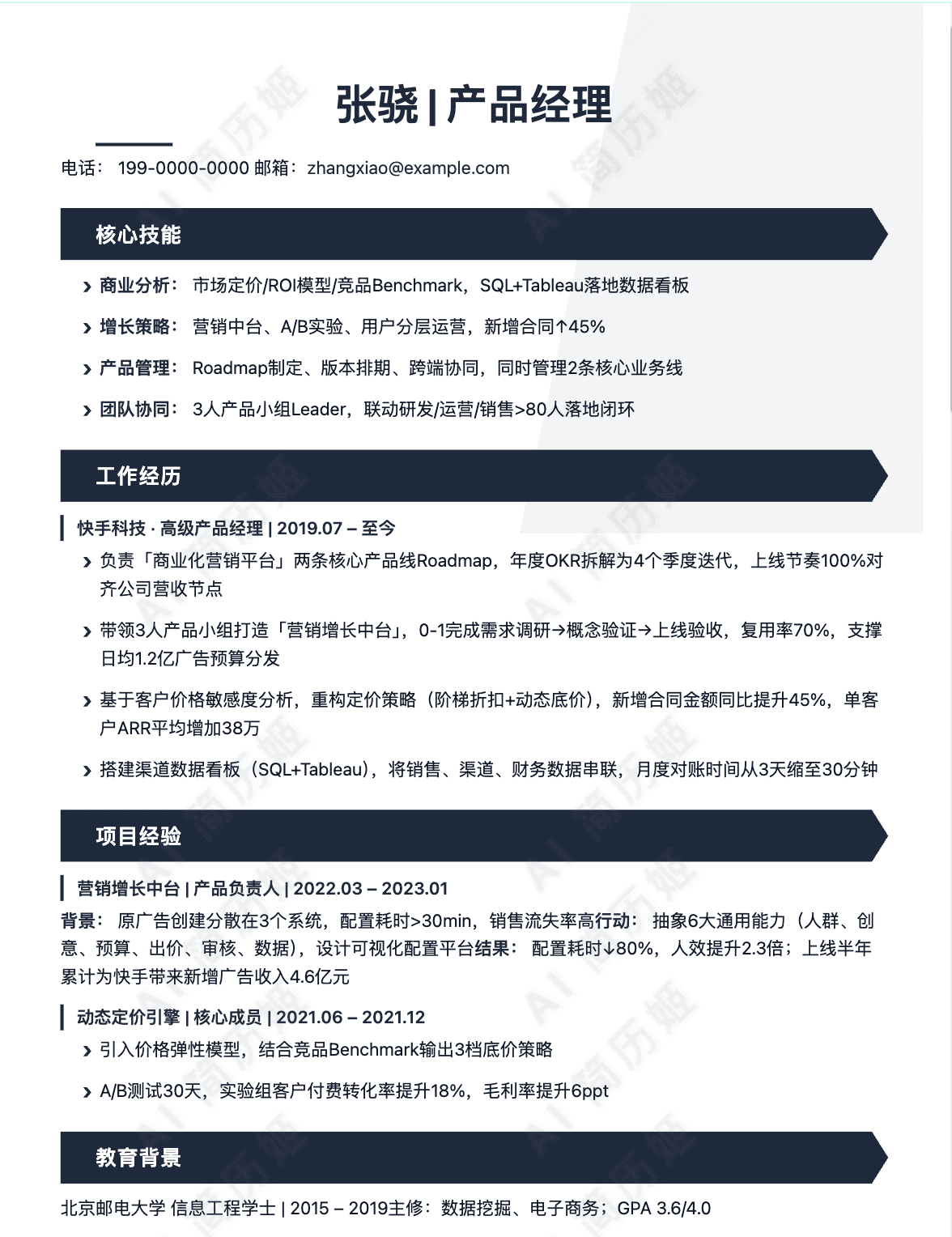
Properly Format Your Human Resources Manager Resume
As an HR professional, you understand the importance of first impressions and structured processes. Your resume must reflect this expertise through impeccable formatting. A clean, professional, and scannable layout not only appeals to human recruiters but also navigates the digital gatekeepers—Applicant Tracking Systems (ATS).
Resume Length: The One-Page vs. Two-Page Rule
For most HR Manager candidates, a two-page resume is standard and expected. The one-page rule primarily applies to early-career professionals. With 10+ years of experience, including leadership roles, strategic initiatives, and specialized certifications, you need space to detail your impact. Be concise, but do not sacrifice critical achievements to fit an arbitrary page limit. Ensure every line on page two adds substantial value.
Choosing the Right Resume Format
The format you choose frames your career narrative. For HR Managers, the following are most effective:
Reverse-Chronological: The industry gold standard. It lists your work history starting with the most recent position, emphasizing career progression and stability. This is ideal if you have a strong, linear career path in HR.
Combination/Hybrid: A powerful choice for HR leaders. It begins with a robust skills and qualifications summary, followed by a reverse-chronological work history. This format allows you to highlight strategic competencies (like HRIS implementation or talent development) upfront before detailing where you applied them.
Functional: Focuses on skills over work history. Generally not recommended for HR Managers, as it can raise red flags about employment gaps and may perform poorly with ATS that prioritize dates and job titles.
Font, Margins, and Spacing Standards
Clarity and readability are paramount. Use a professional, sans-serif font like Calibri, Arial, or Helvetica. Serif fonts like Times New Roman are also acceptable but can appear dated. Font size should be between 10.5 and 12 points for body text, with your name slightly larger. Maintain margins of at least 0.5 inches on all sides, with 0.7 to 1 inch being ideal. Use consistent spacing between sections and employ bullet points for responsibilities and achievements to create visual breathing room.
File Format: Always Submit a PDF
Unless the job posting specifically requests a Microsoft Word document, always submit your resume as a PDF. This preserves your careful formatting across all devices and operating systems. Ensure the PDF is not image-based (text must be selectable) and is optimized for file size. Before sending, confirm that the filename is professional, such as
ATS Optimization Basics
Most companies use ATS to screen resumes. To optimize yours: Use standard section headings (e.g., "Work Experience," "Education," "Skills"). Avoid headers, footers, text boxes, columns, or graphics that can scramble the parsing process. Incorporate keywords from the job description naturally (e.g., "employee relations," "performance management," "HR compliance," "succession planning"). Spell out acronyms on first use (e.g., "Human Resources Information System (HRIS)").
Good Formatting Example
JANE DOE, SHRM-SCP
123 Professional Avenue, City, ST 12345 | (555) 123-4567 | jane.doe@email.com | linkedin.com/in/janedoe
PROFESSIONAL SUMMARY
Strategic Human Resources Manager with 12+ years of experience developing HR initiatives that align with business objectives. Proven expertise in talent acquisition, employee relations, and HR policy development. Certified Senior Professional in HR (SHRM-SCP) dedicated to fostering inclusive and high-performance cultures.
WORK EXPERIENCE
HR Manager | ABC Corporation, City, ST | 2018 – Present
- Led full-cycle recruitment for 200+ exempt and non-exempt roles, reducing time-to-fill by 15%.
- Implemented a new performance management system, increasing employee engagement scores by 20%.
Bad Formatting Mistakes to Avoid
Jane "The Culture Builder" Doe
Phone: 555-123-4567 | ✉ jane@email.com | 🏠 City, ST
• Inconsistent bullet point styles and random indents that make the resume look sloppy.
• Using a header with contact info inside a text box, which an ATS will likely not read, causing your application to appear incomplete.
• Writing paragraphs of dense text under each job instead of using bullet points with quantified achievements, making it difficult for a recruiter to scan quickly.
One‑click format & basics check
Auto‑check contacts, links and layout; generate an ATS‑friendly header.
Write a Strong Human Resources Manager Resume Summary or Objective
The opening statement of your resume is your first and best chance to capture a hiring manager's attention. For an HR Manager role, this section must immediately communicate your strategic value and alignment with the company's people operations goals.
Summary vs. Objective: Knowing the Difference
A resume summary is a brief showcase of your career achievements, skills, and the value you bring. It is best for experienced professionals. An resume objective states your career goals and what you hope to achieve in the position, making it suitable for those changing careers or entering the field with limited direct experience.
When to Use a Summary or an Objective
Use a summary if you have 3+ years of progressive HR experience. It allows you to lead with your proven impact. Use an objective if you are a recent graduate, career changer, or entering the HR management field for the first time. It focuses on your transferable skills, education, and enthusiasm.
Key Elements to Include
Whether summary or objective, integrate these core elements: Years of experience (or relevant academic background), core HR competencies (e.g., talent acquisition, employee relations, HRIS, compliance, L&D), and a value proposition that hints at measurable outcomes like improving retention, streamlining processes, or enhancing culture.
Optimal Length and Conciseness
This section should be a powerful snapshot, not a biography. Aim for 2 to 4 concise, compelling sentences. Use strong action verbs and avoid generic filler words. Every line should serve a purpose and persuade the reader to continue.
How to Tailor It to the Job Posting
Carefully review the job description. Identify keywords (e.g., "strategic business partner," "succession planning," "HRIS implementation") and required qualifications. Mirror this language in your summary/objective to pass Applicant Tracking Systems (ATS) and show you are a precise fit for their specific needs.
Good Examples for Your Resume
For Experienced Professionals (Resume Summary):
For Entry-Level or Career Changers (Resume Objective):
Bad Examples to Avoid
Here are common pitfalls with explanations:
Why it's bad: Vague, self-focused ("looking for a job"), and offers no specific skills, experience, or value to the employer.
Why it's bad: Unprofessional language, passive phrasing ("have done"), and clichés ("people person"). It lacks strategic focus and professionalism expected for a management role.
Why it's bad: This is merely a list of duties and basic software. It fails to convey achievement, depth, or how the candidate's work benefited previous employers. It reads like a job description, not a value proposition.
Why it's bad: This objective is entirely about what the candidate wants, with zero regard for the employer's needs. It provides no information about skills, experience, or how the candidate can contribute.
Generate skills list / summary
Extract hard/soft skills from the JD and create 3 summary variants.
Include Your Best Hard and Soft Skills as a Human Resources Manager
For a Human Resources Manager, your skills section is a strategic tool to demonstrate your comprehensive ability to manage both the technical (hard skills) and interpersonal (soft skills) aspects of the role. Hard skills are the teachable, measurable technical abilities and knowledge, while soft skills are the interpersonal attributes and emotional intelligence needed to navigate complex human dynamics. A compelling skills section will showcase a balance of both, proving you can handle compliance, payroll, and data analysis with the same proficiency as you handle conflict resolution, leadership, and strategic communication.
Essential Hard Skills for an HR Manager
These are the technical, role-specific competencies that form the foundation of your HR expertise. Be specific by naming relevant laws, software platforms, and methodologies.
- HRIS & HR Technology: Proficiency with systems like Workday, SAP SuccessFactors, Oracle HCM, BambooHR, or UKG Pro.
- Talent Acquisition & ATS Management: Expertise in full-cycle recruiting and Applicant Tracking Systems (ATS) such as Greenhouse, Lever, or iCIMS.
- Compensation & Benefits Administration: Designing competitive packages, managing 401(k) plans, health insurance brokers, and conducting salary benchmarking.
- Performance Management: Implementing and managing review cycles, goal-setting frameworks (OKRs/KPIs), and 360-degree feedback systems.
- Learning & Development (L&D): Identifying training needs, managing LMS platforms (e.g., Cornerstone, Docebo), and developing career pathing programs.
- Employment Law & Compliance: In-depth knowledge of FMLA, ADA, EEOC, FLSA, and state/local regulations to mitigate organizational risk.
- Data Analysis & HR Metrics: Analyzing turnover rates, cost-per-hire, time-to-fill, and employee engagement scores to drive data-informed decisions.
- Payroll Processing & Integration: Understanding payroll fundamentals and the integration between HRIS and payroll software (e.g., ADP, Paychex).
- Policy Development & Documentation: Crafting and updating employee handbooks, codes of conduct, and operational policies.
- Workforce Planning & Organizational Design: Modeling headcount, succession planning, and designing efficient organizational structures.
Critical Soft Skills for an HR Manager
These skills enable you to apply your technical knowledge effectively, build trust, and influence positive organizational outcomes.
- Conflict Resolution & Mediation: Facilitating difficult conversations between employees or between management and staff to find mutually agreeable solutions.
- Strategic Communication: Tailoring messages for different audiences, from executive presentations to company-wide announcements and sensitive one-on-ones.
- Emotional Intelligence (EQ): Perceiving, understanding, and managing your own emotions and the emotions of others to build strong relationships.
- Discretion & Ethical Judgment: Handling confidential information with the utmost integrity and making fair, unbiased decisions.
- Leadership & Influence: Gaining the trust of business leaders to act as a strategic partner and guiding your HR team effectively.
- Adaptability & Change Management: Navigating organizational transformations, mergers, or shifts in company culture with resilience and clear guidance.
How to Organize Your Skills Section
A categorized format is far more effective than a simple list. It's scannable for recruiters and allows you to strategically group your competencies.
Human Resources Manager – Core Competencies
HR Technology & Analytics: Workday HCM, SAP SuccessFactors, HR Data Analysis (Turnover, Engagement Metrics), Advanced Excel (PivotTables, VLOOKUP)
Talent Management: Full-Cycle Recruiting (Greenhouse ATS), Performance Management Systems, Succession Planning, Learning & Development Strategy
Compliance & Operations: EEOC/FMLA/ADA Compliance, Policy Development, Benefits Administration, Workforce Planning
Leadership & Interpersonal Skills: Strategic Business Partnering, Conflict Resolution, Change Management, Executive Communication, High-Volume Employee Relations
Matching Skills with Job Description Keywords
Carefully review the job description and mirror its language. If it asks for "experience with an HRIS," name the specific one you use. If it emphasizes "change management," list it as a skill. This strategy helps you pass both human review and Applicant Tracking System (ATS) scans that look for keyword matches.
Job Description Asks For: "Lead performance management cycles and employee development initiatives."
Your Skills Section Includes: "Performance Management (OKR Framework), Career Pathing, Leadership Development Programs"
Job Description Asks For: "Ensure compliance with all federal and state employment regulations."
Your Skills Section Includes: "Knowledge of HR laws" (Too vague)
AI‑assisted bullet quantification
Rewrite bullets using STAR/metrics and auto‑fill numbers and verbs to highlight impact.
Describe Your Work Experience and Key Projects as a Human Resources Manager
Senior Human Resources Manager | Innovatech Solutions | San Francisco, CA | Jan 2020 – Present
• Led a comprehensive HRIS migration project to replace a legacy system, managing a cross-functional team and a $500k budget. (Challenge) The old system caused significant inefficiencies and poor data integrity. (Action) Conducted a vendor evaluation, selected a new cloud-based platform, and managed a phased implementation with extensive change management. (Result) Successfully migrated 1,200 employees on schedule, reducing payroll processing time by 35% and improving employee self-service utilization by 60%.
• Revamped the performance management system to foster a continuous feedback culture. (Action) Designed and launched a new framework with quarterly check-ins and 360-degree feedback tools. (Result) Increased manager participation in formal reviews from 70% to 98% and improved employee engagement scores related to "feedback and growth" by 25 points within one year.
• Directed talent acquisition strategy for a period of rapid growth, scaling the engineering team from 150 to 300. (Action) Implemented structured interviewing, built partnerships with key universities, and launched an employee referral bonus program. (Result) Reduced average time-to-fill for technical roles from 65 to 42 days and improved first-year retention for new hires by 15%.
Human Resources Manager | Global Retail Corp | Chicago, IL | Mar 2016 – Dec 2019
• Spearheaded a regional diversity, equity, and inclusion (DEI) initiative covering 25 store locations. (Challenge) Data showed underrepresentation in leadership roles. (Action) Launched inclusive leadership training for 200 managers and established mentorship programs for high-potential employees from underrepresented groups. (Result) Increased diversity in store management positions by 40% over three years.
• Reduced employee turnover in a high-churn region from 45% to 28% within two years. (Action) Analyzed exit interview data, revamped the onboarding program, and introduced flexible scheduling and recognition programs. (Result) Achieved annual savings of approximately $300k in recruitment and training costs.
• Managed a complex union negotiation for a segment of the workforce. (Action) Collaborated with legal counsel, prepared economic data, and served as a key member of the bargaining team. (Result) Successfully negotiated a 3-year contract ratified by 92% of union members, ensuring labor stability.
Examples of Poor Work Experience Descriptions
• Was in charge of hiring and firing people.
• Did payroll and handled benefits.
• Helped with employee problems.
• Went to meetings.
• Responsible for HR stuff.
• Managed a team.
• Improved processes to make them better.
• Worked on a project to get a new system.
• Made the workplace more engaging.
• Handled a lot of employee relations successfully.
• Duties included recruitment, onboarding, policy implementation, benefits administration, performance management, conflict resolution, training, compliance, and event planning.
• I successfully reduced turnover.
• I cut costs in my department.
• I was tasked with leading an important project that went well.
How to Highlight Key Projects Within Work Experience
Integrate key projects directly into your bullet points using the CAR/STAR method, as shown in the good examples above. Treat the project as the primary "Challenge" or "Task." For instance:
Project experience quantifier
Split goals, actions and results; auto‑suggest metrics and format project cards.
Include Action Words to Make Your Human Resources Manager Resume Pop
In a competitive job market, your resume must immediately demonstrate your value and capability. Strategic use of powerful action verbs is crucial for two key reasons: they pass through Applicant Tracking Systems (ATS) that scan for relevant keywords, and they capture the attention of recruiters by painting a vivid picture of your achievements and leadership. Weak or passive language can make your experience seem flat, while dynamic verbs convey confidence, initiative, and results.
Leadership & Management
These verbs showcase your ability to guide teams, direct strategy, and oversee operations. They position you as a decision-maker and people leader.
- Championed, Directed, Spearheaded, Orchestrated, Mentored, Governed, Steered, Piloted
Technical Implementation
This category highlights your hands-on expertise in executing core HR programs, systems, and processes.
- Administered, Automated, Streamlined, Executed, Processed, Implemented, Deployed, Integrated
Problem-Solving
These verbs demonstrate your capacity to handle challenges, resolve conflicts, and improve difficult situations.
- Mediated, Resolved, Rectified, Troubleshot, Mitigated, Remedied, Reconciled, Addressed
Collaboration
Essential for HR roles, these words emphasize your skill in building relationships and working across the organization.
- Liaised, Partnered, Fostered, Aligned, Consulted, Facilitated, Unified, Bridged
Achievement & Impact
The most powerful category, these verbs quantify your contributions and show the positive outcomes you delivered.
- Accelerated, Boosted, Slashed, Maximized, Optimized, Expanded, Reduced, Strengthened
Analysis & Research
These verbs underline your data-driven and strategic approach to HR initiatives.
- Analyzed, Evaluated, Assessed, Diagnosed, Audited, Interpreted, Forecasted, Benchmarked
Innovation
Showcase your forward-thinking approach and ability to modernize HR functions.
- Pioneered, Revamped, Transformed, Redesigned, Engineered, Modernized, Introduced, Catalyzed
Avoiding Repetition and Choosing Strong Verbs
Avoid overusing generic verbs like "handled," "responsible for," or "worked on." Scan your resume for repetition of "managed" or "led," and replace them with more precise alternatives from the categories above. This not only adds variety but also more accurately reflects the nuance of your work.
Before and After: Weak vs. Strong Language
Weak: Was responsible for employee relations issues.
Strong: Mediated employee relations issues, resolving 95% of conflicts internally without escalation.
Weak: Handled the onboarding program.
Strong: Redesigned the onboarding program, boosting new hire retention by 20%.
Weak: Worked on a new performance review system.
Strong: Spearheaded the implementation of a new performance management system, streamlining review cycles by 30%.
Weak: Did analysis of turnover data.
Strong: Analyzed turnover data to diagnose root causes and recommended targeted retention strategies.
Weak: Made sure the company followed laws.
Strong: Governed HR compliance, auditing policies and mitigating legal risk.
Examples of Strong Action Verb Usage in Context
1. Orchestrated a company-wide diversity and inclusion initiative, fostering a more inclusive culture and increasing diverse hires by 35%.
2. Pioneered a flexible work policy after analyzing employee survey data, which slashed voluntary turnover by 15%.
3. Negotiated with benefits providers, optimizing plan coverage and reducing annual costs by $200,000.
4. Mentored and developed a team of 5 HR generalists, strengthening departmental capabilities and succession planning.
3 summary versions in seconds
Combine role highlights and strengths to generate concise, confident and specific summaries.
Make Your Education Section Count
Your education section is more than a formality; it's a strategic tool to showcase your foundational knowledge and academic achievements. For an HR Manager, this section should reflect your understanding of business, law, psychology, and management principles. Tailor its placement and depth based on your career stage.
Essential Information to Include
At a minimum, list your degree, major, university name, and graduation date. This provides a clear, scannable snapshot of your academic credentials.
University of Michigan, Ross School of Business
Graduated: May 2018
Strategic Placement: Top vs. Bottom
If you are a recent graduate (within the last 3-5 years) with limited HR management experience, place the Education section near the top of your resume, after your contact information and summary. For seasoned professionals with a strong career trajectory, place it at the bottom, as your work experience will be the primary focus.
Enhancing Your Entry-Level Credentials
For those new to the field, adding relevant coursework can bridge the gap between academic theory and practical application. Select courses that directly relate to HR competencies.
GPA, Honors, and Awards
Include your GPA if it is 3.5 or higher on a 4.0 scale. Otherwise, it's best omitted. Always list academic honors, scholarships, and awards (e.g., Dean's List, Beta Gamma Sigma, departmental awards) as they demonstrate excellence and recognition.
Projects and Thesis Work
If you completed a significant capstone project, thesis, or research paper on an HR topic, include it. Briefly describe the focus and outcome. This is especially powerful for recent graduates and demonstrates applied knowledge.
Examples of Effective Education Sections
For a Recent Graduate:
Master of Science, Human Resource Development
Rochester Institute of Technology
Graduated: May 2023 | GPA: 3.7/4.0
Honors: Summa Cum Laude, Outstanding Graduate Award
Relevant Coursework: Talent Acquisition, HR Analytics, Diversity & Inclusion, Change Management
Capstone Project: Designed a comprehensive employee engagement survey and analysis dashboard for a local manufacturing firm, resulting in a 15% identified increase in actionable feedback.
For an Experienced Professional:
Senior Professional in Human Resources (SPHR) – HR Certification Institute, 2020
Master of Business Administration (MBA)
Georgetown University, McDonough School of Business
Bachelor of Arts, Psychology
University of California, Berkeley
Common Mistakes to Avoid
Went to State University
Studied Business
Finished in 2010
High School Diploma, Lincoln High School, 1998
Some college courses at Community College (no degree)
PHR Certification (expired)
University of Phoenix, Online
Graduated: 2015
MBA
(No mention of a bachelor's degree or any specifics)
Auto‑format education & certifications
Normalize titles, dates and bullets — ATS‑safe by default.
Select the Perfect Extra Sections for Your Human Resources Manager Resume
While the core sections of your resume (Experience, Skills, Education) are non-negotiable, strategically chosen extra sections can be the differentiator. They provide a more holistic view of your professional profile, demonstrate passion, and fill potential gaps. The key is to include only those that add tangible value and align with the specific role you're targeting.
1. Technical Projects
This section is ideal for entry-level candidates, career changers, or HR professionals leading digital transformation. Use it to showcase hands-on experience with HRIS implementations (e.g., Workday, SAP SuccessFactors), ATS migrations, or the development of internal tools or dashboards. Briefly describe the project, your specific role, the technologies used, and the measurable outcome (e.g., "Reduced onboarding processing time by 30%").
2. Publications & Speaking Engagements
This is a powerful section for senior HR leaders, consultants, and those establishing thought leadership. Listing articles in industry publications (like SHRM's HR Magazine), whitepapers, or presentations at conferences (e.g., SHRM Annual, HR Tech) positions you as an expert. Include titles, publication/event names, and dates. This demonstrates your ability to influence the broader HR community and stay at the forefront of trends.
3. Languages
Include this section if you are proficient in more than one language, especially if the role is in a multinational company or a diverse geographic region. Clearly state your proficiency level (e.g., Native, Fluent, Professional Working Proficiency, Limited Working Proficiency). Fluency in multiple languages is a direct asset for global talent acquisition, employee relations in multilingual workplaces, and crafting inclusive policies.
4. Professional Affiliations
Listing memberships in organizations like the Society for Human Resource Management (SHRM) or the Association for Talent Development (ATD) signals your commitment to the profession. Always include this section if you hold a certification (like SHRM-SCP or PHR), and list the certifying body here or in a dedicated "Certifications" section. Mentioning leadership roles within these groups (e.g., "Chapter Vice President, 2022-2023") adds even greater impact.
5. Volunteer Experience
Include volunteer work only if it is relevant to HR or demonstrates leadership skills applicable to the role. For example, volunteering as a career coach for a non-profit, serving on a diversity & inclusion committee for a community group, or managing volunteers for a large event. Frame the experience to highlight transferable skills like conflict resolution, training, or project management.
Sections to AVOID on Your HR Manager Resume
Avoid cluttering your resume with irrelevant personal information. Do not include: "Hobbies and Interests" (unless directly relevant like "Workplace Psychology Book Club"), "References Available Upon Request" (this is assumed), or a full street address (city and state suffice). Avoid overly personal details like marital status, age, or religious affiliation, as they are irrelevant to your job performance and can introduce bias. Never include salary history or expectations on the resume itself. Keep the focus squarely on your professional qualifications and value proposition.
How to Format Additional Sections Professionally
Maintain consistent formatting with the rest of your resume. Place extra sections after your core "Experience" and "Education" blocks. Use clear, bold headings. For each entry, provide the same level of detail: a title, organization/event name, location (if applicable), and date. Use bullet points for descriptions where helpful, but keep them concise. Prioritize the order based on relevance to the job you're applying for, placing the most compelling section first.
Pitfalls check
Detect formatting/wording pitfalls and suggest instant rewrites and formatting.
How to Tailor Your Human Resources Manager Resume for a Specific Job Description
In today's competitive job market, a generic resume is a fast track to the rejection pile. For a strategic role like Human Resources Manager, demonstrating a precise fit is paramount. Tailoring your resume for each application is not merely suggested—it's essential. This process involves aligning your proven experience and skills with the specific needs and language of the employer, transforming your resume from a general overview into a targeted value proposition.
Step 1: Analyze the Job Description
Begin by dissecting the job description with a highlighter (digital or physical). Your goal is to identify three categories of information: Must-Have Requirements (e.g., "PHR/SPHR certification," "8+ years of HR generalist experience"), Key Responsibilities (e.g., "lead full-cycle recruitment," "implement performance management system"), and Preferred Skills & Company Culture Keywords (e.g., "data-driven," "employee experience," "change management"). Pay close attention to repeated terms and phrases, as these are the keywords both human recruiters and Applicant Tracking Systems (ATS) will be looking for.
Step 2: Map Your Experience
With the job's requirements clearly outlined, audit your own career history. Create a simple two-column list: on one side, list the job's key requirements; on the other, note your corresponding accomplishments, experiences, and skills. Be specific. Instead of just noting "recruitment," identify a quantifiable achievement that mirrors their need, such as "Reduced time-to-fill by 20% through implementing a new ATS and sourcing strategy." This mapping exercise ensures no critical requirement is left unaddressed on your final resume.
Step 3: Customize Key Sections
This is where you integrate your analysis. Start with your Professional Summary. This 2-3 line opener should immediately reflect the role's focus. Then, weave the keywords and prioritized skills throughout your Work Experience bullet points. Use the same verbs from the description (e.g., "orchestrated," "spearheaded," "mediated"). Finally, review your Skills Section to ensure it lists the hard and soft skills explicitly requested, placing the most relevant ones at the forefront.
Example: Generic vs. Tailored Resume Bullet
Generic: "Managed employee relations issues." This statement is vague and passive.
Tailored for a job emphasizing "positive work culture" and "conflict resolution": "Mediated 15+ complex employee relations investigations annually, achieving a 95% resolution rate without escalation and maintaining a positive, trust-based work environment." This version uses the keyword "mediated," provides quantifiable results, and directly speaks to the cultural goal.
Common Mistakes to Avoid
Avoid these pitfalls when tailoring your HR Manager resume: Over-Tailoring to the Point of Misrepresentation: Never claim expertise in an area where you have none. It's acceptable to highlight relevant foundational skills, but be honest. Keyword Stuffing: Naturally integrate keywords into sentences; a list of disconnected terms reads poorly and can be flagged by ATS. Neglecting Transferable Skills: For requirements where direct experience is light, emphasize adjacent achievements. For example, if you haven't led a specific HRIS implementation but have managed other large-scale projects, highlight that project management prowess. Sending the Wrong Version: Always double-check that you've attached the correctly tailored resume and cover letter for each company. A simple filename like "JaneDoe_HRManager_ABCCompany.pdf" can prevent a costly error.
By investing time in this meticulous tailoring process, you move beyond being a qualified candidate to becoming *the* obvious solution to the employer's stated challenges. Your resume will tell a cohesive, compelling story that clearly answers one critical question: "Why are you the perfect HR Manager for *this* specific role at *this* specific company?"
Pick the right template and apply
Recommend templates by industry and seniority; auto‑map existing content.
Human Resources Manager Resume Examples (Complete Samples)
Apply example in one click
Pick an example and auto‑adapt to your experience and skills.
Frequently Asked Questions (FAQ)
How long should a Human Resources Manager resume be?
For most HR Managers, a one to two-page resume is ideal. If you have over 10 years of highly relevant experience, two pages are acceptable. Prioritize conciseness and relevance, ensuring every line demonstrates strategic impact.
What's the best format for a Human Resources Manager resume?
The reverse-chronological format is highly recommended. It highlights your career progression and recent leadership achievements, which are critical for HR Manager roles. A clean, professional layout with clear section headers is essential for readability.
Should I include a photo on my Human Resources Manager resume?
No, you should not include a photo on your resume in the United States, Canada, or the UK. This helps prevent unconscious bias and ensures focus remains on your qualifications. Company culture and legal compliance in HR make this a particularly important practice.
What are the most important skills to include on a Human Resources Manager resume?
Blend strategic HR competencies with technical proficiencies. Must-haves include talent acquisition, employee relations, HR compliance, and performance management. Also list specific systems like Workday or SAP SuccessFactors, and data analysis skills to show a modern HR approach.
How should I list HR certifications on my resume?
Prominently display relevant certifications like SHRM-CP/SCP or PHR/SPHR near the top of your resume, in a dedicated "Certifications" section or within your summary. These credentials are key differentiators and should be easy for recruiters to spot immediately.
How do I describe my work experience to stand out?
Use bullet points that start with strong action verbs and quantify your achievements. Instead of "responsible for hiring," write "Reduced time-to-fill by 20% by implementing a new applicant tracking system and sourcing strategy." Focus on outcomes, not just duties.
Should I include specific HR projects on my resume?
Yes, highlighting key projects is an excellent way to demonstrate strategic initiative. Create a separate "Key Projects" section or integrate them into your experience. Describe projects like implementing a new HRIS, leading a DEI initiative, or managing a company-wide compensation review.
How many years of work history should I include?
Generally, include the last 10-15 years of your HR career. For earlier roles, summarize them briefly if they are highly relevant. This keeps the resume focused on your most current and senior-level HR management experience.
How do I write a Human Resources Manager resume with no direct manager experience?
Focus on HR generalist or specialist roles where you led key initiatives or acted as a project lead. Emphasize skills like employee relations, policy implementation, and collaboration with department managers. Use a strong summary to frame your strategic readiness for the next step.
Should I include my GPA on my Human Resources Manager resume?
Typically, no. Once you have professional HR experience, your work achievements far outweigh your GPA. An exception might be if you are a recent graduate with a high GPA (3.5+) and limited work experience, and you have room on a one-page resume.
What if I'm changing careers from a different field into HR Management?
Use a combination or functional resume format to highlight transferable skills. Create a powerful summary that connects your past leadership experience to HR competencies like conflict resolution, training, policy development, and data management. Seek relevant certifications to build credibility.
How should I handle gaps in my HR employment history?
Be prepared to address gaps briefly in a cover letter or interview. On the resume, use years (not months) for employment dates and consider listing relevant freelance, consulting, or volunteer work during the gap. Focus the narrative on your skills and accomplishments, not the timeline.