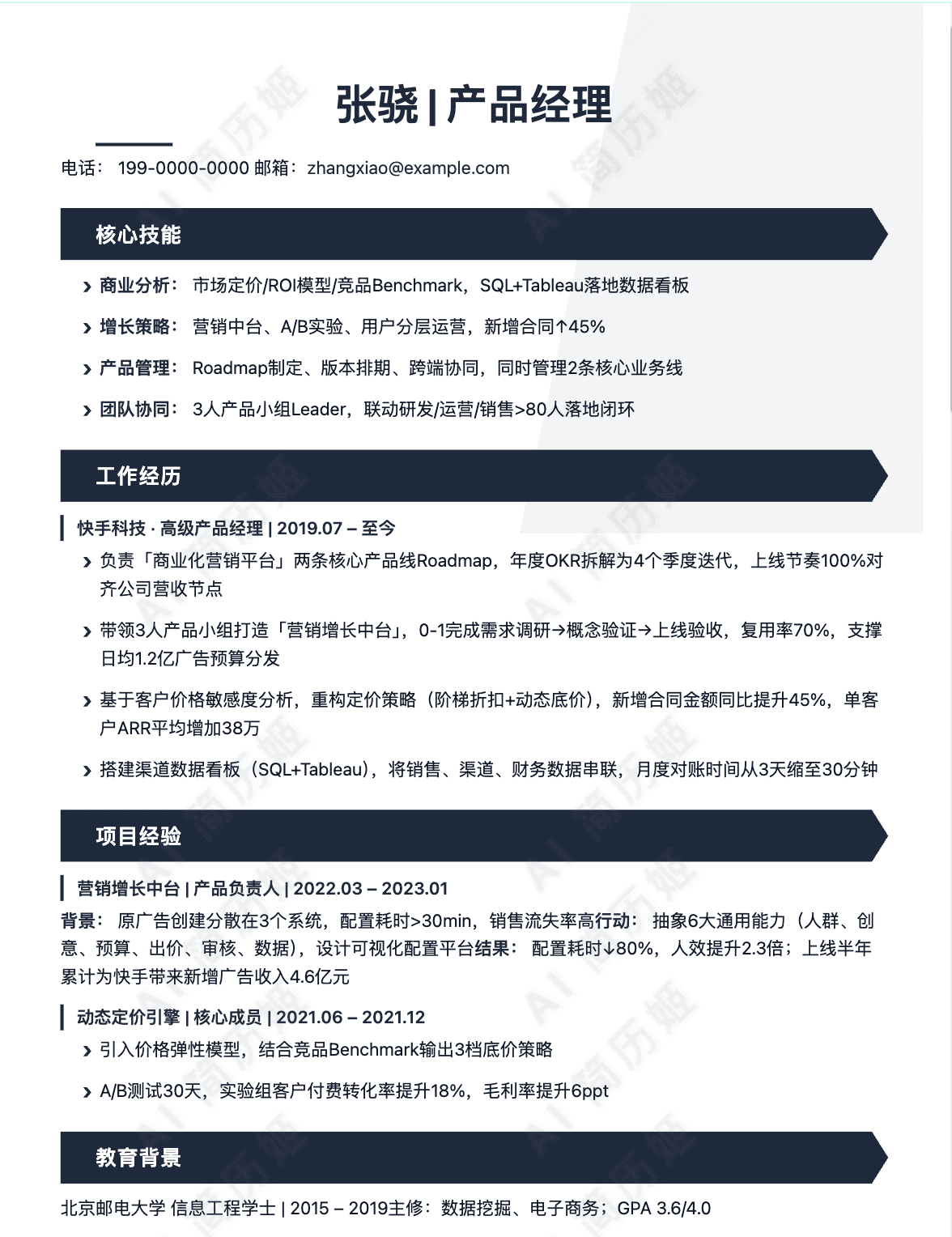
Properly Format Your Project Manager Resume
A polished, professional format is non-negotiable for a Project Manager resume. It demonstrates your organizational skills, attention to detail, and respect for the reader's time—core competencies of the role. A well-structured document ensures your achievements are seen and easily understood by both human recruiters and automated systems.
Resume Length: The One- to Two-Page Rule
For most Project Managers, a one-page resume is ideal for under 10 years of experience. Senior PMs, program managers, or those with extensive, relevant achievements can effectively use two pages. The key is relevance: every line should strengthen your case for the specific role. Never sacrifice readability or white space to cram content onto one page.
Choosing the Right Resume Format
The format you choose frames your narrative. For Project Managers, the following are most common:
Chronological (Reverse-Chronological): The industry standard. Lists work experience in reverse order, emphasizing career progression and stable employment. Best for those with a linear career path in project management.
Combination/Hybrid: The most recommended for PMs. It starts with a powerful summary and a "Core Competencies" or "Skills" section, followed by reverse-chronological work experience. This format highlights your relevant skills upfront before detailing where you applied them.
Font, Margins, and Spacing Standards
Clarity and scannability are paramount. Use a professional, easy-to-read sans-serif font (e.g., Calibri, Arial, Helvetica) or a clean serif font (e.g., Cambria, Georgia). Font size should be 11-12pt for body text and 14-16pt for your name. Maintain consistent margins of at least 0.5 inches on all sides, with 0.75 to 1 inch being standard. Use single or 1.15 line spacing within sections and add a clear space between sections to create visual separation.
File Format: Always PDF
Unless the job posting specifically requests a .docx file, always submit your resume as a PDF. A PDF preserves your formatting across all devices and operating systems, ensuring it looks exactly as you designed it. Name your file professionally: FirstName_LastName_PM_Resume.pdf.
ATS Optimization Basics
Most companies use Applicant Tracking Systems (ATS) to screen resumes. To pass through:
Use standard section headings (e.g., "Work Experience," "Skills," "Education"). Avoid graphics, text boxes, columns, or headers/footers for critical information. Incorporate keywords from the job description naturally (e.g., "stakeholder management," "budget oversight," "risk mitigation," "Scrum"). Spell out acronyms at least once (e.g., "Project Management Professional (PMP)").
Good Formatting Example: Resume Header
JANE DOE, PMP
Senior IT Project Manager | Agile & Hybrid Methodologies
(123) 456-7890 | jane.doe@email.com | linkedin.com/in/janedoepmp | City, State
Bad Formatting Mistakes to Avoid
One‑click format & basics check
Auto‑check contacts, links and layout; generate an ATS‑friendly header.
Write a Strong Project Manager Resume Summary or Objective
The opening statement of your resume is a critical piece of real estate. For Project Managers, it must immediately communicate your ability to lead, execute, and deliver value. This section is typically a Summary for experienced professionals or an Objective for those new to the field.
Summary vs. Objective: Which One to Use?
A resume summary is a brief, powerful statement highlighting your career achievements, core skills, and the value you bring. It's best for candidates with relevant project management experience.
A resume objective focuses on your career goals, enthusiasm, and transferable skills. It's suitable for entry-level candidates, career changers, or those targeting a very specific role.
Key Elements to Include
Whether summary or objective, your statement should be a targeted blend of the following: years of experience (if applicable), core methodologies (e.g., Agile, Waterfall, Scrum), key competencies (e.g., risk management, stakeholder communication, budgeting), and a quantifiable value proposition (e.g., "consistently delivering projects on time and under budget").
Optimal Length and Tailoring
Keep this section to 2-4 concise, impactful sentences. Never use a generic statement. Always tailor it by incorporating keywords and requirements from the specific job description. If the ad emphasizes "Agile transformation" and "cross-functional team leadership," those phrases should be reflected in your summary.
Good Examples for Your Resume
For an experienced Project Manager (Summary):
For an entry-level candidate or career changer (Objective):
Bad Examples to Avoid
Here are common pitfalls with explanations:
Why it's bad: Vague, cliché, and self-centered. It states what you want, not what you offer.
Why it's bad: Fragmented, lacks detail and impact. It lists basic duties without showcasing scope, results, or competencies.
Why it's bad: This is just a list of generic soft skills without context or proof. It reads like keyword stuffing and is forgettable.
Why it's bad: Unfocused and unprofessional wording ("done many things"). A strong summary would focus on transferable PM skills across industries, not list them disjointedly.
Generate skills list / summary
Extract hard/soft skills from the JD and create 3 summary variants.
Include Your Best Hard and Soft Skills as a Project Manager
Your skills section is a critical component of your resume, acting as a quick-reference guide for recruiters and Applicant Tracking Systems (ATS). For a Project Manager, a balanced and well-presented mix of hard and soft skills demonstrates both your technical competency and your leadership ability. Hard skills are the teachable, measurable technical abilities and knowledge, while soft skills are the interpersonal and behavioral attributes that enable you to work effectively with others.
Essential Hard Skills for a Project Manager
These are the technical and methodological competencies required to plan, execute, and close projects successfully. You should list specific methodologies, tools, and technologies you are proficient with.
- Project Methodologies: Waterfall, Agile (Scrum, Kanban), Hybrid, PRINCE2, Critical Path Method (CPM)
- Project Management Software: Microsoft Project, Jira, Asana, Trello, Smartsheet, Monday.com
- Budgeting & Financial Management: Cost estimation, forecasting, variance analysis, proficiency with Excel or specialized tools
- Scheduling & Resource Management: Gantt chart creation, resource allocation and leveling, dependency mapping
- Risk Management: Risk identification, qualitative/quantitative analysis, mitigation planning
- Quality Management: Knowledge of standards (e.g., ISO, Six Sigma), quality assurance/control processes
- Technical Documentation: Writing project charters, requirements specs, status reports, RAID logs
- Data Analysis & Reporting: Using tools like Power BI, Tableau, or advanced Excel for KPI dashboards
- Stakeholder & Communication Tools: Proficiency with Confluence, SharePoint, MS Teams, Slack for centralized communication
- Industry-Specific Knowledge: Understanding of SDLC for IT, regulatory frameworks for healthcare, construction codes, etc.
Critical Soft Skills for a Project Manager
These skills determine how you interact with your team, stakeholders, and challenges. They are often the differentiator between a good PM and a great one.
- Leadership & Influence: Motivating teams without direct authority, driving decision-making, and inspiring confidence.
- Communication: Clear and concise verbal/written updates, active listening, and tailoring messages for different audiences (team, executives, clients).
- Stakeholder Management: Managing expectations, building trust, and navigating complex organizational politics.
- Conflict Resolution & Negotiation: Mediating disagreements within the team and negotiating scope, timelines, or resources with sponsors.
- Adaptability & Problem-Solving: Thinking critically under pressure, pivoting strategies when faced with obstacles, and maintaining composure.
- Emotional Intelligence (EQ): Being aware of your own and others' emotions to manage interactions judiciously and empathetically.
How to Organize Your Skills Section
A categorized format is vastly superior to a simple bulleted list, as it improves readability and helps recruiters find what they're looking for instantly.
Project Management Skills
- Methodologies: Agile (Scrum, Kanban), Hybrid, Waterfall
- Tools: Jira, Microsoft Project, Confluence, Smartsheet, MS Teams
- Core Competencies: Budgeting & Forecasting, Risk Management, Resource Allocation, SDLC
Leadership & Soft Skills
- Stakeholder Management & Communication
- Cross-Functional Team Leadership
- Conflict Resolution & Negotiation
- Strategic Problem-Solving
- Microsoft Project
- Leadership
- Good communicator
- Jira
- Budgeting
- Team player
- Problem solver
- Agile
This disorganized list mixes skill types, uses weak language ("good communicator"), and forces the reader to hunt for relevant keywords.
Matching Skills with Job Description Keywords
Carefully review the job description and mirror its language. If it asks for "Agile Scrum," use that exact phrase, not just "Agile." This is crucial for ATS scans and shows you are a precise fit.
Job Description Asks For: "Experience managing SaaS implementation projects using Agile methodologies and Jira."
Your Resume Should Include: "Project Methodologies: Agile (Scrum)", "Software: Jira", and "Industry Knowledge: SaaS Implementation Lifecycle."
Job Description Asks For: "Proven track record in risk mitigation and financial oversight."
Your Resume Only Has: "Managed budgets" and "Handled project issues." This misses the powerful keywords "risk mitigation" and "financial oversight."
AI‑assisted bullet quantification
Rewrite bullets using STAR/metrics and auto‑fill numbers and verbs to highlight impact.
Describe Your Work Experience and Key Projects as a Project Manager
Senior Project Manager | TechFlow Solutions | San Francisco, CA | Jan 2021 – Present
Lead cross-functional teams in the delivery of enterprise SaaS solutions for Fortune 500 clients, managing a portfolio with an average annual value of $4M.
- Challenge: Client's legacy system migration was 20% over budget and at risk of missing a critical Q4 market launch due to scope creep and vendor delays.
- Action: Spearheaded a project recovery plan, re-negotiating vendor SOWs, implementing a daily stand-up with core tech leads, and decomposing epics into granular, tracked tasks.
- Result: Delivered the "Nexus Platform" migration two weeks ahead of the revised deadline and 15% under the recovered budget, resulting in a 30% increase in client processing efficiency and a contract renewal for 3 additional phases.
- Orchestrated the adoption of a hybrid Agile-Waterfall framework across 5 project teams, reducing average project cycle time by 22% and improving stakeholder satisfaction scores by 18 points.
- Mentored 3 Associate Project Managers, developing their risk management and client communication skills, leading to two early promotions within the department.
Project Manager | Global Retail Corp | Chicago, IL | Jun 2018 – Dec 2020
Managed the end-to-end execution of digital and in-store technology projects to enhance customer experience and operational efficiency for a $10B retail chain.
- Challenge: In-store mobile checkout initiative was plagued by poor user adoption (less than 5%) and negative feedback from frontline staff, threatening ROI.
- Action: Conducted user journey workshops with store associates and customers, reprioritizing the product backlog to address top 10 usability issues. Led a pilot program in 10 high-traffic stores.
- Result: Increased mobile checkout adoption to 35% within 6 months of re-launch, contributing to a 12% reduction in average wait times and saving an estimated 5,000 staff hours annually.
- Managed the $500K RFID inventory tracking pilot project, coordinating with logistics, IT, and store operations, which achieved 99.8% inventory accuracy and reduced stock-count labor by 75%.
- Consistently delivered projects within 5% of the approved budget by implementing rigorous weekly budget vs. actual reviews and forecast adjustments.
Associate Project Manager | BrightMind EdTech | Austin, TX | Jul 2016 – May 2018
Supported the development and launch of K-12 learning applications, assisting senior PMs and leading smaller feature development sprints.
- Coordinated the "Gamified Math Module" project using Scrum, facilitating sprint planning, reviews, and retrospectives for a development team of 8.
- Acted as the primary liaison between the development team and QA, reducing the average bug turnaround time from 5 days to 2 days by improving ticket documentation and prioritization.
- Tracked and reported on project KPIs using Jira and Confluence, creating dashboards that provided real-time visibility into sprint velocity and release readiness, which improved stakeholder communication.
- Result: Contributed to the on-time launch of 3 major app features, which collectively acquired 50,000 new student users in the first quarter post-release.
Examples of Poor Work Experience Descriptions
- Was responsible for managing projects.
- Had meetings with the team and stakeholders.
- Made sure projects were done on time.
- Used Microsoft Office and Jira.
- Did a lot of important software projects.
- Helped make things more efficient.
- Led big teams successfully.
- Got good feedback from my boss.
- Successfully completed all assigned projects.
- Duties included budgeting, scheduling, and team leadership.
- Improved processes.
- Result: Made the company better.
I oversaw the implementation of a new CRM system. It was a challenging project because the sales team was resistant. I talked to them and got the vendor to do more training. In the end, it worked out.
Problem: Written in a paragraph instead of bullet points, lacks structure (CAR/STAR), mentions a challenge but gives no concrete actions or quantified results.Project experience quantifier
Split goals, actions and results; auto‑suggest metrics and format project cards.
Include Action Words to Make Your Project Manager Resume Pop
In a competitive job market, your project manager resume must immediately communicate your capability and impact. Strategic use of action verbs is crucial for two key reasons: first, they help your resume pass through Applicant Tracking Systems (ATS) which are programmed to scan for these powerful keywords; second, they capture the attention of human recruiters by painting a vivid picture of your leadership and results, transforming a list of duties into a compelling narrative of achievement.
Categorized Action Verbs for Project Managers
Organizing your experience with these categorized verbs helps you tailor your resume for specific roles and ensures you cover all facets of project management.
Leadership & Management: Spearheaded, Orchestrated, Directed, Championed, Governed, Mobilized, Piloted, Steered.
Technical Implementation: Engineered, Automated, Integrated, Migrated, Deployed, Architected, Streamlined, Systematized.
Problem-Solving: Resolved, Remediated, Troubleshot, Mitigated, Rectified, Debugged, Overcame.
Collaboration: Liaised, Aligned, Fostered, Coordinated, Facilitated, Partnered, Unified, Mediated.
Achievement & Impact: Accelerated, Amplified, Maximized, Optimized, Boosted, Slashed, Expanded, Surpassed.
Analysis & Research: Analyzed, Evaluated, Audited, Forecasted, Validated, Assessed, Modeled, Quantified.
Innovation: Pioneered, Innovated, Revamped, Transformed, Modernized, Conceptualized, Redesigned.
Avoiding Repetition and Weak Language
Using the same verb like "managed" or "responsible for" repeatedly dilutes your resume's power and suggests a limited scope. The goal is to replace generic, passive, or weak phrases with specific, strong action verbs that convey ownership and result.
Before and After: Weak vs. Strong Verb Examples
Weak: Was responsible for a team of developers.
Strong: Led a cross-functional team of 8 developers; Mobilized a team of developers to achieve sprint goals.
Weak: Did work on the budget for the project.
Strong: Governed a $500K project budget, maintaining costs 10% under forecast.
Weak: Made the process better.
Strong: Streamlined the QA process, slashing release cycle time by 15%.
Weak: Talked to stakeholders about requirements.
Strong: Liaised with key stakeholders to elicit and validate project requirements.
Weak: Handled problems that came up during implementation.
Strong: Mitigated critical path risks and resolved vendor deployment issues, preventing a 3-week delay.
Strong Action Verb Usage in Context
Here are examples of how these powerful verbs come to life in resume bullet points:
1. Orchestrated the end-to-end launch of a new SaaS platform, coordinating efforts across engineering, marketing, and sales teams.
2. Pioneered an Agile/Scrum adoption that amplified team velocity by 25% and boosted product quality.
3. Analyzed user feedback and performance metrics to redesign the onboarding workflow, slashing customer churn by 18%.
4. Steered a $2M infrastructure migration project, mitigating risks to achieve a seamless transition with zero data loss.
3 summary versions in seconds
Combine role highlights and strengths to generate concise, confident and specific summaries.
Make Your Education Section Count
Your education section is more than a formality; it's a chance to showcase foundational knowledge and academic excellence. For project managers, it provides context for your analytical, leadership, and organizational skills. Tailoring this section to your career stage is crucial for making the right impact.
Essential Information to Include
At a minimum, list your degree, major, university name, and graduation date. This core information is non-negotiable and should be presented clearly and consistently.
University of Michigan, Ross School of Business
Graduated: May 2018
Strategic Placement: Top or Bottom?
Where you place your education section depends on your experience level. Recent graduates or career changers with less than 5 years of project management experience should place it near the top, right after the summary. Experienced professionals with a robust work history should move it to the bottom, as their recent accomplishments will carry more weight.
Enhancing Your Entry-Level Profile
If you are new to the field, leverage your academic background to bridge the experience gap. Include relevant coursework, significant projects, and your thesis or capstone work. This demonstrates applied knowledge.
Capstone Project: Led a 5-person student team to develop a full project charter, WBS, and risk register for a simulated $500K community tech initiative, delivering the presentation to a panel of industry professionals.
GPA, Honors, and Awards
Include your GPA only if it is strong—typically 3.5 or higher on a 4.0 scale. Otherwise, omit it. Academic honors, scholarships, and awards, however, should always be included as they are tangible proof of merit and stand out to recruiters.
Carnegie Mellon University
Graduated: Magna Cum Laude, May 2023 | GPA: 3.7/4.0
Awards: University Trustee Scholarship (Full-tuition), Dean's List (All Semesters)
Format for the Experienced Professional
Seasoned project managers should keep this section concise and focused on credentials. Highlight advanced degrees and relevant certifications, letting your professional experience section do the heavy lifting.
PMP® Certification, Project Management Institute (2020)
Master of Science, Engineering Management, Stanford University (2012)
Bachelor of Science, Civil Engineering, Georgia Institute of Technology (2008)
Examples of Poor Education Sections
Avoid these common mistakes that weaken your resume's professionalism and clarity.
• 2009: Got my diploma
Auto‑format education & certifications
Normalize titles, dates and bullets — ATS‑safe by default.
Select the Perfect Extra Sections for Your Project Manager Resume
While the core sections of your resume (Experience, Skills, Education) are non-negotiable, strategically chosen extra sections can be the differentiator. They provide a more holistic view of your capabilities, demonstrate passion, and fill potential gaps, helping you stand out in a competitive field.
Recommended Extra Sections to Showcase Your Value
Consider these optional sections to enhance your project manager resume:
1. Technical Projects
When to Include: Ideal for entry-level candidates, career changers, or PMs in tech-heavy industries (IT, software, engineering) who need to demonstrate hands-on capability. Use this section to detail personal or academic projects where you applied project management methodologies, tools, or technical skills.
How to Format: Treat it like a work experience section. For each project, include the project name, your role, dates, and 2-3 bullet points highlighting objectives, tools used (e.g., Jira, Asana, SQL), and quantifiable outcomes.
2. Publications & Speaking Engagements
When to Include: Highly recommended for senior, principal, or director-level project managers. This section establishes you as a thought leader and expert in your domain. It shows you contribute to the broader professional community.
How to Format: List formally. For publications, include title, publication name, and date (or "forthcoming"). For speaking, list the event/conference name, your presentation title, and the date. This adds immense credibility.
3. Languages
When to Include: Include this section if you are proficient in more than one language, especially if the role involves international teams, clients, or stakeholders. Even conversational proficiency can be a valuable asset in global organizations.
How to Format: List languages clearly and honestly indicate your proficiency level (e.g., Native, Fluent, Professional Working Proficiency, Conversational). Avoid overstating your ability.
4. Professional Affiliations
When to Include: Include if you are an active member of organizations like the Project Management Institute (PMI), Agile Alliance, or Scrum Alliance. Mentioning "PMI Member" or "Certified ScrumMaster® (CSM)" is good, but a dedicated section shows deeper engagement if you hold leadership roles within the chapter or regularly attend events.
How to Format: List the organization name, your membership type or role (e.g., "Active Member," "Chapter Volunteer"), and the duration of your involvement.
5. Volunteer Experience
When to Include: Include if the volunteer work utilized or developed project management skills (e.g., coordinating a community fundraiser, managing a website redesign for a non-profit). It's also valuable if it demonstrates leadership or fills an employment gap. If it's not relevant, omit it.
How to Format: Format it like a professional experience entry. Focus on transferable PM skills and achievements, even if the context was volunteer-based.
Sections to AVOID on Your Project Manager Resume
Be selective and professional. Avoid cluttering your resume with:
"References Available Upon Request": This is assumed and wastes valuable space. Have a separate document ready.
An "Objective" Statement: For most PMs, a professional "Summary" or "Profile" section is far more powerful and common.
Irrelevant Hobbies or Personal Details: Unless a hobby directly demonstrates a relevant skill (e.g., competitive chess for strategic thinking), it typically doesn't belong. Never include marital status, age, or a photo.
An Uncurated "Interests" List: Like hobbies, keep this out unless it creates a genuine, professional point of connection.
Outdated or Beginner-Level Skills: Listing Microsoft Word as a skill is not impressive. Focus on specialized PM software (MS Project, Smartsheet), collaboration tools (Confluence, Slack), and methodologies (Agile, Waterfall, Hybrid).
Pitfalls check
Detect formatting/wording pitfalls and suggest instant rewrites and formatting.
How to Tailor Your Project Manager Resume for a Specific Job Description
In today's competitive job market, a generic resume is a fast track to the rejection pile. For Project Managers, tailoring your resume to each specific job description is not just a recommendation—it's a necessity. It demonstrates your attention to detail, your understanding of the role's unique needs, and directly shows the hiring manager you are the solution to their problem. This section will guide you through the process of effectively customizing your resume.
Step 1: Analyze the Job Description
Begin by thoroughly dissecting the job posting. Look beyond the job title. Print it out or copy it into a document and highlight or underline every requirement, skill, and keyword. Pay special attention to recurring themes, specific methodologies (like Agile, Scrum, Waterfall), required software (like Jira, MS Project, Asana), and industry-specific terminology. Separate "must-haves" from "nice-to-haves" to prioritize your matching efforts.
Step 2: Map Your Experience
With the job's requirements clearly identified, audit your own experience. Create a two-column list: on one side, list the key requirements from the job description; on the other, list your corresponding accomplishments, skills, and quantifiable results. Be specific. Instead of just "managed projects," note "Managed a $500K SaaS implementation using Agile, delivering 2 weeks ahead of schedule." This mapping becomes the blueprint for your tailored resume.
Step 3: Customize Key Sections
Use your mapping document to strategically rewrite your resume's most critical sections. Start with your Professional Summary, weaving in top keywords and aligning your career narrative with the company's stated goals. Next, revamp your Work Experience bullet points. For each past role, lead with the accomplishments most relevant to the new job. Finally, ensure your Skills section mirrors the exact terminology used in the posting, prioritizing the most requested skills at the top.
Example: Generic vs. Tailored Resume Bullet
Generic: "Led project teams to deliver software products."
Tailored (for a job seeking "Agile," "cross-functional teams," and "on-time delivery"): "Orchestrated cross-functional Agile teams of 12 to deliver 4 major software releases in 2 years, consistently meeting sprint deadlines and improving release cycle time by 15%."
Common Mistakes to Avoid
Avoid these pitfalls when tailoring your resume: Over-tailoring to the point of misrepresentation—never claim experience or certifications you don't have. Keyword stuffing—keywords should be integrated naturally into your accomplishments, not listed awkwardly. Forgetting to tailor your cover letter—your resume and cover letter should tell a cohesive, targeted story. Saving every version as "resume_final_v2.pdf"—save your files with clear names like "FirstName_LastName_PM_CompanyName.pdf" to stay organized and professional.
Striking the Right Balance
The goal of tailoring is to create a powerful, authentic connection between your proven capabilities and the employer's specific needs. It's about framing your existing experience through the lens of what they value most. By following a structured process of analysis, mapping, and customization, you transform your resume from a general history into a compelling, targeted argument for your candidacy.
Pick the right template and apply
Recommend templates by industry and seniority; auto‑map existing content.
Project Manager Resume Examples (Complete Samples)
Apply example in one click
Pick an example and auto‑adapt to your experience and skills.
Frequently Asked Questions (FAQ)
How long should a Project Manager resume be?
For most Project Managers, a one-page resume is ideal, especially with under 10-15 years of experience. Senior PMs with extensive, relevant leadership roles and a track record of complex programs may extend to two pages. Prioritize conciseness and relevance, as hiring managers often scan quickly.
What's the best format for a Project Manager resume?
The reverse-chronological format is highly recommended, as it clearly showcases your career progression and recent achievements. A hybrid format, which combines a strong skills section with chronological experience, is also effective. Avoid functional resumes, as they can obscure your work history.
What are the most important skills to include on a Project Manager resume?
Include a mix of technical (hard) and leadership (soft) skills. Hard skills include methodologies (Agile, Scrum, Waterfall), tools (Jira, MS Project, Asana), and budgeting. Essential soft skills are leadership, communication, stakeholder management, and risk management. Tailor this list to match the keywords in the job description.
Should I get a PMP certification before applying, and how do I list it?
While not always mandatory, the Project Management Professional (PMP) certification is a significant differentiator and is highly valued. If you have it, list it prominently in a "Certifications" section and/or next to your name in the header. If you're in progress, you can note "PMP (Expected [Month, Year])".
How should I describe my work experience to stand out?
Use bullet points that start with strong action verbs and quantify your impact. Instead of "Responsible for project timelines," write "Managed a $2M software development project, delivering it 2 weeks ahead of schedule and 10% under budget." Focus on outcomes, scope, budget, timeline, and team size.
Should I include a "Projects" section separate from my work experience?
This is beneficial if you have significant freelance, academic, or internal projects that don't fit neatly under a single job title. For example, an IT professional transitioning to PM could list a major system implementation here. For most, integrating projects within the relevant job entry is clearer.
How do I write a Project Manager resume with no direct PM experience?
Focus on transferable skills and project-based accomplishments from your current roles. Use a strong summary to frame your objective, highlight relevant skills like organization and coordination, and detail any project contributions (e.g., "Led a cross-functional team of 4 to implement a new CRM system").
As an entry-level candidate, should I include my GPA or relevant coursework?
Include your GPA if it's above 3.5/4.0 and you're a recent graduate (within 3 years). You can list relevant coursework (e.g., Project Management Fundamentals, Operations) if you lack practical experience. However, prioritize internships, capstone projects, and any leadership roles in clubs or organizations.
What if I'm changing careers to become a Project Manager?
Use a combination or hybrid resume format. Start with a powerful summary that states your transition goal and highlights transferable skills. In your experience section, reframe past achievements using PM terminology—emphasize leadership, budgeting, process improvement, and any project coordination you performed.
How many years of work history should I include on my resume?
Generally, include the last 10-15 years of relevant experience. For a Project Manager, this is typically enough to demonstrate expertise. You can summarize earlier roles in a brief "Earlier Career" section if they add valuable context, but the focus should be on your most recent and impactful positions.
Should I include a photo on my Project Manager resume?
No, you should not include a photo on your resume in the US, Canada, or UK. It can introduce unconscious bias and is not standard professional practice. Focus the space on your skills and accomplishments. In some countries, it is customary, so always research local norms for the job market you're targeting.
How important are keywords, and how should I use them?
Extremely important, as many companies use Applicant Tracking Systems (ATS). Integrate keywords naturally from the job description, such as specific methodologies (Scrum, PRINCE2), tools, and skills (Stakeholder Engagement, Risk Mitigation). Include them in your skills section and weave them into your bullet points.