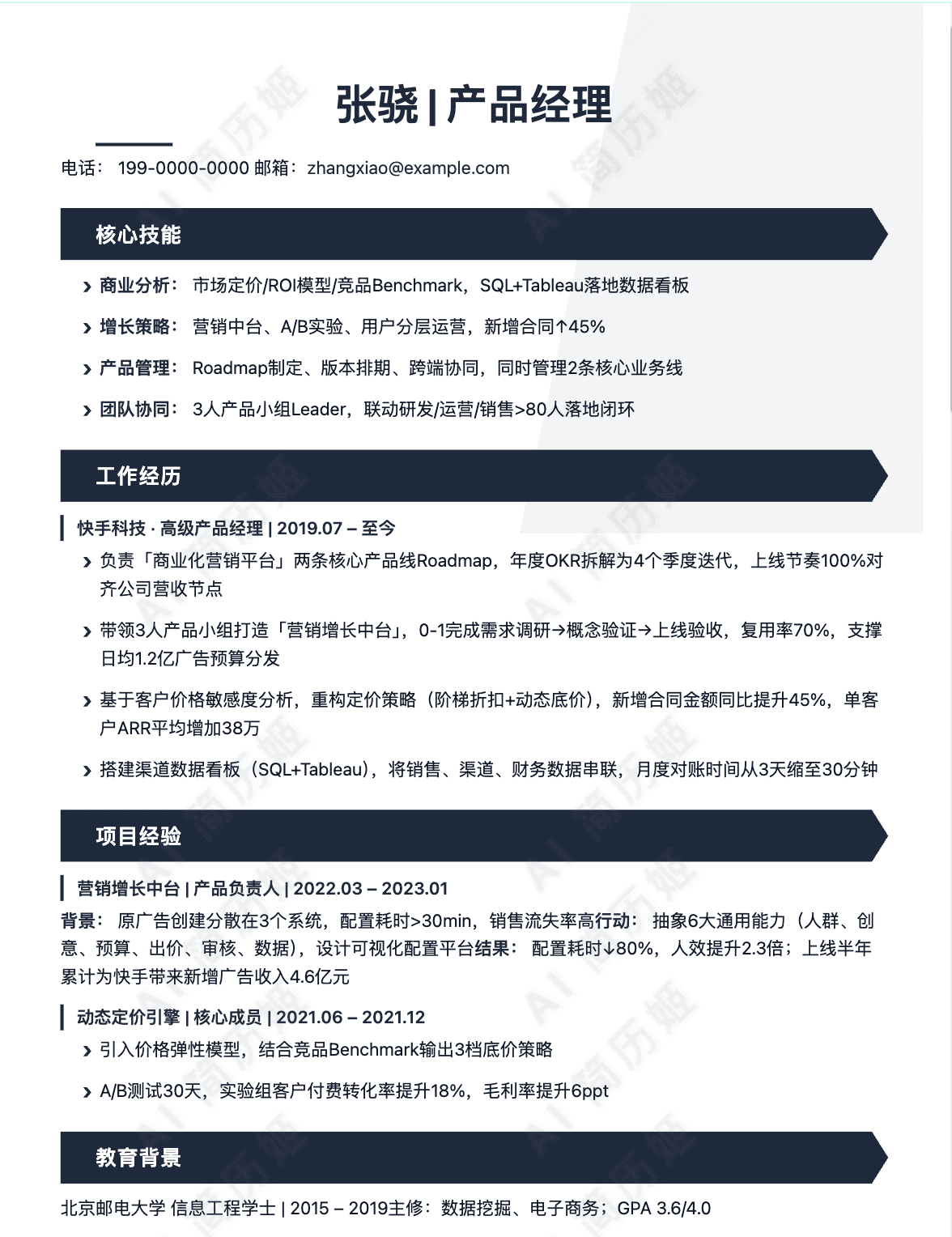
Properly Format Your Customer Service Representative Resume
A well-formatted resume is your first opportunity to demonstrate your attention to detail and professionalism. For a Customer Service Representative, this is particularly important, as these qualities are central to the role. A clean, organized, and easy-to-read format ensures your key skills and experiences are noticed by both hiring managers and automated Applicant Tracking Systems (ATS).
Resume Length: Keep It to One Page
As a general rule, Customer Service Representatives should aim for a one-page resume. This length is sufficient to detail your relevant experience, skills, and accomplishments without overwhelming the reader. A concise, one-page document is easier to scan and shows you can prioritize information effectively. If you have over 10-15 years of highly relevant experience, a second page may be acceptable, but for most applicants, one page is the target.
Choose the Right Resume Format
Selecting the appropriate format is crucial for presenting your background in the best light. The chronological format is almost always the most effective for Customer Service Representatives.
Chronological Format: This format lists your work history in reverse-chronological order, with your most recent job first. It is the gold standard because it highlights career progression and stability, which are highly valued in customer service roles. It is also the format most easily parsed by ATS software.
Functional Format: This format focuses on skills and abilities rather than work history. It is not recommended for CSR roles as it can raise red flags about employment gaps and lack of specific experience.
Combination/Hybrid Format: This format blends elements of both chronological and functional resumes. It can be useful for career changers who have transferable skills, but for most, the straightforward chronological format is the safest and most effective choice.
Font, Margins, and Spacing Standards
Your resume should be visually balanced and easy to read. Stick to professional, clean fonts that are universally recognized. Margins should be between 0.5" and 1" on all sides to create a balanced frame of white space. Use line spacing (leading) between 1.0 and 1.15 to ensure text is not cramped, and add a blank line between sections for clear visual separation.
File Format: Always Submit a PDF
Unless the job application specifically requests a different format, you should always save and submit your resume as a PDF (.pdf). A PDF preserves your formatting across all devices and operating systems, ensuring that the hiring manager sees the clean, professional layout you intended. A Microsoft Word document (.docx) can have its formatting altered when opened on a different computer.
Optimizing for Applicant Tracking Systems (ATS)
Many companies use ATS software to scan and filter resumes before they ever reach a human. To get past this digital gatekeeper, your formatting must be ATS-friendly. This means using a simple, clean layout with standard section headings (e.g., "Work Experience," "Skills," "Education"). Avoid using images, graphics, tables, or text boxes, as the ATS may be unable to read them. Instead, rely on bullet points and bold text for emphasis.
Good and Bad Formatting Examples
Here is an example of a properly formatted resume header and contact information section:
(123) 456-7890 | jane.doe@email.com | linkedin.com/in/janedoe | Seattle, WA
Here are specific formatting mistakes that can hurt your chances:
One‑click format & basics check
Auto‑check contacts, links and layout; generate an ATS‑friendly header.
Write a Strong Customer Service Representative Resume Summary or Objective
The resume summary or objective is the first thing a hiring manager reads. This brief section, located at the top of your resume, must immediately capture their attention by showcasing your most relevant skills and career goals. A well-crafted introduction can be the difference between landing an interview and having your resume overlooked.
Resume Summary vs. Objective: What's the Difference?
Understanding the distinction between a summary and an objective is crucial for making a strong first impression.
Resume Summary: A resume summary is a 2-4 sentence professional synopsis that highlights your experience, key skills, and major accomplishments. It is best suited for candidates with relevant work experience in customer service.
Resume Objective: A resume objective is a 2-4 sentence statement of your career goals and the value you hope to bring to a company. It is ideal for those new to the workforce, such as recent graduates, career changers, or those with limited experience.
When to Use a Summary vs. an Objective
Your career level should dictate your choice. Using the wrong one can send the wrong message to potential employers.
Use a Resume Summary if: You have one or more years of experience in customer service, call center, or related roles. It allows you to sell your proven track record.
Use a Resume Objective if: You are an entry-level candidate, a recent graduate, or transitioning from a different industry. It allows you to focus on your transferable skills and enthusiasm.
Key Elements to Include
Whether you choose a summary or an objective, it must contain specific, compelling information. Avoid generic statements and focus on these core elements:
Years of Experience: Mention your total years in the field (e.g., "Customer service professional with 5+ years of experience...").
Core Competencies: List 2-3 key skills mentioned in the job description, such as "conflict resolution," "CRM software," "order processing," or "multilingual support."
Value Proposition or Goal: For a summary, state what you bring to the table (e.g., "...aiming to leverage proven support skills to enhance customer satisfaction scores"). For an objective, state what you aim to achieve (e.g., "...seeking to apply excellent communication and problem-solving skills to support customers and contribute to team goals").
Optimal Length and Structure
Recruiters often scan resumes quickly. Your summary or objective should be a concise, powerful pitch, not a lengthy paragraph. Aim for 2-4 concise sentences or 3-5 bullet points. Use strong action verbs and quantify your achievements whenever possible to add credibility and impact.
How to Tailor It to the Job Posting
A generic summary/objective is ineffective. To stand out, you must customize this section for each job you apply for. Carefully read the job description and identify keywords related to skills, software, and qualifications. Then, mirror that language in your summary or objective. If the ad emphasizes "retention" and "technical support," ensure those terms are featured in your statement.
Good Resume Summary Examples
Here are examples of strong resume summaries for experienced professionals:
Good Resume Objective Examples
Here are examples of effective resume objectives for those with less experience:
Bad Resume Summary/Objective Examples
Avoid these common mistakes that can weaken your resume:
Why it's bad: It's self-centered, vague, and shows no specific skills or value offered to the employer.
Why it's bad: It's generic, lacks quantifiable achievements, and uses weak language ("done," "good with"). It fails to differentiate you from other applicants.
Why it's bad: This is a cliché that focuses entirely on what you want from the company, not what you can contribute. It provides no relevant skills or experience.
Why it's bad: This simply lists duties from a job description without showcasing any results, skills, or the impact of your work.
Generate skills list / summary
Extract hard/soft skills from the JD and create 3 summary variants.
Include Your Best Hard and Soft Skills as a Customer Service Representative
A well-crafted skills section is a critical component of any Customer Service Representative resume. It allows hiring managers to quickly assess your qualifications and see if you have the specific abilities needed for the job. This section should be a balanced mix of hard skills (teachable, measurable abilities) and soft skills (interpersonal traits and behaviors).
Hard Skills vs. Soft Skills: What's the Difference?
Hard Skills are the technical, teachable abilities you've acquired through training, education, or experience. For a Customer Service Representative, these are the specific tools and systems you know how to use. Soft Skills are your personal attributes and interpersonal skills that describe how you work and interact with others. They are often more subjective but are equally, if not more, important for success in a customer-facing role.
Essential Hard Skills for a Customer Service Representative
Here are 8-12 role-specific hard skills that demonstrate your technical proficiency. Be specific about the tools and technologies you have experience with.
- Customer Relationship Management (CRM) Software (e.g., Salesforce, Zendesk, HubSpot Service Hub)
- Help Desk & Ticketing Systems (e.g., Freshdesk, Jira Service Management, Zoho Desk)
- Live Chat Support Platforms (e.g., LiveChat, Intercom, Drift)
- Phone Systems & VoIP (e.g., Five9, Aircall, RingCentral)
- Payment Processing & Billing Software (e.g., Stripe, Square, PayPal)
- Microsoft Office Suite & Google Workspace (Advanced proficiency in Excel/Sheets for data tracking)
- Knowledge Base Management & Documentation
- Social Media Management Tools (e.g., Hootsuite, Sprout Social) for customer service outreach
- Basic Technical Troubleshooting & Product Knowledge
- Data Entry & Speed Typing (e.g., 60+ WPM)
- Multilingual Support (e.g., Fluent in Spanish and English)
Relevant Soft Skills for a Customer Service Representative
These 4-6 professional skills showcase your ability to build relationships and handle challenging situations effectively.
- Empathy & Active Listening
- Verbal & Written Communication
- Problem-Solving & Critical Thinking
- Patience & Resilience
- Conflict Resolution & De-escalation
- Time Management & Organization
How to Organize Your Skills Section
You can present your skills in a simple list format, but a categorized format is often more impactful and easier for recruiters to scan. Grouping your skills shows a higher level of organization and allows you to tailor the section more precisely to the job description.
Skills
Technical & Software Proficiency
Zendesk, Salesforce CRM, Freshdesk, LiveChat, Five9 VoIP, Microsoft Office Suite, Stripe
Customer Service & Communication
Conflict Resolution, Empathetic Listening, Verbal & Written Communication, Problem-Solving
Operational Excellence
Time Management, Data Entry, Multitasking, Knowledge Base Documentation
Skills
Good with people, Microsoft Office, phone skills, typing, problem solver, CRM, communication, team player, hard worker, detail-oriented
Matching Your Skills with Job Description Keywords
Always carefully review the job description and mirror its language. If the ad emphasizes "de-escalation," "CRM software," and "multitasking," ensure those exact terms are in your skills section. Many companies use Applicant Tracking Systems (ATS) to scan for these keywords, so this is a crucial step to get your resume seen by a human.
Job Description Seeks: "Proven experience with CRM platforms, de-escalating tense situations, and providing timely support via phone and email."
Your Skills Section Includes: "Salesforce CRM, Conflict De-escalation, Phone & Email Support, Time Management"
Job Description Seeks: "Proven experience with CRM platforms, de-escalating tense situations, and providing timely support via phone and email."
Your Skills Section Includes: "Customer software, calming people down, fast responses"
AI‑assisted bullet quantification
Rewrite bullets using STAR/metrics and auto‑fill numbers and verbs to highlight impact.
Describe Your Work Experience and Key Projects as a Customer Service Representative
Senior Customer Service Specialist | TechSolutions Inc. | San Francisco, CA | June 2020 – Present
Customer Service Representative | Global Retail Corp. | Austin, TX | August 2017 – May 2020
Examples of Poor Work Experience Descriptions
Project experience quantifier
Split goals, actions and results; auto‑suggest metrics and format project cards.
Include Action Words to Make Your Customer Service Representative Resume Pop
In a competitive job market, your resume needs to instantly grab a recruiter's attention and pass through an Applicant Tracking System (ATS). Action verbs are the engine that drives your resume, transforming it from a passive list of duties into a dynamic record of your accomplishments. Using strong, targeted action words helps you stand out, demonstrates proactivity, and provides concrete evidence of your value to a potential employer.
Why Action Verbs Are a Resume Game-Changer
Action verbs serve two critical functions. First, they are essential for ATS optimization. These systems are programmed to scan for keywords that match the job description, and strong action verbs are often among them. Second, for the human recruiter who spends only seconds on an initial scan, action verbs create a powerful first impression. Words like "orchestrated" or "streamlined" suggest competence and impact far more effectively than generic terms like "handled" or "responsible for." They show you as a results-oriented professional, not just a task-completer.
Categories of Action Verbs for a Customer Service Representative
To create a well-rounded resume, use action verbs from various categories that reflect the multifaceted nature of customer service. This strategy ensures you highlight all your relevant skills.
Leadership & Management: Guided, Mentored, Trained, Orchestrated, Supervised, Coordinated
Technical Implementation: Configured, Updated, Documented, Processed, Operated, Automated
Problem-Solving: Resolved, Troubleshot, Rectified, Mediated, Diagnosed, Corrected
Collaboration: Liaised, Partnered, Facilitated, Supported, Consulted, Aligned
Achievement & Impact: Accelerated, Boosted, Reduced, Maximized, Enhanced, Secured
Analysis & Research: Analyzed, Identified, Evaluated, Assessed, Investigated, Compiled
Innovation: Streamlined, Pioneered, Revamped, Engineered, Optimized, Transformed
Avoiding Repetition and Weak Language
A common mistake is overusing a single verb like "managed" or "helped" throughout the resume. This makes your experience sound monotonous and fails to showcase the full scope of your abilities. Instead, pull from the different categories above to create a rich and varied narrative. Furthermore, avoid weak, passive phrases like "Responsible for" or "Duties included." These are red flags for recruiters as they focus on the job description rather than your personal achievements. Start every bullet point with a strong action verb to take immediate ownership of your accomplishments.
Before and After: Transforming Your Resume Bullets
See how replacing weak language with powerful action verbs creates a more impactful and professional resume.
Weak: Was responsible for answering customer phones.
Strong: Managed a high-volume inbound call center queue, consistently exceeding answer-rate targets.
Weak: Helped customers with their problems.
Strong: Diagnosed and resolved complex technical issues, achieving a 95% first-contact resolution rate.
Weak: In charge of the customer feedback system.
Strong: Analyzed customer feedback data and collaborated with the product team to implement three new feature requests.
Weak: Had to deal with upset customers.
Strong: De-escalated tense client interactions and secured customer retention through empathetic problem-solving.
Weak: My duties included processing orders.
Strong: Processed over 50 orders daily with 99.9% accuracy, minimizing shipping errors and returns.
Examples of Strong Action Verbs in Use
Here are complete bullet points that effectively incorporate strong action verbs to demonstrate capability and achievement.
• Orchestrated the rollout of a new CRM software, training a team of 15 representatives and boosting team productivity by 20%.
• Streamlined the returns process by creating a new checklist, which reduced processing time by 15 minutes per transaction.
• Liaised between the customer service and technical departments to diagnose recurring product flaws, leading to a key design improvement.
• Analyzed call center metrics to identify top-performing strategies, which were then incorporated into new-hire training materials.
3 summary versions in seconds
Combine role highlights and strengths to generate concise, confident and specific summaries.
Make Your Education Section Count
Your education section is a key component of your Customer Service Representative resume. How you present it can significantly impact a hiring manager's perception. Tailor this section to highlight your most relevant qualifications, whether you're a recent graduate or an experienced professional.
What to Include in Your Education Entry
For each degree you list, you should aim to include the following core information. Consistency and clarity are crucial for a professional presentation.
Essential Details:
- Degree: e.g., Bachelor of Arts, Associate of Science, High School Diploma.
- Major: Your field of study (e.g., Communications, Business Administration).
- University: The name of the institution and its location.
- Graduation Date: Use the month and year (e.g., May 2023). If you are still attending, you can list your anticipated graduation date.
Where to Place Your Education Section
The placement of your education section on your resume depends heavily on your level of professional experience.
Recent Graduates (0-3 years of experience): Place the Education section near the top of your resume, below your objective or summary statement. This allows you to lead with your most current and relevant qualification.
Experienced Professionals (3+ years of experience): Move the Education section to the bottom of your resume. At this stage, your proven work experience and accomplishments are more valuable to a hiring manager than your educational background.
Enhancing Your Entry with Relevant Coursework
If you are an entry-level candidate with limited work experience, listing relevant coursework is an excellent way to demonstrate you possess foundational knowledge in key areas.
University of Example, Anytown, USA
Graduated: May 2023
Relevant Coursework: Interpersonal Communication, Conflict Resolution, Public Speaking, Business Writing, Psychology of Persuasion.
Guidelines for Including Your GPA
Including your Grade Point Average (GPA) is optional and should be a strategic decision. The general rule of thumb is to include it if it strengthens your candidacy.
Include your GPA if: It is 3.5 or higher on a 4.0 scale, you are a recent graduate, or the job application specifically requests it.
Omit your GPA if: It is below 3.5, you graduated more than three years ago, or your work experience is more substantial and impressive than your academic record.
Highlighting Academic Honors and Awards
Don't be shy about showcasing academic recognition. Honors and awards provide third-party validation of your hard work and abilities. Include items like Dean's List, scholarships, honor societies, and departmental awards.
State Community College, Somewhere, USA
Graduated: December 2022 | GPA: 3.8
Awards: President's List (All Semesters), Business Department Scholarship Recipient
Showcasing Relevant Projects and Thesis Work
If you completed a significant project, capstone, or thesis that demonstrates skills valuable for a Customer Service Representative role, consider adding it. This could include research on consumer behavior, a project analyzing customer satisfaction data, or a thesis on effective communication strategies.
Sample University, City, State
Graduated: May 2024
Senior Thesis: "An Analysis of Social Media's Impact on Customer Loyalty and Brand Perception"
Good Education Section Examples
For a Recent Graduate:
Bachelor of Arts in Communications | May 2023
University of Example City, Example City, State
GPA: 3.6, Magna Cum Laude
Relevant Coursework: Conflict Management, Technical Writing, Intercultural Communication.
Awards: Dean's List (Spring 2021 - Spring 2023), Alpha Gamma Sigma Honor Society
For an Experienced Professional:
A.A. in Business Administration | 2015
City Community College, Metropolis, State
Professional Certifications:
HDI Customer Service Representative | 2022
Bad Education Section Examples
Here are some common mistakes to avoid when crafting your education section.
Went to college for a few years and studied business. Didn't quite finish but learned a lot.
Problem: Vague, unprofessional, and highlights a lack of a degree without putting a positive spin on the completed coursework.
High School
1998
Problem: For an experienced professional, this is too brief and dated. It wastes valuable space without adding any value. If you have a degree, omit high school. If you don't, consider adding relevant highlights or achievements from that time if space allows.
University of Example (2019-2023)
Bachelor's Degree
GPA: 2.8
Problem: Including a GPA that is below the recommended threshold can raise unnecessary red flags. It's better to omit it and focus on other strengths like relevant skills or projects.
BS in Computer Science - State University - 2021
AS in General Studies - City College - 2019
High School Diploma - Local High - 2017
Problem: The formatting is inconsistent (degree vs. major first, using "BS" and "AS" without periods). Once you have a college degree, you typically no longer need to list your high school diploma, which clutters the section.
Auto‑format education & certifications
Normalize titles, dates and bullets — ATS‑safe by default.
Select the Perfect Extra Sections for Your Customer Service Representative Resume
While the core sections of your resume are essential, strategically chosen extra sections can be the deciding factor that lands you an interview. These optional areas allow you to showcase a broader range of skills, demonstrate cultural fit, and highlight unique qualifications that set you apart from other candidates. The key is to be selective and only include sections that add genuine value and relevance to your application.
Recommended Extra Sections to Enhance Your Resume
Consider incorporating one or more of the following sections to present a more comprehensive and compelling picture of your professional profile.
1. Technical Projects
This section is particularly valuable for entry-level candidates or those transitioning into a customer service role from another field. If you have completed projects—even academic or personal ones—that required skills like problem-solving, software use, data analysis, or process improvement, list them here. For example, you might describe a project where you analyzed customer feedback data to propose a new support workflow. This demonstrates initiative and practical application of skills beyond a job description.
2. Publications & Speaking Engagements
This is a powerful section for senior-level Customer Service Representatives, Team Leads, or Trainers. If you have authored articles on customer service best practices, written internal knowledge base content, or presented at industry conferences or company meetings, include it here. This positions you as a thought leader and an expert in your field, showcasing your deep commitment to the profession and your ability to communicate complex ideas effectively.
3. Languages
In today's global economy, fluency in multiple languages is a significant asset. Create a dedicated "Languages" section to list any additional languages you speak, specifying your proficiency level (e.g., Native, Fluent, Conversational, Basic). This is especially crucial if you are applying to companies with an international customer base or in diverse communities, as it directly expands your capacity to assist a wider audience.
4. Professional Affiliations
Listing memberships in professional organizations, such as the International Customer Service Association (ICSA) or similar groups, shows a proactive commitment to your career development. It indicates that you are engaged with the larger customer service community, stay updated on industry trends, and are serious about your professional growth. Be sure to include any leadership roles you have held within these organizations.
5. Volunteer Experience
Volunteer work can be a strong addition if it is relevant to the customer service role. Look for experiences that utilized skills like communication, empathy, teamwork, event coordination, or support. For instance, volunteering at a helpline, organizing a community event, or providing support at a non-profit demonstrates a service-oriented mindset and can effectively fill experience gaps for those new to the workforce.
How to Format Additional Sections Professionally
To maintain a clean and professional resume, format these sections consistently with the rest of your document. Use the same font, heading styles, and bullet point system. For each entry, provide a clear title (e.g., "Volunteer Experience"), the organization name, dates of involvement, and a brief description or list of accomplishments that highlight transferable skills. Keep descriptions concise and focused on results and relevance.
Sections to AVOID on Your Resume
Being selective also means knowing what to omit. Avoid cluttering your resume with irrelevant or personal information that does not contribute to your candidacy.
References Available Upon Request: This is considered outdated and wastes valuable space. Employers assume you will provide references if asked.
Personal Information: Do not include your marital status, religious beliefs, political affiliation, or a photograph (unless specifically requested in your country). This information is irrelevant to your job performance and helps prevent unconscious bias.
Hobbies and Interests (Unless Highly Relevant): Generic hobbies like "reading" or "traveling" do not add value. Only include a hobby if it directly showcases a relevant skill, such as "Conflict Resolution Mediation" or "Multilingual Book Club Coordinator."
An "Objective" Statement: For most professionals, a "Professional Summary" is far more effective than an "Objective," as it focuses on what you can offer the employer rather than what you want from them.
Pitfalls check
Detect formatting/wording pitfalls and suggest instant rewrites and formatting.
How to Tailor Your Customer Service Representative Resume for a Specific Job Description
In the competitive field of customer service, a generic resume is often a one-way ticket to the rejection pile. Hiring managers are looking for candidates who have taken the time to understand their specific needs. Tailoring your resume for each job application is the most effective strategy to demonstrate that you are the perfect fit. This process involves aligning your skills, experience, and achievements with the specific requirements outlined in the job description.
Step 1: Analyze the Job Description
Begin by thoroughly reading the job description, not just once, but multiple times. Your goal is to move beyond a surface-level understanding and identify the core problems the company is trying to solve by hiring for this role. Look for recurring themes, specific software mentioned, and the types of customer interactions highlighted (e.g., technical support, billing inquiries, customer retention). This deep analysis forms the foundation for your entire tailoring strategy.
Step 2: Identify Key Requirements and Keywords
As you analyze the description, create two lists. The first list should contain the hard skills and mandatory requirements, such as "2+ years of experience in a call center," "proficiency with Zendesk," or "typing speed of 50 WPM." The second list should capture the soft skills and keywords that describe the ideal candidate's attributes, such as "empathy," "problem-solving," "customer retention," "first-call resolution," or "cross-functional collaboration." These keywords are critical for both the human reader and the Applicant Tracking System (ATS) that scans your resume.
Step 3: Map Your Experience to the Job Requirements
With your lists in hand, review your own experience and accomplishments. For each key requirement and keyword you identified, find a corresponding achievement or responsibility from your past roles. The goal is to draw a direct line for the hiring manager, showing them you have exactly what they are looking for. Instead of just listing your duties, reframe them to mirror the language of the job description.
Customizing Your Resume Summary and Keywords
Your professional summary is the first thing a recruiter reads, so it must be powerfully tailored. Incorporate the most important keywords and requirements from the job description right at the top. This immediately signals that your resume is relevant. Similarly, when describing your work experience, weave these keywords naturally into your bullet points, ensuring your resume speaks the same language as the job posting.
Good Practice: Before and After Example
Let's assume a job description emphasizes "resolving customer escalations," "utilizing Salesforce CRM," and "improving customer satisfaction scores."
Generic Bullet Point (Before):
• Handled customer calls and solved problems.
Tailored Bullet Point (After):
• De-escalated tense customer situations effectively, resolving an average of 15+ escalated tickets weekly using Salesforce CRM, leading to a 10% improvement in customer satisfaction survey scores.
Bad Practice: Common Mistakes in Resume Tailoring
While tailoring is essential, there are pitfalls to avoid. A common mistake is over-tailoring to the point of misrepresentation. Never claim proficiency with software you've never used or exaggerate your level of experience. This will be quickly uncovered in an interview. Another error is keyword stuffing, where you cram in keywords so unnaturally that the resume becomes difficult to read. Finally, avoid sending a generic resume altogether; it shows a lack of genuine interest in the specific role and company.
Avoiding Over-Tailoring or Misrepresenting Skills
Honesty is the best policy. The purpose of tailoring is to highlight your *relevant* skills, not to invent new ones. If a job requires a skill you don't fully possess, you can still frame your existing experience positively. For example, if they ask for "Salesforce" and you've used a similar CRM like "HubSpot," you can state "Proficient in HubSpot CRM, with a proven ability to quickly adapt to new CRM platforms like Salesforce." This demonstrates both your current skill and your capacity to learn.
Pick the right template and apply
Recommend templates by industry and seniority; auto‑map existing content.
Customer Service Representative Resume Examples (Complete Samples)
Apply example in one click
Pick an example and auto‑adapt to your experience and skills.
Frequently Asked Questions (FAQ)
How long should a Customer Service Representative resume be?
For most Customer Service Representatives, a one-page resume is ideal. This length is sufficient to highlight your relevant skills and experience without overwhelming the hiring manager. If you have over 10 years of extensive, relevant experience, a two-page resume may be acceptable.
What's the best format for a Customer Service Representative resume?
The reverse-chronological format is highly recommended as it clearly presents your most recent experience first. This format is easy for recruiters to scan and effectively showcases your career progression. Functional or hybrid formats are better suited for those with significant employment gaps or those changing careers.
Should I include a photo on my Customer Service Representative resume?
In the United States and Canada, it is generally not recommended to include a photo on your resume. This helps prevent unconscious bias and keeps the focus on your qualifications. Exceptions may apply in certain creative industries or if explicitly requested by the employer.
What are the most important skills to include on a Customer Service Representative resume?
Focus on a mix of hard and soft skills. Essential skills include communication, problem-solving, active listening, empathy, and proficiency with CRM software like Zendesk or Salesforce. Always tailor your skills section to match the keywords found in the job description you are applying for.
Should I list soft skills and hard skills separately?
It's often more effective to integrate them into your experience bullet points. For example, instead of just listing "problem-solving," write "Resolved an average of 50+ customer issues per day by actively listening and implementing tailored solutions." This demonstrates the skill in action.
How do I describe my customer service experience effectively?
Use strong action verbs and quantify your achievements. Instead of "Handled customer calls," write "Managed 70+ customer inquiries daily, achieving a 95% first-contact resolution rate." Quantifying your impact provides concrete evidence of your value to potential employers.
Should I include non-customer service work experience?
Yes, if you can highlight transferable skills. For roles in retail, food service, or volunteering, emphasize skills like communication, teamwork, conflict resolution, and time management. Frame this experience to show how it prepared you for a customer-facing role.
How do I write a Customer Service Representative resume with no experience?
Focus on your transferable skills, education, and any relevant projects or volunteer work. Create a strong summary statement that highlights your customer-centric attitude and key soft skills. You can also leverage a hybrid resume format to bring your relevant skills to the forefront.
Should I include my GPA on my Customer Service Representative resume?
Typically, no. For an entry-level Customer Service role, your relevant skills and any practical experience are more important. You should only include your GPA if it is exceptionally high (e.g., 3.8 or above) and you are a recent graduate with limited work experience.
What if I'm changing careers to become a Customer Service Representative?
Create a powerful summary that clearly states your objective and passion for customer service. Emphasize transferable skills from your previous roles, such as communication, problem-solving, and patience. Consider taking a short course in a popular CRM system to bolster your technical qualifications.
How far back should my work history go on my resume?
Generally, include the last 10-15 years of relevant work history. If you have older experience that is highly relevant, you can mention it briefly in your summary or a separate "Early Career" section without detailed bullet points. This keeps the resume focused and modern.
What should I do if I have employment gaps?
Be prepared to address them honestly and focus on the skills you maintained or gained during that time. If you were freelancing, caring for family, or taking courses, you can list this experience to show productivity. Using a functional or hybrid resume format can also help de-emphasize chronological gaps.